Cody Lovins is a Houston, Texas based entrepreneur and franchise owner with a long standing interest in performance vehicles and automotive design. Best known for building and operating a large portfolio of Sports Clips and Dogtopia franchise locations, Cody Lovins combines operational leadership with personal enthusiasm for engineering, aviation, and classic cars. He holds a graduate degree in geological engineering and applies analytical thinking to both business and personal pursuits.
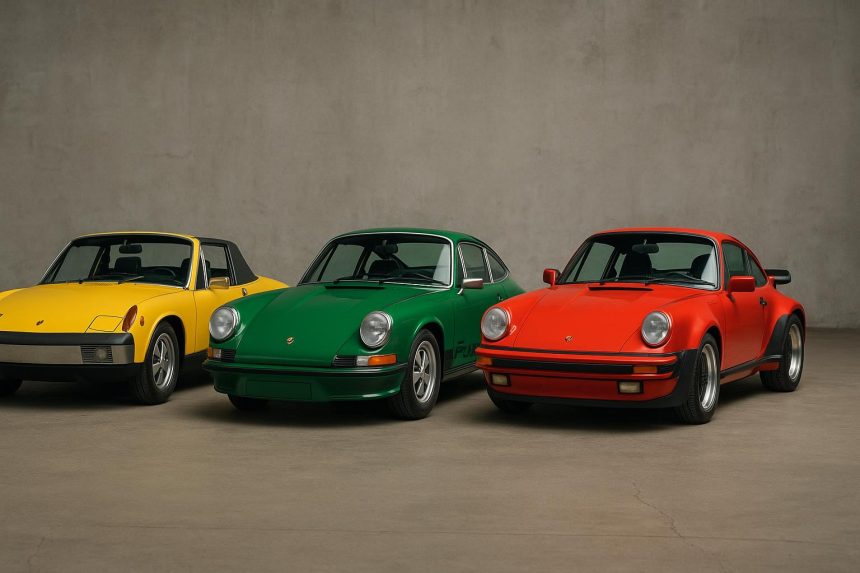
Beyond his work in franchising, Lovins maintains a strong interest in automotive history, particularly models that reflect innovation during periods of change. The 1970s marked a defining decade for Porsche, as the manufacturer responded to economic pressures, fuel concerns, and shifting consumer expectations. Several models introduced during this era combined engineering creativity with practicality and racing credibility. Understanding these vehicles offers insight into how Porsche adapted its design philosophy while preserving performance and brand identity during a challenging automotive decade.
Three Iconic 1970s Porsche Models
With Porsche having established itself as a top sports car brand in the 50s and 60s, it entered the 1970s with an established presence in the commercial and racing arenas. Seeking an affordable alternative to the Porsche 911, the Stuttgart automaker teamed up with Volkswagen in 1970 to produce the 914/6. The six-cylinder variant of the mid-engine sports car features a 2.0-liter flat-six engine that is an offshoot of the 911S engine.
Not fully convertible, the targa-top model featured a lightweight removable roof panel that fit comfortably in the trunk. This allowed for open-air driving, with the fixed roll bar and rear window delivering structural support. The 914/6 was not as inexpensive as planned and had a price point nearly as high as the 911T. This limited appeal and Porsche only produced the model through 1972, with some 3,351 units total rolling off the assembly plant floor.
Porsche enthusiasts still seek out the 914/6 for the outstanding handling and balance provided by the unique mid-engine layout. The 914/6 proved its worth in the racing arena, taking victories within its class in IMSA GT series competition and at the 1970 Le Mans.
Interestingly, the collaboration between Porsche and VW on the 914/6 was not the first. Back in the late 1940s, the initial Porsche 356 sports car featured numerous Volkswagen Beetle mechanical components. Produced from 1975 to 1976, the rear-engine Porsche 912E reused the 2.0-liter, four-cylinder, naturally aspirated boxer engine developed by VW for the 914.
With its curved rear end, the 912E closely resembled that era’s 911. It was produced for the American market to bridge a gap between the sunsetting of the mid-engined 914 in 1975 and the front-engine 924’s launch in 1977. With no base model on offer, Porsche adapted the air-cooled flat-four VW engine that had resided in the US-spec 914 engine bay, placing it in the rear of a 911 body.
The resulting 912E sold for around $10,000, or $3,000 less than the 911S. It provided drivers the opportunity to enjoy a 911 ride, though with half the power, at a reasonable price. Discontinued at the exact moment the 924 launched, the 912E stands as Porsche’s only vehicle ever manufactured with planned obsolescence as the aim.
Despite its relatively short lifespan, the 912E has proved enduringly popular for its styling, performance, and outstanding fuel mileage for the era (around 25mpg). The latter facet was particularly important to consumers around the oil crisis, when gas prices rose to all-time highs and lines around the block at gas stations were not uncommon. Like the 914/6, the 912E is a rare and coveted model by classic Porsche enthusiasts, with only 2,000 ever produced.
In the works since 1971, the Porsche 924 was an outgrowth of a VW project known as EA 398, with EA meaning Entwicklungsauftrag (development assignment). The following year, it took the project code name 425 and incorporated VW/Audi engine, transmission, and suspension components, which also went into the VW Golf (Rabbit).
These projects ultimately diverged, with Porsche buying back design and manufacturing from Volkswagen, and completely redesigning what was now called the 924 as a front-engine, entry-level Porsche. The resulting vehicle was marketed as low-emissions and low fuel consumption, and offered drivers the first fully automatic Porsche option. The popular model excelled on the racing circuit, earning world champion status in 1976, which led to a special, commercially available Martini Edition 924 with racing stripes.
About Cody Lovins
Cody Lovins is a Houston based entrepreneur who owns and operates multiple Sports Clips and Dogtopia franchise locations. With a background in geological engineering, he brings a structured, analytical approach to business operations and growth. Lovins has received multiple franchise awards for sales performance and expansion. Outside of work, he maintains a strong interest in aviation, classic automobiles, and outdoor activities, and he supports several community and philanthropic organizations.

Lynn Martelli is an editor at Readability. She received her MFA in Creative Writing from Antioch University and has worked as an editor for over 10 years. Lynn has edited a wide variety of books, including fiction, non-fiction, memoirs, and more. In her free time, Lynn enjoys reading, writing, and spending time with her family and friends.