Ask most managers when their team does its best work and they’ll say Monday. It sounds logical. The data says otherwise.
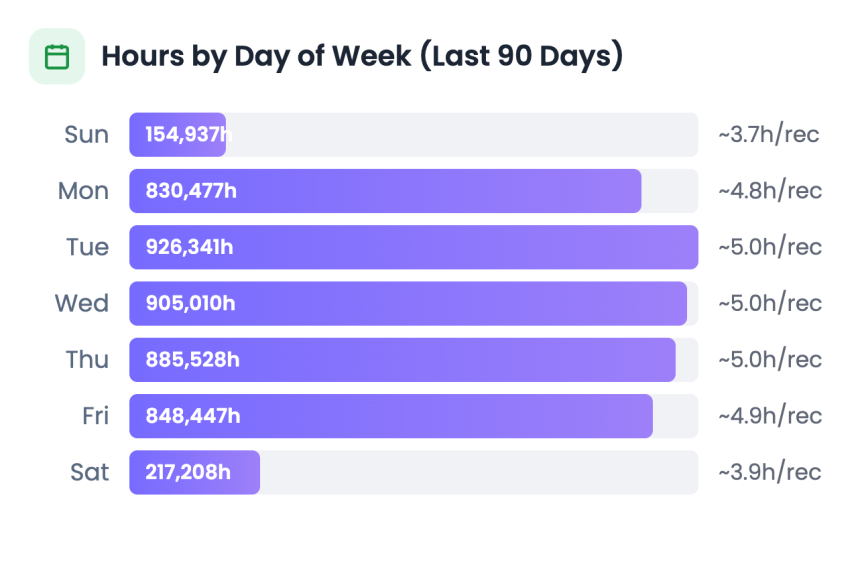
An analysis of over 45 million work hours tracked by WebWork Time Tracker across 37,000 professionals in more than 10 countries found the same pattern: Tuesday and Wednesday are peak performance days. Monday ranks fourth. Friday is last.
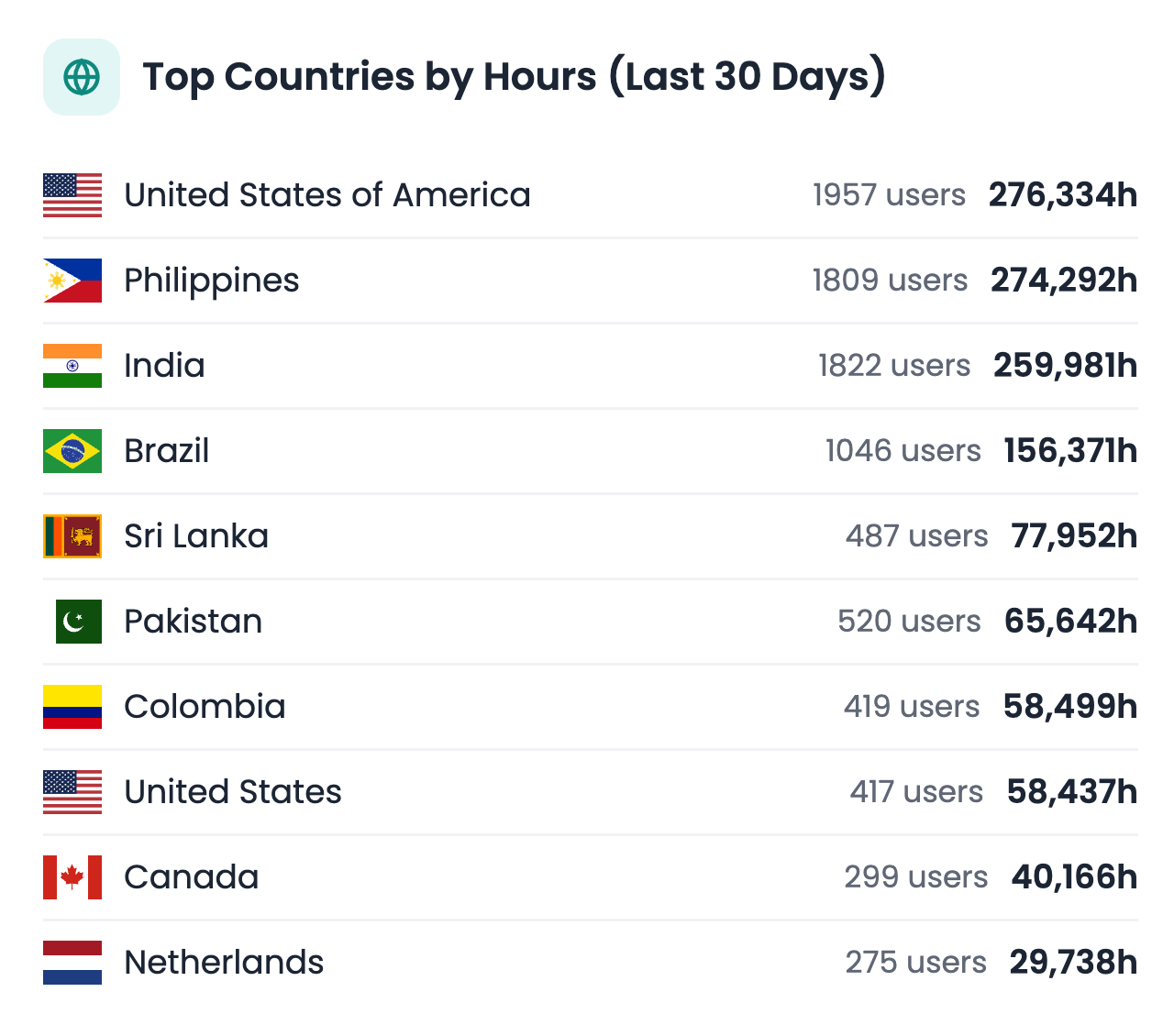
The data doesn’t come from a survey or a self-reported poll. It comes from WebWork’s continuous, automated time tracking across real companies — agencies, software teams, BPOs, support centers — spread across the United States, India, the Philippines, Brazil, Sri Lanka, and beyond.
Monday Has a Productivity Problem
Organizations routinely stack their most important work at the front of the week. Sprint kickoffs, strategic reviews, all-hands meetings — all Monday. The data suggests this is a structural mistake.
Tuesday and Wednesday each logged over 900,000 tracked hours across the 90-day dataset. Thursday held close. Monday came in noticeably lower. Friday dropped roughly 8% below the midweek peak.
A company scheduling deep-focus work on Monday mornings is placing high-value work on the day its team is least ready to deliver. Monday is the warmup. Tuesday and Wednesday are the performances.
Remote Workers Are Outperforming the Stereotype
The narrative around remote work productivity has always been skeptical. Without physical oversight, the assumption goes, people lose focus. They drift. Output suffers.
The numbers don’t support this. Across the full dataset, idle time — tracked periods with no detectable keyboard or mouse activity — accounted for just 4.2% of all recorded hours. On a standard 8-hour day, that’s roughly 20 minutes.
That figure looks different when placed next to office research. A study from the University of California, Irvine found that office workers are interrupted on average every 11 minutes and need up to 23 minutes to return to full concentration afterward. The math on office productivity is worse than most organizations acknowledge.
At WebWork, where workforce data flows in from thousands of organizations across dozens of countries, this pattern holds at every scale. Remote professionals with clear priorities and reasonable autonomy maintain focus. The teams that struggle tend to have a process problem — not a people problem.
“Talented people spend roughly 30% of their time on the work they were hired to do,” says Vahagn Sargsyan, who has led distributed teams for over 15 years. “The other 70% disappears into organizational friction that nobody measures.”
Vahagn Sargsyan, author of Builder’s Time, argues that fixing productivity starts with measuring where time actually goes — not where managers assume it goes.
What WebWork’s Data Shows: The Desktop Is Still Where Work Happens
A second finding from WebWork’s dataset challenges another popular assumption: that work is shifting to mobile.
Nearly 80% of all productive tracked time — 79.6% to be precise — happened on desktop applications. Web-based tracking added 12.8%. Mobile accounted for just 0.4%.
WebWork’s data across 37,000 professionals confirms it. Messages get read on phones. Approvals get tapped through. But the actual work — writing, coding, designing, analyzing — still happens at a desk, on a full screen, with a keyboard.
WebWork tracks time across both desktop and mobile — so the data reflects real behavior, not assumptions. The desktop remains where output happens. Mobile is where communication happens. Both matter, but they serve different purposes in a productive workday.
Teams building productivity infrastructure around mobile-first assumptions are optimizing for the wrong channel. The smarter move is to track both — and let the data tell you where your team actually works.
What AI-Powered Tracking Reveals That Traditional Tools Miss
Knowing Tuesday outperforms Monday is useful. Knowing why your team’s Tuesday underperforms is actionable.
That’s the gap WebWork’s AI-powered time tracking closes. Traditional tracking records hours. It confirms someone was logged in from 9 to 5. It doesn’t explain whether those hours produced focused output or disappeared into tool-switching and shallow tasks.
AI flags when a team member’s output drops over consecutive days — an early signal of burnout. It classifies time into deep focus, meetings, and administrative overhead. It identifies which workflows drive output and which ones kill it.
Organizations that made this shift saw project overruns drop by 15% and billable-hour accuracy improve by up to 30%. The gains didn’t come from working harder. They came from removing invisible waste that hour-counting tools never surface.
The Shape of a Productive Week
Companies that get this right don’t work more hours. They schedule the right work on the right days, protect their peak performance windows, and cut the friction that eats into productive time.
Across thousands of organizations tracked in this dataset, the pattern is consistent — the teams that perform best aren’t working longer, they’re working smarter.
The week has a shape. Forty-five million hours of data make that shape visible. The question is whether your organization is ready to act on it.
Vahagn Sargsyan is the Founder and CEO of WebWork Time Tracker, a workforce management platform used by thousands of businesses worldwide. He is the author of Builder’s Time: The Blueprint for Creators, Leaders, and Teams to Master Time.

Lynn Martelli is an editor at Readability. She received her MFA in Creative Writing from Antioch University and has worked as an editor for over 10 years. Lynn has edited a wide variety of books, including fiction, non-fiction, memoirs, and more. In her free time, Lynn enjoys reading, writing, and spending time with her family and friends.