Content creators who earn a living from their online work often find managing taxes and expenses overwhelming.
In many cases, they end up paying more tax than they need to.
This usually comes down to one thing: not fully understanding what counts as an allowable expense. HMRC allows you to deduct certain business costs before calculating tax, but only if they meet specific criteria.
Let’s explore what expenses you can claim on and where confusion sometimes lies.
What does claiming expenses actually mean?
If you are new to self-employment or have often been confused over your expenses, it pays to have an understanding of what it means to actually “claim an expense.”
You aren’t getting the money back – a common misconception – instead, you are reducing the amount of profit you pay tax on.
For example, let’s assume you have generated £30,000 from your creative work in the tax year.
In this time, you’ve spent £5,000 on business-related costs such as software, travel, and equipment. You can claim on these, therefore reducing your taxable profit.
- Income £30,000
- Expenses £5,000
- Pay tax on £25,000 and not the £30,000 you earned
All expenses must purely be for your business and not for personal costs. Think of it as stopping you from being taxed on money you never really kept.
Equipment and recording accessories
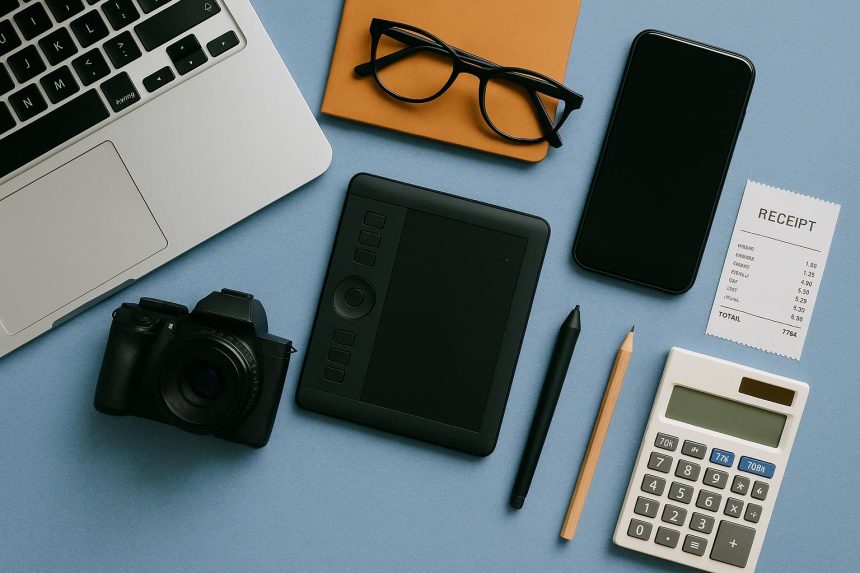
Your camera, editing gear, tripods, microphones and other equipment that help you bring your content to life are crucial investments and can all be claimed as an expense when you submit your tax return.
Items falling within this category, you can claim as expenses include:
- Cameras
- Tripods
- Lenses
- Lighting
- Laptops
- Editing equipment
- Microphones
- Tablets
The important factor to realise here is that if any of these items are used personally as well as for your business, you may have to apportion their usage. In some cases, higher-value items may be treated as capital assets and claimed through capital allowances rather than day-to-day expenses.
Home office costs
Even if you create content from your bedroom and nowhere else, it still technically counts as your office. This means you can claim some expenses. You’ll need to be careful, though, as it’s still your home and therefore not purely a workspace.
You can claim:
- A portion of your rent or mortgage
- A portion of electricity, heating and internet bills
There are two methods of doing this. You could claim a simple, HMRC-approved flat rate, or calculate an actual cost split. This is the more accurate method, but it can be a significant drain on time and effort.
Software and subscription costs
Polishing your content so it looks just right, scheduling posts and keeping your website running are all key aspects of maintaining your online presence. Tools such as Adobe, Canva, Buffer, and more all help you keep your output streamlined, content seamless and website sublime. They aren’t free, and when they are, they only come with limited options. Paying for these accounts ensures you can maintain the high standards that keep your audience coming back for more.
Common claims include:
- Editing software
- Cloud storage
- Website hosting
- Productivity tools
The simple way to look at it is, if you use it for the business, it’s usually allowable.
Travel and content-related trips
The world of content creation can open you up to a lot of new opportunities. From collaborations with other creators to brand deals with sponsors, new avenues can be explored, but in most cases, you’ll have to travel to make some aspects of them work.
You can claim expenses in some cases, but there can be a bit of a grey area here and it’s one HMRC looks at closely.
- Transport and accommodation for content-related trips can be claimed
- Holidays cannot be claimed
- The trip must be primarily for business
- Trips combining business with pleasure may need to be split
Clothing and props
This is perhaps one of the biggest hurdles many creators fall at. You want to look your best online, so you may kit yourself out with a varied, and perhaps expensive, wardrobe. If these clothes constitute everyday wear, even if you wear them just in your video, you won’t be able to claim them as a tax expense.
The easiest way to look at it is that if you’d wear it outside of work, HMRC probably wouldn’t allow it.
This means that you may be able to claim on:
- Costumes
- Specialist outfits not suitable for everyday wear
- Props used only for content
Gifts, PR and giveaways
Many creators offer prizes to their audience. It helps boost engagement and can act as a promotion for the brand that supplied the item.
You can claim:
- Giveaways for your audience
- Small business gifts (within limits)
For 2026, business gifts must typically be no more than £50 per recipient per year and not in the form of cash or vouchers.
Marketing & promotion
Some creators are lucky and go viral. From there, growth can be rapidly accelerated, and future content relies on very little promotion to get noticed. However, this isn’t as easy as it sounds. Going viral often relies on jumping on a trend before many others have, or making something based on an existing, successful trend and just doing it better than everyone else.
As a result, more natural content requires some effort. This could stem from paid ads, enhanced website design, portfolio creation and branding shoots.
If you spend money on any of those ways to promote your brand, you are normally allowed to claim as it’s seen as a way of trying to grow your brand and your income.
The common mistakes made by content creators
Even when aware of what can be claimed, it’s common to see mistakes being made. Among the most common errors are:
- Failing to keep receipts
- Guessing costs rather than tracking them
- Claiming personal expenses
- Missing out recurring costs such as subscriptions
- Leaving it until deadline day to sort your taxes
How can a creator remain compliant?
It’s quite simple. Look at the list of common mistakes we covered above and do the opposite.
This means you should:
- Track expenses weekly
- Keep digital copies of receipts
- Use a separate business account for easy tracking of spending
- Categorise as you go
As your income grows and your content evolves into a business, managing your finances becomes more complex. Working with accountants for creatives can help you stay compliant, reduce your tax bill and focus on what you do best.

Lynn Martelli is an editor at Readability. She received her MFA in Creative Writing from Antioch University and has worked as an editor for over 10 years. Lynn has edited a wide variety of books, including fiction, non-fiction, memoirs, and more. In her free time, Lynn enjoys reading, writing, and spending time with her family and friends.