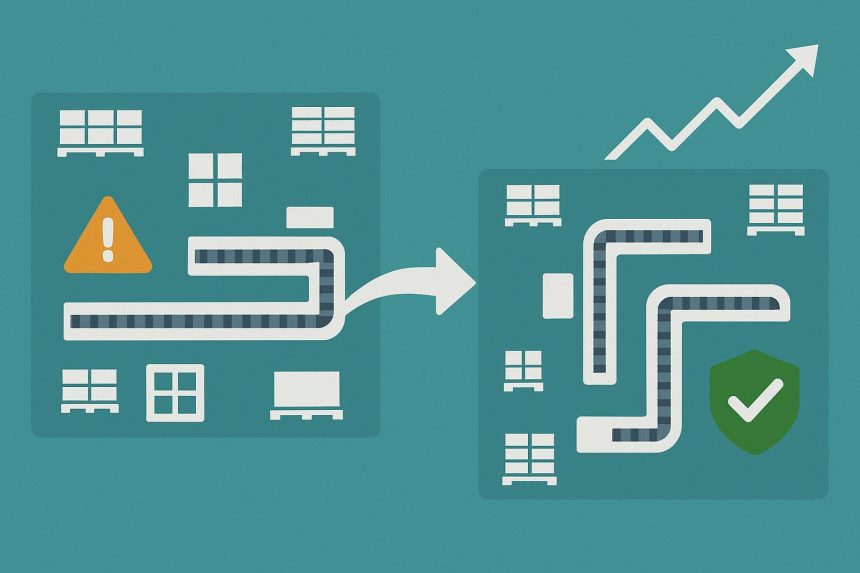
A facility layout change can look better on paper and still fail on the floor. The strongest proof comes from comparing the same risk and flow measures before and after the change, using matched operating conditions. That gives operations and EHS teams evidence that a new route, barrier, staging area, or workstation position reduced exposure without creating a new bottleneck somewhere else.
Capture a baseline before anything moves
Start before the first line is repainted or the first barrier is moved. Record how the area performs during normal production, including busy periods, shift changes, replenishment windows, and other conditions that can alter traffic. A single quiet hour will not give you a fair baseline for a space that becomes congested every afternoon.
The baseline should describe both movement and risk. For flow, record route length, travel time, dwell, queue duration, repeated detours, and congestion at intersections. For safety, record traffic overlap, proximity events, blocked sightlines, restricted-area entries, or other site-specific leading indicators that the layout change is meant to address.
- Use the same zones and measurement definitions throughout the test.
- Record enough time to capture normal variation across shifts and volume levels.
- Note temporary conditions such as maintenance work, stock overflow, or unusual staffing.
- Save the original layout, measurement period, and operating context with the baseline data.
This step prevents a common problem in improvement projects. Teams often make a sensible change, see fewer visible issues, and then struggle to show that the result came from the layout rather than a quieter week or a different work mix.
Pair risk measures with flow measures
Layout projects often start from one side of the problem. EHS may focus on pedestrian and vehicle interaction, while Operations may focus on travel distance or queue time. Measuring both gives a fuller picture because the same change can improve one outcome while making another worse.
For example, moving a pedestrian route away from a forklift aisle may reduce path intersections. If the new route adds a long detour, though, people may begin taking informal shortcuts or the process may lose time on every trip. A good evaluation checks the safety signal and the operational signal together.
Choose a small set of measures that connect directly to the reason for the redesign. A warehouse might track forklift and pedestrian intersections, average traverse time through a high-traffic aisle, and queue duration near staging. A manufacturing site might compare material travel distance, congestion near a cell entrance, and repeated flow interruptions during changeovers.
Run a like-for-like before-and-after comparison
After the new layout is in place, repeat the baseline measurement under conditions that are as similar as practical. Compare the same shifts, production windows, zones, and volume ranges. If demand changed sharply, separate the data by volume band instead of treating the whole period as one average.
Look for changes in frequency, duration, and location. A reduction in traffic intersections is stronger evidence when the same period also shows shorter queues and stable or lower travel time. A faster route is less convincing if congestion simply moved to the next junction.
Consider a distribution area where forklifts and pedestrians repeatedly crossed at the entrance to a staging zone. The site moves the pedestrian path behind a barrier and shifts a pallet drop point several feet away. After the change, the team compares matched high-volume shifts. Path intersections fall, the entrance remains clear for longer periods, and average travel time through the area also drops. That combination gives the team a stronger case that the redesign improved both risk exposure and flow.
Do not rely on a single percentage. Keep the underlying counts, time windows, zone definitions, and operating notes. Those details make the result easier to review later and help another site repeat the same method.
Check that the problem did not move somewhere else
A local improvement can create a downstream issue. Review nearby intersections, staging zones, access points, and alternate routes after the change. If a queue disappears from one aisle but grows near a dock door, the redesign may need another adjustment.
Use floor observations, operational records, or privacy-preserving movement analysis to review patterns over time. If cameras support the measurement, keep the analysis at the zone, equipment, event, congestion, and path level. Avoid individual identification or person-level scoring. The purpose is to improve the process and physical environment, not to evaluate named people.
Give the change enough time to settle before making a final judgment. Early results can be distorted as teams adapt to new signage, barriers, storage positions, or traffic rules. A short initial review can catch immediate problems, followed by a second comparison after normal operating patterns have stabilized.
Build proof that can support the next layout decision
A useful layout review ends with evidence another team can act on. Keep the original hypothesis, baseline period, change made, matched comparison period, and results in one record. Add the operational context that could affect interpretation, such as throughput level, shift mix, or temporary site conditions.
Teams that want a structured way to compare path efficiency, congestion, space use, and intersection patterns can review Protex AI facility flow insights as one approach to gathering that evidence. The goal is a repeatable before-and-after process that shows where risk fell, where flow improved, and where another adjustment may still be needed.

Lynn Martelli is an editor at Readability. She received her MFA in Creative Writing from Antioch University and has worked as an editor for over 10 years. Lynn has edited a wide variety of books, including fiction, non-fiction, memoirs, and more. In her free time, Lynn enjoys reading, writing, and spending time with her family and friends.