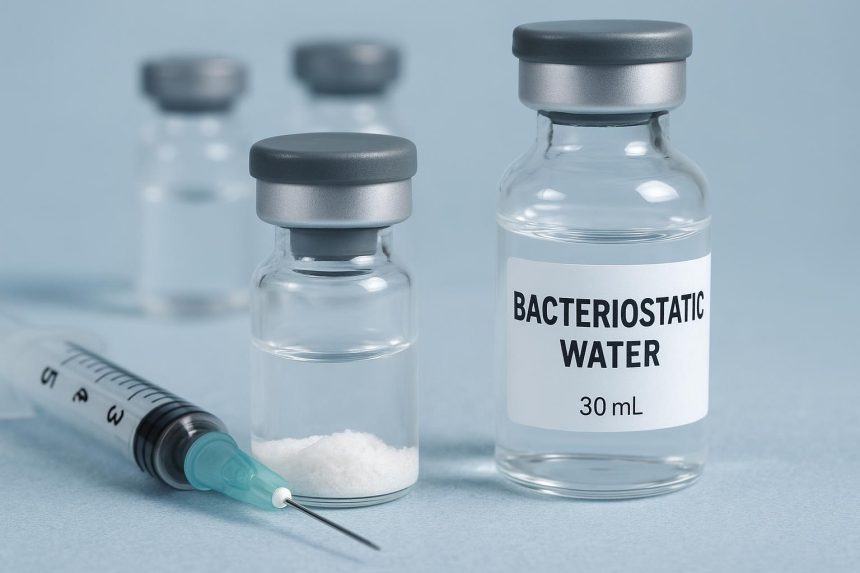
When researchers work with injectable peptide compounds like P-21, the science of the molecule itself often receives far more attention than the preparation step that precedes every experiment. That gap has consequences. A poorly reconstituted peptide can degrade before the experiment begins, introduce contamination, or produce inconsistent results that obscure what the compound is actually doing. Understanding bacteriostatic water, and how to use it correctly, is foundational to reliable peptide research.
What Lyophilization Means for Researchers
Most research-grade peptides arrive as a fine, powdered solid. This is the result of lyophilization, a process where the peptide is dissolved in water and then frozen, after which the surrounding pressure is reduced so the ice sublimates directly to vapor without passing through a liquid phase. The result is a shelf-stable powder that can be stored for extended periods without the degradation that liquid peptides would undergo.
P-21, a cyclic peptide derived from a functional region of brain-derived neurotrophic factor (BDNF), is supplied in this form. Research published in peer-reviewed literature examining its neurogenic properties typically works with reconstituted solutions, meaning the lyophilized powder must be brought back into a stable liquid state before use. This is what reconstitution refers to: dissolving the dry peptide in a suitable liquid vehicle to restore it to a form that can be accurately measured and handled in a laboratory setting.
The choice of that liquid vehicle is not trivial.
Why Bacteriostatic Water Instead of Sterile Water
Plain sterile water would work for reconstitution in a narrow sense, the peptide would dissolve. The problem is that sterile water contains no preservative. Once opened and introduced to the environment, it becomes a medium for microbial growth within hours. For single-use applications where the entire vial is consumed immediately, this may not matter. For research settings where a reconstituted peptide solution will be accessed multiple times across days or weeks, it matters considerably.
Bacteriostatic water addresses this by incorporating benzyl alcohol at a concentration of 0.9 percent by volume. Benzyl alcohol is a preservative that inhibits the growth of bacteria and fungi by disrupting microbial cell membranes. The United States Pharmacopeia designates this formulation as the standard for multi-dose injectable preparations. It does not sterilize a contaminated solution after the fact, but it prevents the proliferation of microorganisms introduced through normal lab handling, needle access, air exposure during drawing, and so on.
For a compound like P-21, which researchers are using across multiple time points in a study, bacteriostatic water is the appropriate choice because it extends the usable window of the reconstituted solution while maintaining the integrity researchers depend on for reproducible results.
The Reconstitution Process in Research Contexts
The goal of reconstitution is to dissolve the peptide completely and uniformly without introducing mechanical stress that can damage the molecular structure. Peptides, particularly smaller cyclic ones, are more resilient than larger proteins, but careless handling can still reduce potency through aggregation or chemical degradation.
The practical approach that experienced researchers use follows a consistent sequence. The lyophilized peptide vial is allowed to reach room temperature before being opened or reconstituted. This prevents condensation from forming inside the vial when cold powder meets warmer, humid air. The bacteriostatic water is then drawn into a sterile syringe and injected slowly into the peptide vial, directing the stream against the glass wall rather than directly onto the powder. This reduces foaming and the shear stress that forceful liquid impact can cause.
Swirling rather than shaking is the standard method for mixing. Vigorous shaking introduces air bubbles and can promote aggregation in some peptides. Gentle rotation allows the solvent to gradually incorporate the solid without mechanical agitation. The solution should become clear and free of particulates when reconstitution is complete; cloudiness or visible particles indicate incomplete dissolution or potential degradation.
The volume of bacteriostatic water used determines the final concentration of the solution, so accurate measurement is critical for experimental consistency. Researchers typically calculate this based on the desired working concentration and document the final volume added to each vial as part of their experimental record.
Storage After Reconstitution
Reconstituted peptide solutions are not as stable as their lyophilized precursors. Refrigeration at two to eight degrees Celsius is standard practice for limiting degradation in the days following reconstitution. Freezing a reconstituted solution is possible but introduces a variable: each freeze-thaw cycle carries risk of ice crystal formation that can mechanically damage peptide structures and reduce the functional consistency of the solution over time. Where repeated freeze-thaw cycles are unavoidable, researchers often aliquot the reconstituted solution into single-use volumes before initial freezing, drawing from fresh aliquots rather than refreezing the same solution repeatedly.
Light exposure is a secondary consideration. Peptide vials stored in opaque or amber containers, or simply kept in a refrigerator drawer rather than exposed to ambient light, tend to show better stability over time. This is particularly relevant for peptides with aromatic amino acid residues, though it represents good general practice regardless of the compound.
Equipment Considerations
The purity of the bacteriostatic water matters. Research-grade bacteriostatic water prepared for pharmaceutical injection use is preferable to any improvised substitute. The syringe used to transfer liquid should be appropriately sized for the volume being drawn; oversized syringes make it difficult to control small volumes accurately. Needle gauge affects both the ease of drawing liquid from sealed vials and the foaming risk on injection into the peptide vial; a finer gauge (higher number) reduces the force required and limits mechanical disruption.
For researchers new to working with injectable peptide compounds, the preparation step is where methodology errors most commonly occur. A detailed step-by-step reconstitution guide, including handling, concentration calculations, and storage guidance, is available at Peptides Please (https://peptidesplease.com/how-to-mix-bacteriostatic-water-with-peptides/) for reference.
Consistency as a Research Variable
One aspect of peptide research that is underappreciated in published methods sections is the degree to which preparation variability introduces noise. Two researchers following the same protocol but using different reconstitution techniques, different water sources, or inconsistent storage practices may produce divergent results from nominally identical experiments. When P-21's neurogenic effects are being studied across dosing paradigms or compared across laboratory sites, uncontrolled preparation variables can make results difficult to interpret or replicate.
This is not a marginal concern. The push for reproducibility in preclinical research has surfaced reconstitution and storage practices as a meaningful contributor to the inconsistency that plagues peptide and protein research literature. Standardizing these steps, and documenting them with the same rigor applied to the experimental protocol itself, strengthens the integrity of the work.
For researchers working with P-21 or any injectable peptide compound, the reconstitution step is not a formality to be completed quickly before the real experiment begins. It is part of the experimental methodology, and treating it as such is what separates results that hold up from results that do not.

Lynn Martelli is an editor at Readability. She received her MFA in Creative Writing from Antioch University and has worked as an editor for over 10 years. Lynn has edited a wide variety of books, including fiction, non-fiction, memoirs, and more. In her free time, Lynn enjoys reading, writing, and spending time with her family and friends.