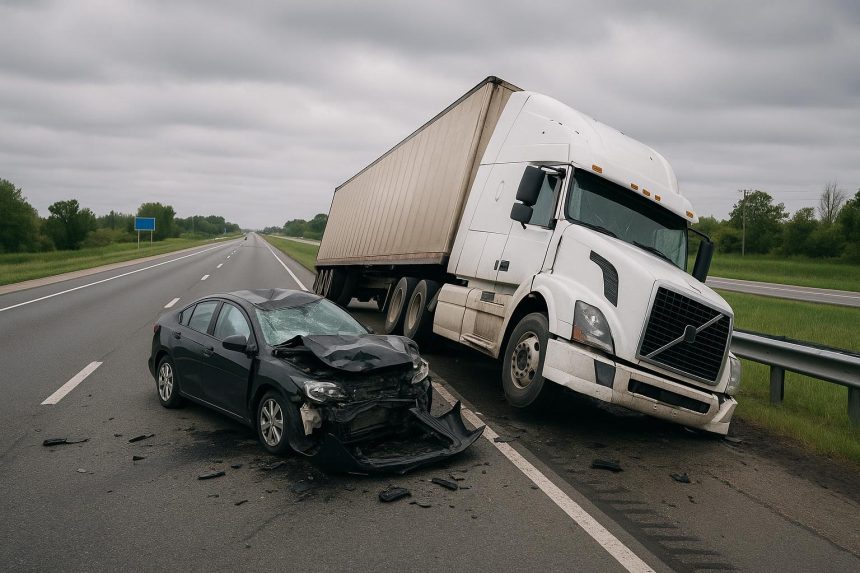
Indiana sits at the intersection of some of the busiest freight corridors in the country. Interstate 65, Interstate 70, and Interstate 80/90 cut through the state and carry enormous volumes of commercial truck traffic every day. Semi-trucks are a constant presence on Indiana roads, and for good reason. They keep the economy moving. But when something goes wrong at 80,000 pounds and highway speeds, the consequences for other drivers and passengers can be catastrophic.
What many accident victims do not fully understand until it is too late is that semi-truck accident claims operate under an entirely different legal framework than standard car accident cases. Federal regulations, multiple liable parties, aggressive corporate legal teams, and time-sensitive evidence all make these cases significantly more complex. Getting the wrong representation, or no representation at all, can cost you a substantial portion of the compensation you are actually owed.
Why Semi-Trucks Are So Dangerous in a Crash
A fully loaded semi-truck can weigh up to 80,000 pounds. The average passenger car weighs somewhere between 3,000 and 4,500 pounds. When these two vehicles collide, the physics are unforgiving. The forces involved in the impact are so disproportionate that even a relatively low-speed collision between a semi and a passenger vehicle can cause severe structural damage to the car and devastating injuries to the occupants inside.
Injuries common in semi-truck crashes include traumatic brain injuries, spinal cord injuries that can result in partial or complete paralysis, crush injuries, internal organ damage, severe fractures across multiple body parts, and in far too many cases, wrongful death. The financial impact that follows, between emergency care, hospitalization, surgery, long-term rehabilitation, and lost income, can be overwhelming for victims and their families.
“Truck accident claims can become complicated very quickly due to the number of parties involved in the operation of a commercial truck.”
The Federal Regulations That Shape Every Semi-Truck Case
Unlike a crash between two private drivers governed entirely by state law, semi-truck accidents are subject to both Indiana negligence law and the Federal Motor Carrier Safety Administration’s comprehensive regulatory framework. FMCSA regulations establish strict standards for commercial truck drivers and the companies that employ them. When those standards are violated, the violation itself becomes powerful evidence of negligence.
Hours of service rules are among the most critical of these federal standards. FMCSA regulations limit commercial truck drivers to no more than 11 consecutive hours of driving after 10 consecutive hours off duty, and drivers cannot extend their driving window beyond 14 hours after first coming on duty. A mandatory 30-minute rest break is required after eight consecutive hours of on-duty time. These rules exist because driver fatigue is one of the leading causes of serious truck accidents. When a company pushes a driver past these limits, or when a driver falsifies their logbook to hide violations, that conduct can be a central element of the legal case against them.
Modern semi-trucks also carry electronic logging devices, or ELDs, which automatically record driving time, rest periods, and vehicle operation data. Black box data recorders capture speed, braking patterns, and other critical information from the moments before impact. This evidence is time-sensitive. Trucking companies know it exists and have motivation to allow it to be destroyed or overwritten. Sending a spoliation letter to preserve that data is one of the first things a qualified attorney should do after a semi-truck crash.
Who Can Be Held Responsible?
This is where semi-truck cases diverge most significantly from ordinary car accidents. In a crash involving a passenger vehicle, you are almost always dealing with one at-fault driver. In a semi-truck case, liability can extend across a web of parties.
The truck driver bears personal responsibility for negligent operation, including distracted driving, speeding, impairment, or fatigued driving. The trucking company may share liability if they failed to maintain the vehicle, improperly trained the driver, pressured the driver to exceed hours of service limits, or hired someone with a problematic safety history. If defective equipment contributed to the crash, the manufacturer of that part or system can be held accountable. And if improperly loaded or unsecured cargo played a role, the loading company or shipper may also face legal exposure. More liable parties mean more applicable insurance policies and more potential compensation for victims.
Vaughan & Vaughan Has Handled These Cases for Over 110 Years
The Vaughan & Vaughan semi-truck accident attorneys bring something that most law firms simply cannot offer: over 110 years of personal injury litigation experience in Indiana, including a long and successful track record in complex commercial truck cases. The firm has recovered over $25 million for clients and includes lead attorney Charles V. Vaughan, who is board certified in civil trial law by the National Board of Trial Advocacy, one of the most demanding certifications available to personal injury attorneys.
When a new semi-truck accident case comes in, the team consults accident reconstruction experts, reviews all available evidence including police reports and medical records, analyzes driver logs and ELD data for compliance violations, and handles all communications with insurers, defendants, and opposing counsel. The goal is always to maximize what clients recover, whether through a negotiated settlement or a jury verdict.
There Is No Fee Unless Vaughan & Vaughan Wins
Vaughan & Vaughan handles every case on a contingency fee basis. No upfront costs, no hourly fees, no payment of any kind unless the firm wins compensation for you. Free consultations are available any time, day or night, seven days a week.

Lynn Martelli is an editor at Readability. She received her MFA in Creative Writing from Antioch University and has worked as an editor for over 10 years. Lynn has edited a wide variety of books, including fiction, non-fiction, memoirs, and more. In her free time, Lynn enjoys reading, writing, and spending time with her family and friends.