

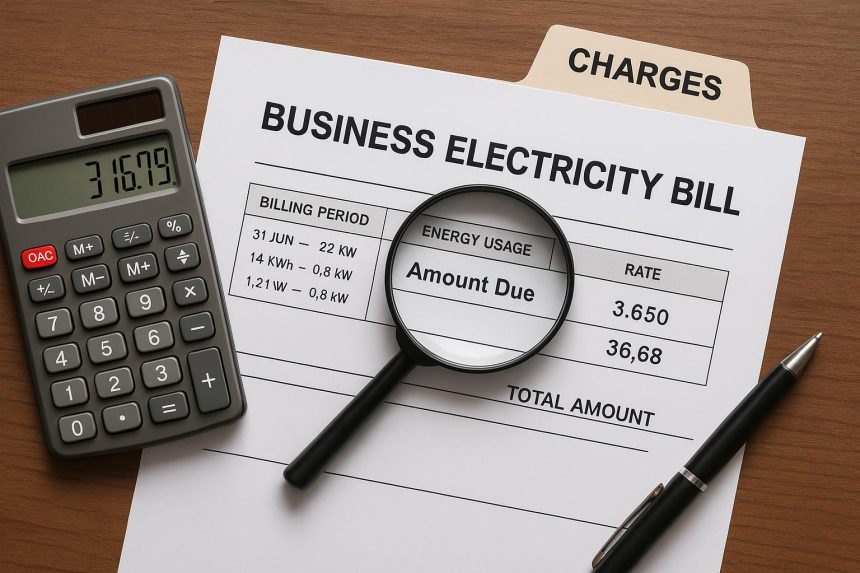
Most business owners look at an electricity bill the same way: find the total, wince, pay it and move on. The pages of line items, tariff codes, network charges and kilowatt figures can feel like they were designed to be confusing. Yet buried in those details are the reasons your bill is as high as it is, and sometimes, opportunities to reduce it.
Understanding what you’re paying for is the first step towards paying less. Many businesses are surprised to discover that the energy itself is only part of the cost. Network charges, demand charges and tariff structures can make up a large share of the bill, and they’re not always well suited to how the business actually uses power. An independent network tariff analysis can reveal whether a business is on the right tariff or paying more than it needs to.
The main parts of a business electricity bill
A typical business electricity bill includes several components.
Energy charges cover the electricity you use, usually measured in kilowatt hours. This is the part most affected by your retail contract and market prices.
Network charges pay for the poles, wires and substations that deliver electricity to your premises. These are set by network businesses and approved by regulators, and they vary depending on your location and tariff.
Environmental and market charges cover government schemes, such as renewable energy programs, and the costs of operating the energy market.
Metering charges cover the cost of your electricity meter and data services.
Daily supply charges are fixed fees you pay regardless of how much electricity you use.
Some businesses also pay demand charges, which are based on the highest amount of power drawn at any one time during a billing period.
Demand charges: the silent bill-raiser
Demand charges catch many businesses by surprise. Instead of charging only for the total energy used, they charge for the peak level of demand, often measured in kilowatts or kilovolt-amperes.
That means a single short spike in usage, such as several large machines starting at the same time or air-conditioning units all switching on together on a hot morning, can increase your bill for the entire month or even longer, depending on the tariff.
Managing demand can lead to savings. Staggering equipment start-up times, scheduling energy-intensive tasks outside peak periods and using timers or building management systems can help smooth out spikes.
Time-of-use tariffs
Many businesses are on time-of-use tariffs, where electricity costs more during peak periods and less during off-peak times. If your business uses a lot of power during peak hours, your costs will be higher.
Understanding when you use power can help you take advantage of cheaper periods. Some businesses can shift certain activities, such as running dishwashers, charging equipment or operating machinery, to off-peak times.
Your smart meter data, often available through your retailer or network provider, can show exactly when your business uses electricity. This information is far more useful than a quarterly total.
Are you on the right tariff?
Network tariffs aren’t one-size-fits-all. Businesses may be placed on a tariff when their meter is installed or when their account is set up, and it may never be reviewed again. As operations change, the original tariff may no longer be the best fit.
In some cases, businesses may be eligible to move to a different network tariff that better suits their usage pattern. This can reduce costs without changing how much electricity is used. Tariff options and eligibility vary between network areas, so expert advice is often useful.
Checking for errors and acting on what you find
Billing errors happen more often than you might think. Incorrect meter readings, wrong tariffs, duplicate charges or rates that don’t match your contract can all inflate bills. Compare your bills against your contract and meter data, and query anything that doesn’t look right.
Understanding your bill is only valuable if you act on it. Review your contract before it expires, compare offers from different retailers and look for ways to reduce usage, such as upgrading to efficient lighting and equipment.
Electricity bills don’t have to be a mystery. By breaking them down, understanding the charges and checking whether your tariff suits your business, you can take more control over one of your biggest operating costs and, in many cases, find genuine savings.

Lynn Martelli is an editor at Readability. She received her MFA in Creative Writing from Antioch University and has worked as an editor for over 10 years. Lynn has edited a wide variety of books, including fiction, non-fiction, memoirs, and more. In her free time, Lynn enjoys reading, writing, and spending time with her family and friends.