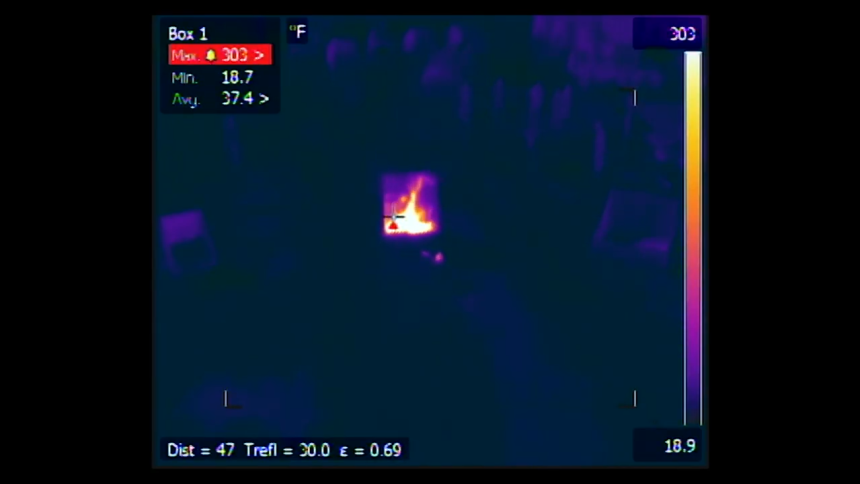
Among the innovations that have recently become available to the public, it’s hard to find anything more in demand today than night vision and thermal imaging. Both technologies are widely used across various fields and have no comparable alternatives. Experts and ordinary people often compare thermal vs. night vision to determine the clear winner. This process requires considering multiple aspects and assessing the effectiveness of each technology in specific situations. This is the key topic of this article.
Performing actions in complete darkness
For many, the key criterion for comparing the effectiveness of night vision and thermal imaging is performance in complete darkness. These conditions are common in caves, basements, and other darkened spaces where artificial lighting is undesirable or impossible. Thermal imaging is far more effective in these situations. Thermal imaging-enabled devices always provide users with high-quality images, enabling them to identify surrounding objects, determine their locations, navigate, and so on. However, NV is utterly useless in complete darkness. The only available option for its use in such situations is to activate IR illumination on various devices. This unmasks the user but maintains acceptable image quality.
Orienteering
Most often, people use both of these technologies for orientation. While each offers the potential for this task, night vision is still more effective. It allows hikers, birdwatchers, hunters, and other outdoor enthusiasts to notice and identify various objects. Bushes, trees, rocks, streams, and even puddles on a trail – all of these can be seen with NV technology. This feature makes orientation simple. Thermal imaging can also perform some of these tasks. However, it is almost always unable to distinguish a trail from the background, "see" rocks and branches in cold weather, or distinguish uneven terrain, etc. Because of this, night vision, which offers users more options, is always used for orientation.
Search for people/animals
Searching for people or other living creatures at night is always challenging. That’s why hunters, zoologists, rescuers, police officers, and other users always rely on NV and TI technologies. Night vision can accomplish this task, but only under certain conditions. However, if a person is wearing dark clothing or an animal is surrounded by vegetation, the chances of detecting them are slim. TI equipment, however, will always be up to the task. The person and animal will be highlighted in bright orange or red on the optics’ display, allowing for quick detection. This can be achieved even when the search target is hidden behind a natural obstacle (such as a tree or bush) or is far from the user of the optics.
Carrying out tasks in a dense forest
Dense forests are challenging environments for any optics. The abundance of vegetation will inevitably create large dark spots in the image, making it extremely difficult to distinguish even large objects. This is why night vision is unsuitable for dense forests. While it will allow the user to distinguish everything close to them, it will fall short when it comes to seeing further (due to the numerous plants that obscure their view). Thermal imaging won’t be super-effective, but it will certainly offer more than its competitor. Thermal imaging can detect heat even if the object emitting it is hidden behind a bush or tree branches. This will help form a more informative image and allow for further viewing than with NVDs.
Walking around the city at night
In urban areas, NV and TI technologies are rarely used. However, when street lighting is out, they become a real lifesaver for people trying to get home safely. Thermal imaging is less effective in such conditions, but it still provides a general overview of the surrounding environment. It can detect the heat of hot asphalt, buildings, and various equipment. It also allows one to see people, cars, and pets. Night vision is a more useful technology in urban environments. It uses ambient light, even in sparsely populated, unlit cities, to form an image. Thanks to the available source data, NVDs can create a clear, detailed image. The only problem is sharp flashes of light. Without proper optics protection, these can damage existing equipment.
Navigation in extreme conditions
Sometimes people find themselves in extreme conditions, either voluntarily or accidentally. Sudden heavy precipitation, dust storms, smoke, and rapidly descending fog—all these phenomena significantly reduce visibility at night and make navigation extremely challenging. This is why various TI equipment is often used in such situations. It can effectively perform its job even when forced to penetrate smoke, dust, fog, and rain, and still produce a decent-quality image. This data enables the user to navigate the terrain, determine the correct direction of travel, find suitable rest areas, and more. NV technology will be unable to do any of these things in extreme situations. Instead of a clear picture, only a dark spot will appear on the screen, making it virtually impossible to discern anything. IR illumination can help improve the situation somewhat, but its capabilities are unlikely to be sufficient for good visibility.
Working in high-temperature conditions
Thermal and night vision perform differently in high-temperature conditions (such as hot weather or working with hot metal in an industrial facility). NV technology almost always wins, providing consistently high image quality. Thermal imaging, however, can be effective or ineffective. It all depends on the situation and the task the user of such optics wants to accomplish. For example, when determining the heating temperature of different areas of a freshly melted part, a thermal imager performs admirably. However, if the difference between the object’s temperature and the ambient temperature is minimal (such as a stone on sun-heated asphalt or a person standing next to a building wall on a hot day), the chances of achieving the desired result are slim.
Performing activities in cold weather
When it’s cold outside, any device doesn’t perform as effectively as it does at a comfortable temperature. This also applies to devices that support NV technology. While they guarantee good visibility in low-light conditions, image quality is almost always lower than in normal temperature conditions. Thermal imagers also have several drawbacks in cold weather. Due to low air temperatures, all heated objects cool quickly, meaning the device can only detect them within a few minutes of exposure. However, thermal imagers detect people and animals very quickly. The greater contrast between heated objects and a cold background facilitates this.
Night vision and thermal imaging are closely related technologies, so it’s not surprising that they are often compared. In this process, each side favors its own favorite and cites ample evidence. However, in reality, there is no clear winner in the debate between NV and thermal imaging. Each technology is an optimal choice in certain situations and can help people accomplish specific tasks. Therefore, the optimal solution is to use night vision and thermal imaging simultaneously. This way, they complement each other and open up unlimited possibilities for users.

Lynn Martelli is an editor at Readability. She received her MFA in Creative Writing from Antioch University and has worked as an editor for over 10 years. Lynn has edited a wide variety of books, including fiction, non-fiction, memoirs, and more. In her free time, Lynn enjoys reading, writing, and spending time with her family and friends.