Local search visibility continues to shape how customers discover nearby businesses. In 2026, accurate and consistent business listings are no longer optional. They are a direct driver of traffic, calls, and in-store visits. Businesses with multiple locations face even greater complexity due to frequent data updates, new directories, and evolving search behavior.
Local business listing management tools help brands control their presence across search engines, maps, and online directories. These platforms reduce errors, improve discoverability, and protect brand credibility at scale.
This blog highlights the top 7 local business listing management tools in 2026, with a deeper look at why Birdeye Listings AI stands out as the most complete solution for growing brands.
7 Best Local Listing Management Software in 2026
1. Birdeye Listings AI
Best suited for: Enterprise and multi-location brands managing 100 to 10,000+ locations that need accurate listings and scalable optimization.
Birdeye Listings AI is an enterprise-grade listings management software designed to help multi-location brands stay accurate, visible, and competitive across the platforms that matter most for local discovery. From a single dashboard, brands can manage and optimize business information across Google Business Profile, Apple Business Connect, Yelp, Facebook, and other high-traffic directories.

Birdeye Listings AI uses an agent-led execution approach, with agents that continuously scan listings, identify issues as they appear, and recommend or apply updates within defined brand guardrails. This enables organizations to maintain consistency and performance across thousands of locations with minimal manual effort.
Key capabilities
Listings Optimization Agent
Continuously scans your profiles and competitor content across Google, Apple, Facebook, Yelp, and other key platforms to surface gaps and opportunities. It identifies missing attributes, outdated information, and duplicate listings, then delivers clear recommendations. With approvals in place, the agent can apply updates while maintaining brand standards.
Local keyword and visibility analysis
Provides visibility insights based on location data and competitive context to highlight the keywords and attributes that influence local discovery. These insights help brands improve profile completeness and visibility.
Duplicate suppression
Identifies and suppresses duplicate listings across 100+ directories.
Listings analytics and performance insights
Tracks performance metrics such as traffic, calls, and keyword ranking, with real-time insights.
Focus on high-traffic platforms
Instead of distributing data across low-value directories, Birdeye Listings AI prioritizes accuracy and optimization on the platforms customers actually use, and helps keep business information accurate on 100+ sites.
Enterprise integrations Birdeye Listings AI integrates with 3,000+ enterprise systems, including Salesforce, HubSpot, and QuickBooks Online, keeping listings data in sync with core business systems.
Pros
- Built specifically for enterprise and large multi-location brands
- Continuous, agent-led optimization instead of manual listing updates
- Strong governance with approvals and brand controls for large teams
- Deep integration ecosystem with 3,000+ enterprise systems
- Focus on high-impact platforms that drive real local discovery
- Scales easily across hundreds to thousands of locations from a single dashboard
Cons
- Functionalities are focused more on large enterprise brands than on small or single-location businesses.
Why Birdeye Listings AI stands out
Birdeye is the #1 Agentic Marketing Platform that goes beyond basic listing distribution. By combining continuous monitoring, agent-driven optimization, and enterprise governance, it directly links local visibility to performance and customer experience. Trusted by the biggest multi-location brands globally including H&R Block, Aspen Dental, and Caesars Entertainment, this execution-focused, agentic approach makes Birdeye Listings AI one of the strongest listing management software for enterprise brands in 2026.
As per G2, Birdeye is the No.1 Enterprise Local Listing Management Software. 4.7/5 with 3,900+ reviews

2. Moz Local
Best suited for: Small to mid-sized businesses focused on local SEO basics
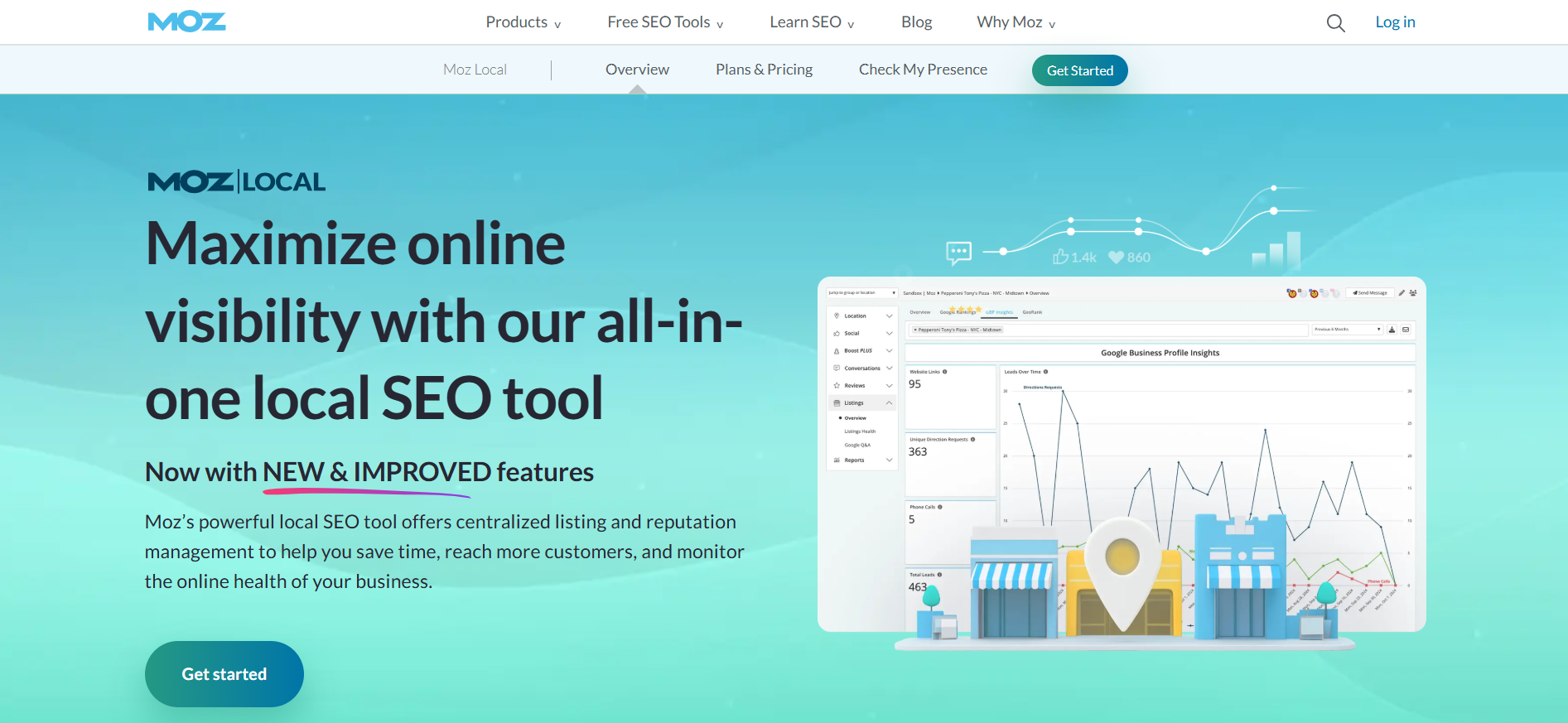
Moz Local helps businesses maintain accurate listings across key directories, search engines, and social platforms from a centralized dashboard. It simplifies how businesses update and sync business information so that customers find correct and consistent details online.
Key features
- Centralized distribution of business listings to major directories
- Monitoring of listing accuracy and completeness
- Review alerts and basic reputation insights across connected platforms
Pros
- Helps maintain consistent business information across multiple sources
- Reasonable solution for small local SEO efforts
Cons
- Listings management is not fully automated end-to-end
- Fewer integrations compared with other enterprise solutions like Birdeye
- Some users report support and update delays on external platforms
G2 rating: 4.2/5 (470+ reviews)
3. Synup
Best suited for: Growing businesses managing multiple locations

Synup is a local presence management platform that helps businesses manage listings, monitor reviews, and track visibility across search engines and directories. It aims to simplify how organizations control their location data, measure performance, and respond to customer feedback.
Key features
- Listings management and synchronization to key directories and search platforms
- Analytics dashboards for visibility, engagement, and local performance
- Review monitoring and response tracking across multiple sites
Pros
- Strong analytics and performance reporting
- Review monitoring is integrated with location performance metrics
Cons
- Interface and setup can be complex for new users
- Some users note inconsistent directory coverage in certain regions
- Fewer third-party integrations compared with larger platforms
G2 rating: 4.5/5 (300+ reviews)
4. Localo
Best suited for: Local businesses focused on Google Business Profile optimization
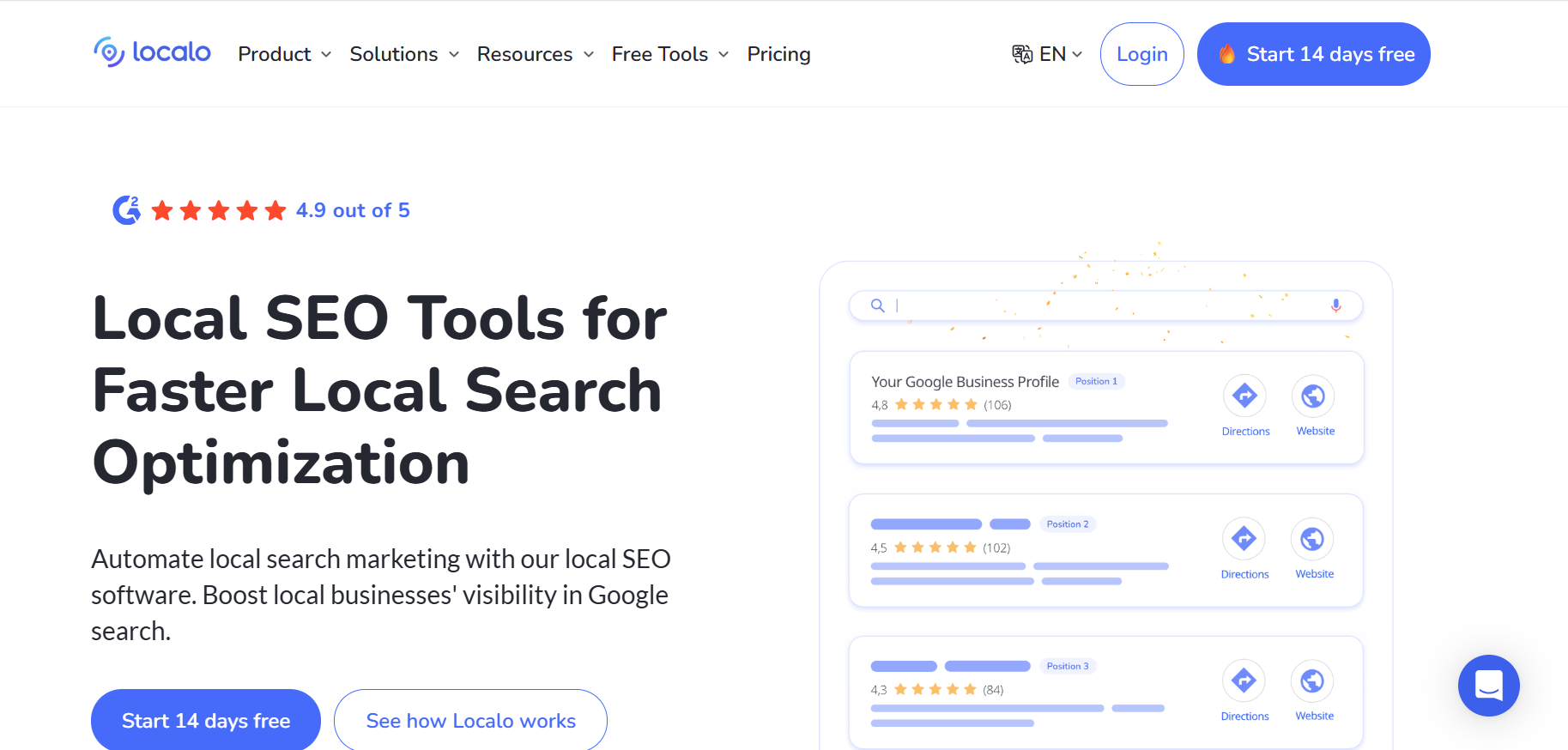
Localo is a tool designed to help businesses improve their visibility on Google Search and Google Maps through targeted optimization recommendations and performance insights. It focuses on strengthening Google Business Profile presence, listing completeness, and local search signals.
Key features
- Google Business Profile optimization guidance
- Insights into visibility and search performance
- Task-based recommendations to improve local search presence
Pros
- Easy-to-use interface for basic optimization tasks
- Good visibility insights for Google Business Profile
Cons
- Limited directory management beyond Google properties
- Not ideal for managing large numbers of locations
- The feature set is narrower compared with full listings platforms
G2 rating: 4.7/5 (100+ reviews)
5. WhiteSpark
Best suited for: Businesses and SEO professionals focused on local citations and local rank tracking
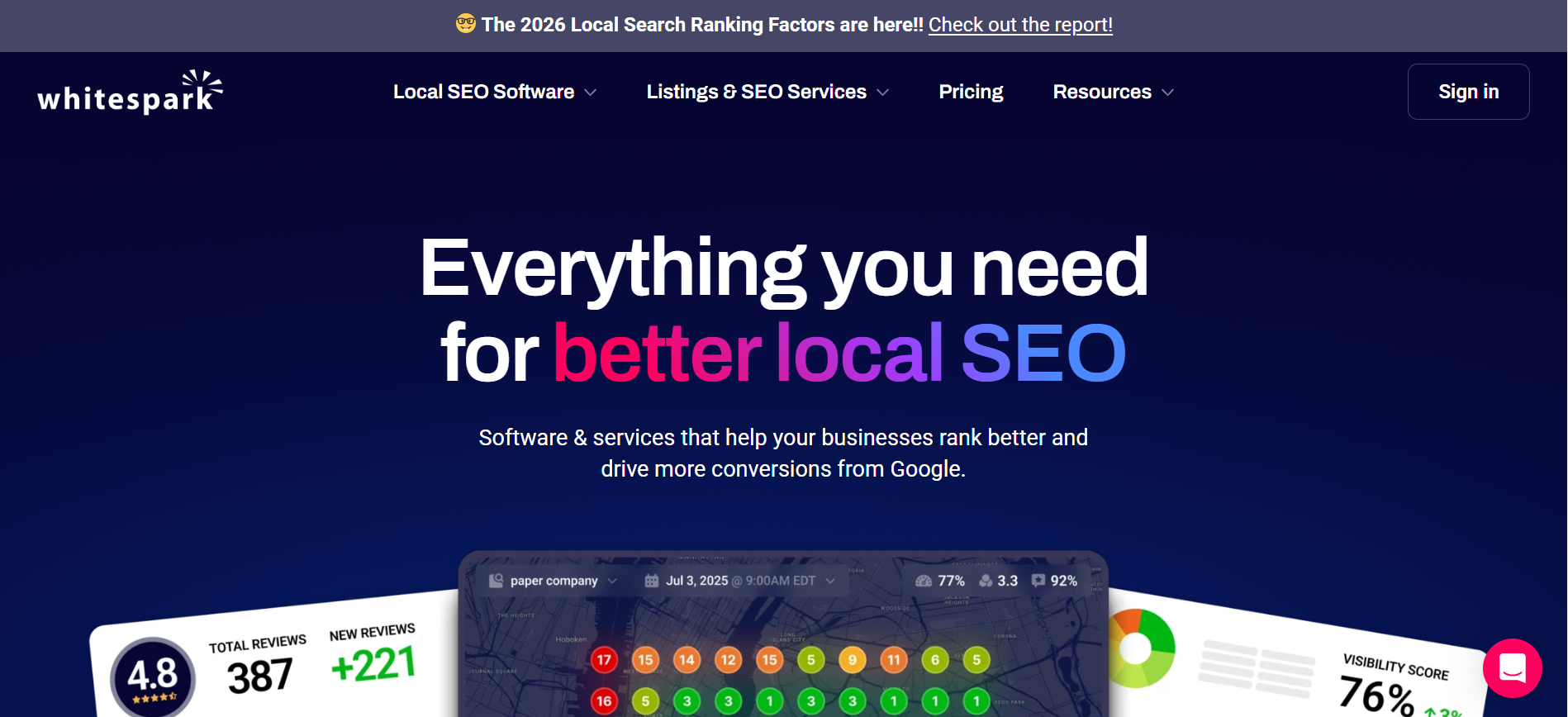
WhiteSpark offers tools to help businesses and marketers improve local search rankings through citation building, cleanup, and performance tracking. Its focus is on strengthening local search signals and improving visibility in local search results.
Key features
- Local citation discovery and cleanup for accurate listings
- Local rank tracking to monitor search performance
- Competitive analysis for citation and visibility benchmarking
Pros
- Strong citation expertise and local SEO insights
- Accurate and detailed rank tracking tools
Cons
- Manual citation processes can be time-consuming
- Limited automation for listings distribution
- Narrower focus compared with all-in-one listing platforms
G2 rating: 4.6/5 (20+ reviews)
6. Thryv
Best suited for: Small businesses looking for an all-in-one management solution with basic listings support
Thryv is a business management platform that includes listing management, CRM, scheduling, and customer communications in a single system. It helps small businesses maintain consistent listings while also handling appointments, messaging, and payments.
Key features
- Business listings management on key directories
- Unified CRM with contact and customer history
- Appointment scheduling and messaging tools
Pros
- Combines listings with CRM and business operations
- Good support and onboarding for small businesses
Cons
- Listings are not the primary focus of the platform
- Dashboard can feel crowded due to many tools in one place
- Some users report limitations in deep analytics and reporting
G2 rating: 4.3/5 (1,900+ reviews)
7. Uberall
Best suited for: Brands managing local search presence and customer engagement across multiple platforms
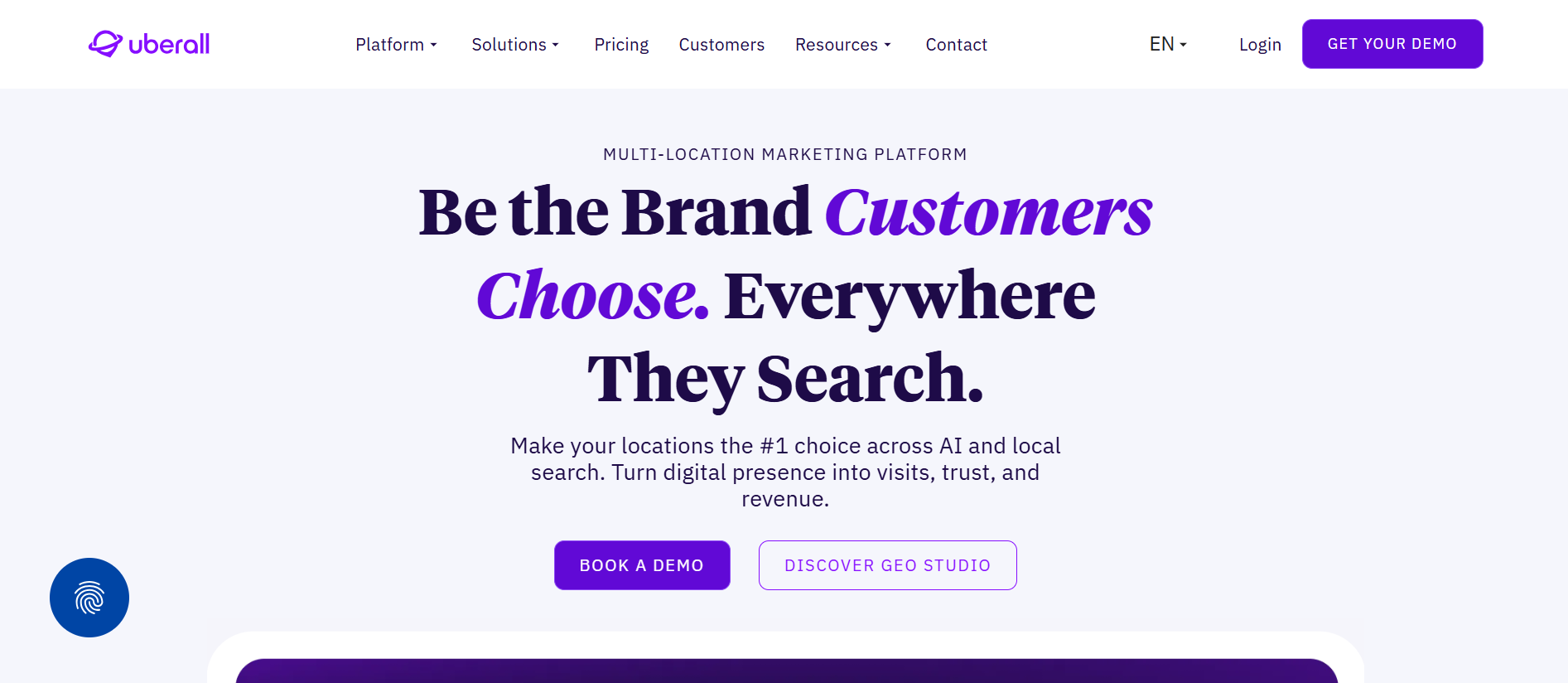
Uberall is a location experience platform that helps businesses manage listings, update location data, and monitor customer interactions across search engines, directories, and maps. It focuses on improving local presence and aligning brand information across multiple online sources.
Key features
- Centralized listings management across key platforms
- Local search analytics and performance reporting
- Review monitoring and response tools across directories and maps
Pros
- Intuitive interface with consolidated location data
- Good visibility into search performance and listing accuracy
Cons
- Some users report that features feel complex at first
- Limited directory coverage in certain regions compared to larger networks
- Pricing and contracts can be restrictive for smaller businesses
G2 rating: 4.3/5 (190+ reviews)
Why Birdeye Listings AI is the best choice for multi-location brands
Accurate business listings remain essential for visibility and customer trust in 2026. While many tools support specific aspects of local listing management, most are best suited for limited use cases or smaller teams.
Birdeye delivers unmatched scale, automation, and depth of integration. For organizations managing thousands of locations, it offers the strongest foundation for long-term local visibility and growth, making it the leading local business listing management solution in 2026.

Lynn Martelli is an editor at Readability. She received her MFA in Creative Writing from Antioch University and has worked as an editor for over 10 years. Lynn has edited a wide variety of books, including fiction, non-fiction, memoirs, and more. In her free time, Lynn enjoys reading, writing, and spending time with her family and friends.