Key takeaways
Businesses running rewards, incentives, or payout programs at scale need more than a spreadsheet and a prayer. API-powered gift card distribution eliminates manual work, cuts errors, and lets you send thousands of branded digital gift cards in seconds — directly from your existing systems.
What you’ll learn:
- Why API integration is the inflection point for scaling gift card programs
- The specific features that separate a production-ready gift card API from a toy
- How to evaluate whether your current workflow is costing you time and money
- A step-by-step integration path from sandbox to live distribution
The Problem with Manual Bulk Gifting
Most companies start the same way. Someone in HR or marketing gets tasked with sending gift cards to 500 people. They download a CSV, manually enter codes, triple-check email addresses, and pray nothing bounces. It takes hours. Someone always gets the wrong amount. Someone else never gets theirs at all.
This doesn’t scale. And when you’re running employee rewards across multiple countries, powering a customer loyalty program, or distributing payouts through a reseller channel, manual processes become a liability — not just an inconvenience.
The fix isn’t hiring more people. It’s removing humans from the repetitive parts entirely.
What a Gift Card API Actually Does
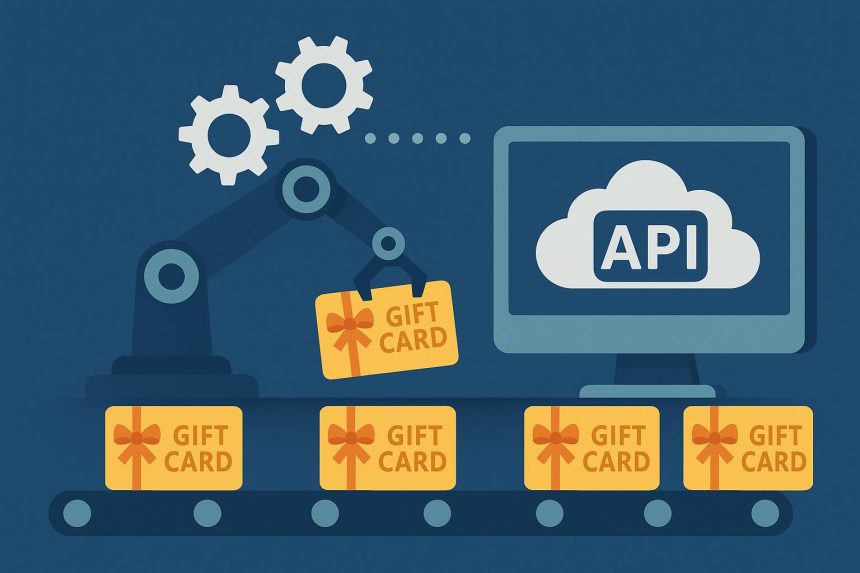
A gift card API connects your internal systems — CRM, HRIS, marketing automation, custom apps — directly to a gift card fulfillment engine. Instead of logging into a portal and placing orders by hand, your system makes an API call, and cards get delivered instantly.
Here’s what that looks like in practice:
- Your HR platform triggers a birthday reward → API call fires → employee receives a branded $50 gift card via email in seconds
- Your marketing tool segments high-value customers → API call fires → personalized gift cards land in their inbox as part of the campaign
- Your reseller dashboard processes a bulk order → API call fires → codes are generated, delivered, and logged automatically
No portal logins. No CSV uploads. No manual QA. The system handles it.
What to Look for in a Bulk Gift Card API
Not all gift card APIs are built for production-grade, high-volume use. Here’s what separates a real solution from a demo:
1. RESTful Architecture with Clear Documentation
If your developers can’t integrate it in a day, the docs are the problem. Look for well-structured RESTful endpoints, clear authentication flows, and comprehensive error handling guides.
2. Sandbox Environment
You need to test before you go live. A proper sandbox lets your team simulate orders, validate workflows, and catch edge cases — without spending real money or sending real cards to test accounts.
3. True Bulk Support
Sending one card at a time through an API isn’t bulk — it’s just automation. True bulk support means batch processing: submit a list of 1,000 recipients in a single call and get them all fulfilled simultaneously.
4. Global Brand Catalog
Your recipients aren’t all in one country, and they don’t all want the same brand. A strong catalog covers hundreds of global and local brands — Amazon, Starbucks, regional retailers — across multiple currencies.
5. Custom Branding and Messaging
Generic reward emails get ignored. The ability to add your company logo, customize the email template, and include personalized messages turns a transaction into an experience.
6. Security and Compliance
Gift cards are financial instruments. Your provider needs encrypted delivery, robust access controls, and compliance certifications. If they can’t explain their security posture clearly, move on.
7. Real-Time Tracking and Analytics
You should know exactly when a card was delivered, whether it was opened, and when it was redeemed. Real-time dashboards and exportable reports let you measure ROI, not just hope for it.
How GIFQ Solves This
At GIFQ, we built the platform specifically for businesses that need reliable, high-volume gift card distribution with deep integration capabilities.
Here’s what the integration looks like:
Capability | What You Get |
API Architecture | RESTful API with comprehensive docs and sandbox environment |
Bulk Processing | Submit batch orders — hundreds or thousands of cards in a single call |
Brand Catalog | Hundreds of global and local brands across multiple regions and currencies |
Custom Branding | White-label emails, company logos, personalized messages per recipient |
Delivery Speed | Instant — codes generated and delivered in seconds |
Security | Encrypted transactions, robust compliance, enterprise-grade infrastructure |
Developer Tools | Detailed documentation, sandbox testing, and dedicated integration support |
Tracking | Real-time delivery status, redemption analytics, and exportable reports |
Real example: A partner recently automated their employee birthday rewards program through GIFQ’s API. What used to take their HR team 3+ hours of manual work per month — pulling lists, buying codes, sending personalized emails — now runs automatically. The API handles recipient lookup, card selection, personalized messaging, and delivery. Total human involvement: zero.
Step-by-Step: Integrating a Gift Card API
Whether you’re using GIFQ or evaluating any provider, here’s the integration path that works:
Step 1: Authentication Setup
Register for API credentials. Configure API keys, set user permissions, and establish secure authentication flows.
Step 2: Catalog Integration
Query the available brand catalog. Filter by region, currency, or category to build the selection that fits your program.
Step 3: Sandbox Testing
Run test orders in the sandbox environment. Validate recipient delivery, error handling, and edge cases before touching production.
Step 4: Bulk Order Configuration
Set up batch processing — recipient lists, card values, custom messages, and branding. Test with a small live batch first.
Step 5: Workflow Automation
Connect the API to your existing systems. Trigger gift card sends from CRM events, HR milestones, marketing campaigns, or reseller orders.
Step 6: Monitor and Optimize
Track delivery rates, redemption stats, and program ROI through your dashboard. Adjust card values, brands, and messaging based on data.
Common mistakes to avoid:
- Skipping sandbox testing and going straight to production
- Not validating email addresses before batch sends
- Ignoring error responses and retry logic
- Underestimating the importance of branded delivery emails
The Business Case for API-Powered Gift Cards
The ROI argument is straightforward:
Time savings. Teams that switch from manual to API-driven distribution report cutting processing time by 90%+. What took hours now takes seconds.
Error reduction. Manual data entry is the #1 source of gift card delivery failures. Automation eliminates typos, duplicate sends, and missed recipients.
Scalability. Your first campaign sends 100 cards. Your next sends 10,000. With API integration, the effort is identical.
Personalization at scale. Custom messages, branded emails, and recipient-chosen brands turn a generic reward into something people actually value.
Measurable impact. Real-time analytics let you tie gift card spend directly to business outcomes — employee retention, customer engagement, campaign conversion.
Who Benefits Most from Bulk Gift Card APIs
- HR teams running employee rewards, recognition, and milestone programs
- Marketing teams powering customer acquisition, loyalty, and re-engagement campaigns
- Sales teams using gift cards as meeting incentives or deal sweeteners
- Resellers and channel partners distributing gift cards at volume
- Product teams embedding gift card rewards directly into apps and platforms
FAQ
Is it cheaper to buy gift cards in bulk?
Yes. Bulk purchasing typically comes with volume discounts and eliminates per-transaction overhead. Digital delivery also removes shipping costs entirely. Savings typically range from 5–15% depending on volume.
What is a gift card API?
A gift card API is a programmatic interface that lets your software buy, send, and track gift cards automatically. Instead of manual ordering through a portal, your systems make API calls to handle the entire workflow.
How fast can I integrate a gift card API?
With clear documentation and a sandbox environment, most development teams can complete a basic integration in 1–3 days. Full production deployment — including workflow automation and branding — typically takes 1–2 weeks.
Can I customize the gift card delivery experience?
Yes. A good API platform lets you white-label the delivery email, add your company logo, include personalized messages, and let recipients choose from a curated brand selection.
Next Steps
If you’re still sending gift cards manually — or you’re locked into a platform that can’t keep up with your volume — it’s time to look at API-powered distribution.
Here’s how to start with GIFQ:
- Explore the documentation at https://docs.gifq.com/ to review API capabilities
- Request sandbox access to test integration with your systems
- Run a pilot with a small batch to validate delivery and branding
- Scale up once you’ve confirmed the workflow fits your program
The shift from manual gifting to automated, API-driven distribution isn’t a nice-to-have anymore. For businesses running rewards at scale, it’s table stakes.
GIFQ is a B2B platform for bulk digital gift cards, global payouts, and API-led rewards distribution. Learn more at gifq.com.

Lynn Martelli is an editor at Readability. She received her MFA in Creative Writing from Antioch University and has worked as an editor for over 10 years. Lynn has edited a wide variety of books, including fiction, non-fiction, memoirs, and more. In her free time, Lynn enjoys reading, writing, and spending time with her family and friends.