Hans Klingbeil is a Global Family Office advisor at UBS who works closely with ultra-high-net-worth clients across Latin America, Europe, and the United States. Hans Klingbeil brings a global perspective shaped by his academic background in business and finance from Universidad Anáhuac in Mexico and his early experience as an equities trader at Goldman Sachs and Banco Santander. His work focuses on delivering diversified, risk-aware investment strategies that span both private and public markets. With extensive certifications including Series 7, 24, 55, and 63, he applies deep knowledge of securities, investments, and financing structures. This experience directly connects to how companies raise capital, as understanding the distinctions between public and private markets is central to constructing long-term investment strategies for sophisticated clients.
Understanding How Companies Choose Between Public and Private Capital
When a company decides to seek outside funding, one of its biggest decisions is how to raise that capital. That choice matters because it affects who can invest, how much information the company must share, and how much flexibility it keeps over time. Raising capital means obtaining money from investors to support business activity and growth. In practical terms, companies may raise capital either through registered public offerings or through private offerings that rely on an exemption from registration.
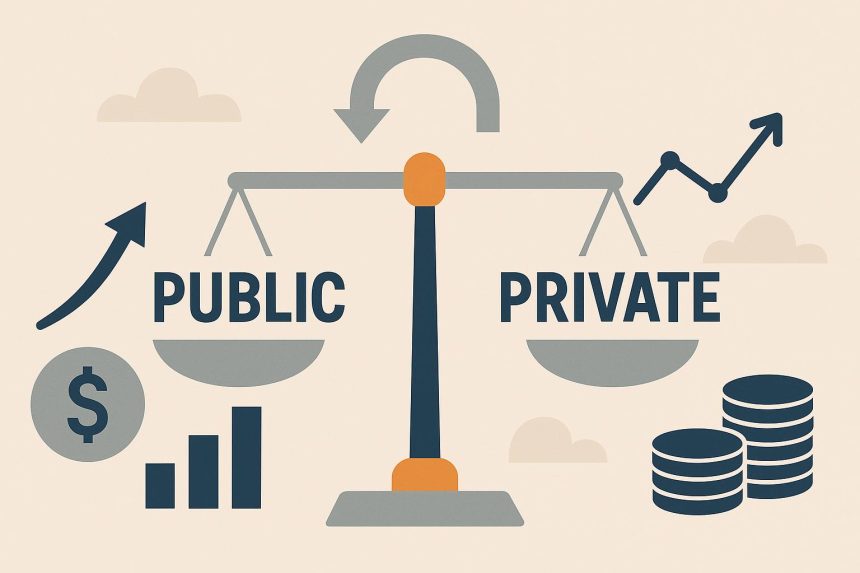
Both public and private markets help companies raise outside funding, but they operate under different rules and attract different types of investors. Some businesses use private funding early in their growth, then enter public markets later. Others stay private for much longer.
In public markets, companies raise capital through registered offerings by filing a registration statement and selling securities to the public after the registration statement becomes effective. Going public typically begins with an initial public offering (IPO), in which a company sells shares of stock to the public to raise additional capital. After an IPO, the company becomes a reporting company with ongoing reporting obligations, and it may return to registered offerings later for additional financing or for secondary offerings that let shareholders sell more easily.
Private market fundraising typically does not involve a national securities exchange. Instead, a private company sells securities either through a registered transaction or, more commonly, under an exemption from registration, including common Regulation D pathways. These sales can involve friends and family, angel investors, venture capital funds, and private funds, depending on the company’s stage and the exemption it uses.
Who can invest is one of the clearest differences between the two approaches. Registered public offerings generally allow the general public to participate. Private offerings often narrow the investor pool by limiting sales to accredited investors or restricting the number of non-accredited investors who can participate, which affects both marketing and deal structuring.
The marketing of an IPO can also differ. A common private placement pathway, Rule 506(b), generally does not allow general solicitation or advertising and limits sales to no more than 35 non-accredited investors. Rule 506(c) permits broad solicitation, but it requires all purchasers to be accredited investors and requires the company to take reasonable steps to verify that status.
The reporting burden also differs sharply once a company is public. SEC rules generally require reporting companies to file annual reports on Form 10-K and quarterly reports on Form 10-Q, along with disclosures for significant events. Private companies raising capital may still share information with investors, but they typically avoid the standardized, ongoing reporting requirements that come with public-company status.
Liquidity is another important distinction. In public markets, shares can trade through exchanges, often through exchange-traded funds (ETFs), which can make buying and selling easier and give existing shareholders more opportunities to seek liquidity. In private offerings, investors often receive restricted securities and face more limited resale options, leading them to hold those investments longer.
Choosing between public and private capital does not just affect how a company funds its next stage of growth. It also influences how widely ownership can spread, how much ongoing disclosure the business must provide, and how easily early investors can sell their stakes. Those differences can shape decision-making long after the financing is complete. In that sense, the market a company enters helps define not only how it raises money, but how it operates afterward.
About Hans Klingbeil
Hans Klingbeil is a Global Family Office advisor at UBS, serving ultra-high-net-worth clients with a focus on Latin America and international markets. He provides tailored, diversified investment strategies that incorporate both public and private assets. Educated at Universidad Anáhuac in Mexico, he holds advanced finance credentials and multiple industry licenses. His experience includes roles at Goldman Sachs and Banco Santander, and he is known for applying a global, multidisciplinary approach to long-term wealth management.

Lynn Martelli is an editor at Readability. She received her MFA in Creative Writing from Antioch University and has worked as an editor for over 10 years. Lynn has edited a wide variety of books, including fiction, non-fiction, memoirs, and more. In her free time, Lynn enjoys reading, writing, and spending time with her family and friends.