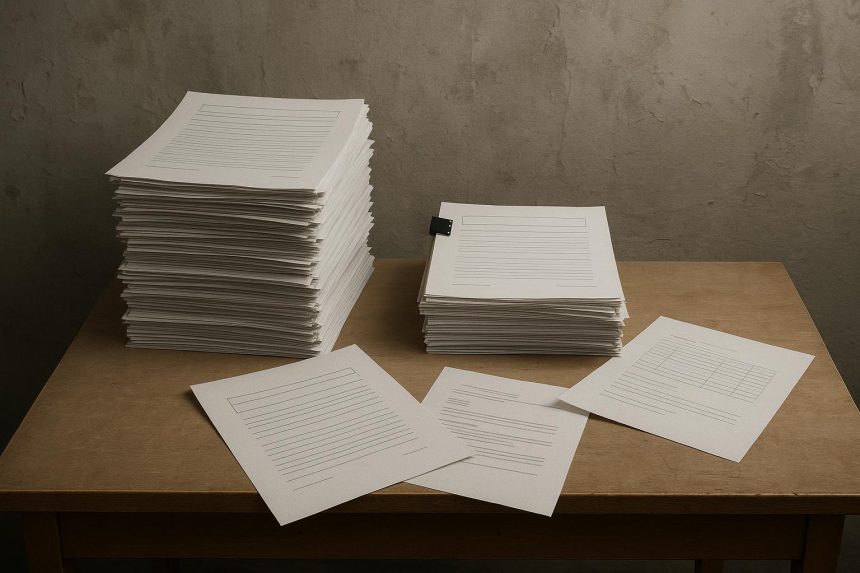
There is a folder on most people’s desktops, or buried in a browser tab they keep meaning to close, full of PDFs they fully intended to read. The 40-page industry whitepaper. The quarterly market report a colleague forwarded with “worth a look.” The vendor’s technical brief. They get opened, skimmed for two minutes, and abandoned around page four. Not because the content is unimportant — often it’s exactly the thing that would have been useful — but because the format demands a kind of sustained, distraction-free attention that almost nobody has during a working day.
I’ve started to think of this as the unread-report problem, and it’s worth examining honestly before reaching for any solution.
Why Dense PDFs Resist Being Read
A long-form PDF is optimized for the author, not the reader. Whoever produced that whitepaper needed to be thorough, cite their sources, hedge their claims, and cover every angle a critical reviewer might raise. The result is precise and defensible — and also dense, repetitive, and front-loaded with throat-clearing before the useful part arrives.
Reading research keeps pointing at the same things. We read screens more shallowly than print, we skim in an F-shaped pattern that misses the middle of paragraphs, and our working memory taps out long before a 12,000-word document does. A PDF gives you no pacing, no emphasis, no sense of where the important part is. It’s a wall, and you’re expected to climb it alone.
The Cost of Information You Meant to Absorb
The agitating part isn’t the wasted download. It’s the slow accumulation of half-knowledge. You vaguely remember that a report said something relevant, but not what, so you can’t cite it, act on it, or bring it into a meeting with confidence. Decisions get made on the strength of an executive summary that flattened the nuance you needed.
Multiply that across a team and the cost compounds. The same report gets “read” by eight people, each absorbing a different fragment, and the organization never builds a shared understanding of what it actually said. The information existed. It was even paid for. It just never made the jump from the page into anyone’s head.
Turning the Page Into Something Watchable
This is where a different mode of consumption helps. Audio and video succeed precisely where dense reading fails: they impose pacing, they carry emphasis through a human-sounding voice, and they let you absorb content while your eyes are busy elsewhere — on a commute, on a walk, between tasks. The question has always been the production overhead. Manually narrating and editing a report into a video is hours of work nobody has time for.
AI document-to-video tools have closed that gap. Leadde.ai is one of the platforms built around exactly this conversion: you upload a PDF — files up to 200MB are supported — and it generates a structured, narrated video rather than a flat read-aloud. The AI breaks the document into scenes, drafts a voiceover, and lays out on-screen text and subtitles so each section of the report becomes a distinct, paced segment. For slide-based source material there’s a dedicated Slide Presenter that turns static PDF or PowerPoint pages into a moving explainer. The practical upshot for a reader is that you can convert PDF to video online and end up with something you’ll actually finish, with subtitles for the moments you can only watch on mute.
Where This Actually Earns Its Place
A few situations where converting a report to video genuinely changes consumption:
The backlog you keep deferring. Those whitepapers and analyst reports sitting unread become a queue you can work through while doing something else, the way people clear a podcast feed.
Shared team understanding. Instead of eight people each skimming a different quarter of the same report, one narrated version with consistent emphasis gives everyone the same baseline — and subtitles make it scannable for those who’d rather read after all.
Revisiting at speed. A video with clear scene breaks is easier to jump back into than re-skimming a PDF. You remember roughly where the relevant scene was, far more than where a paragraph sat on page 27.
Where It Falls Short — and That’s Fine
This is not magic, and pretending otherwise sets you up for disappointment. AI narration has come a long way but can still sound subtly synthetic; on-screen avatars read as digital. Output quality tracks input quality closely — a rambling, poorly structured PDF produces a rambling video. Heavy diagrams, dense data tables, and complex charts translate poorly to a linear video format; they were designed to be studied, not narrated past. And the deep, brand-perfect customization a human production team delivers isn’t on the table here.
So treat it as a consumption aid, not a replacement for the source. The PDF stays the record; the video is how you get the content into your head.
If the unread folder bothers you, the low-cost test is obvious: take one report you genuinely meant to read, run it through a free tier, and see whether you finish the video. The answer tends to be quietly revealing.
Written by a productivity writer who covers reading workflows, note-taking systems, and the tools knowledge workers use to keep up with more than they can possibly read.

Lynn Martelli is an editor at Readability. She received her MFA in Creative Writing from Antioch University and has worked as an editor for over 10 years. Lynn has edited a wide variety of books, including fiction, non-fiction, memoirs, and more. In her free time, Lynn enjoys reading, writing, and spending time with her family and friends.