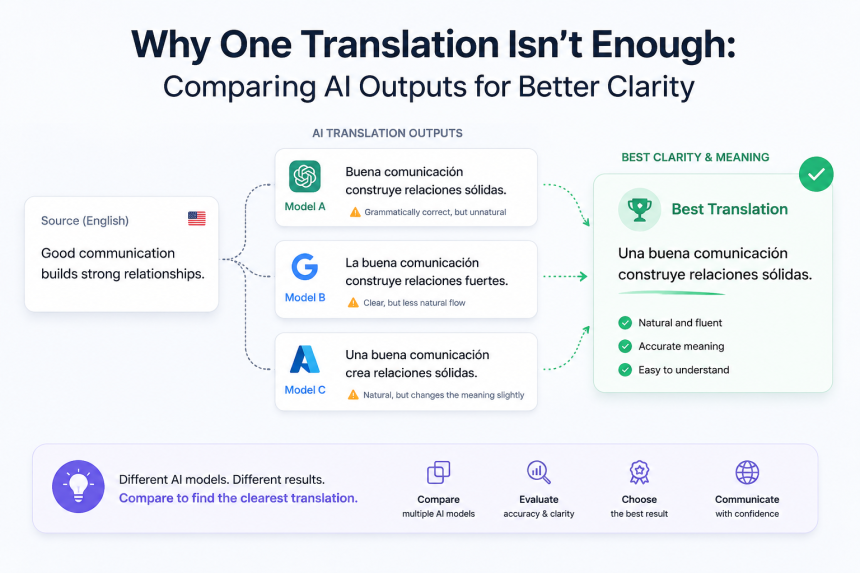
Type the same sentence into two different AI translators and you’ll often get two different answers: different tense, different register, sometimes a different meaning entirely. That’s not a bug. It’s a feature of how large language models work, and it’s exactly why relying on a single AI translation is a risky habit for anyone sending business email, contracts, or customer support replies across languages.
Here’s why comparing outputs, not just generating one, is becoming the smarter default for anyone using AI to communicate across languages:
- Every AI model is trained on different data, which means each one develops its own preferences for tone, formality, and word choice, even for the same sentence.
- Common business phrases are often the most inconsistent, because they carry cultural and register nuance that a single model can miss or guess wrong.
- Consensus, not confidence, is the better accuracy signal. A model that “sounds” fluent isn’t necessarily the model that’s correct.
What is single-model translation risk?
Single-model translation risk is the chance that the one AI engine you happened to use produced an output that’s fluent-sounding but subtly wrong in tone, formality, or literal meaning. Because most people only ever see one translation, they have no way to know whether it’s the accurate one or just the confident one.
This is a bigger problem than it sounds. AI translation tools don’t flag their own uncertainty. A model will render a sentence with total fluency whether it nailed the nuance or missed it completely. Without a second (or twenty-second) opinion, you’re trusting a coin flip and calling it precision.
Why do different AI models translate the same sentence differently?
Different AI models translate the same sentence differently because they’re trained on different corpora, tuned with different objectives, and make different judgment calls on ambiguous inputs, especially around verb tense, formality, and idiom.
A clear, real-world example: the English phrase “I look forward to hearing from you”, one of the most common closing lines in business email. If you compare this phrase using MachineTranslation.com, you can see how 22 leading AI translation models interpret the same sentence differently. The platform displays each model’s translation side by side and identifies the SMART consensus translation, the version that best reflects the meaning and tone agreed upon by the majority of AI models. It’s an easy way to spot subtle differences that might otherwise go unnoticed when relying on a single translator.
It’s a phrase where AI models routinely split on two things:
Verb tense. Some models render it with a present-tense construction, others reach for a more formal subjunctive or future-oriented phrasing.
Register. Some outputs land casual enough for a colleague; others tip formal enough for a legal filing.
How does comparing multiple outputs improve translation clarity?
Comparing multiple AI outputs improves clarity because it turns invisible uncertainty into visible data. Instead of guessing whether one model’s phrasing is right, you can see:
| What you get from one model | What you get from comparing 22 |
| A single, unverified answer | A visible range of interpretations |
| No way to detect ambiguity | Clear signal on where models disagree |
| Confidence with no accuracy check | A consensus-backed “most agreed” version |
| Risk hidden in fluent-sounding text | Risk exposed before you hit send |
This is the same logic behind why professional translators cross-check dictionaries, style guides, and native-speaker review before finalizing sensitive copy. AI just makes that cross-checking process visible and instant, provided the tool you’re using actually shows you more than one output.
When does this matter most?
Not every translation needs a 22-way comparison. But it matters most when:
- The text is customer-facing, like email sign-offs, support replies, or marketing copy, where tone directly affects how professional or warm you come across.
- The audience is unfamiliar to you, so you can’t personally verify whether a phrase reads as too stiff or too casual for that market.
- The stakes are high enough that “close enough” isn’t good enough: contracts, HR communications, or anything that could be reread and scrutinized later.
For low-stakes, internal, or throwaway text, a single fast translation is usually fine. But for anything representing your brand or your professional voice, seeing where models agree, and where they don’t, is the difference between publishing a translation and gambling on one.
How SMART resolves model disagreement
This is the exact problem MachineTranslation.com’s SMART engine was built to solve. Rather than asking one model for an answer and trusting it blindly, SMART runs the same input through 22 AI models simultaneously, compares every output, and surfaces the version the majority of models agree on, while still letting you see every individual variant if you want to dig into the differences yourself.
FAQ
Why do AI translators give different results for the same sentence?
Because each model is trained on different data and makes independent judgment calls on tone, tense, and register, especially in ambiguous, everyday phrases.
Is one AI translation ever accurate enough on its own?
Sometimes, but you have no way to verify it without a second output to compare against. Fluency isn’t the same as accuracy.
What kinds of phrases split AI models the most?
Common conversational or business phrases, greetings, sign-offs, and polite requests, tend to split models on formality and tense more than technical or literal text does.
How can I check whether a translation’s tone is right for my audience?
Compare multiple model outputs for the same phrase and see which version the majority converge on, rather than accepting the first result you get.

Lynn Martelli is an editor at Readability. She received her MFA in Creative Writing from Antioch University and has worked as an editor for over 10 years. Lynn has edited a wide variety of books, including fiction, non-fiction, memoirs, and more. In her free time, Lynn enjoys reading, writing, and spending time with her family and friends.