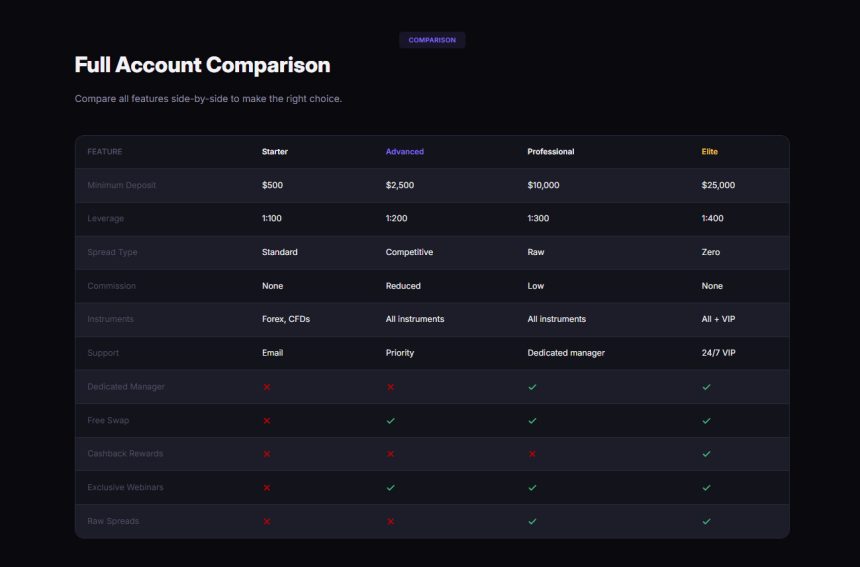
A simple chart can be turned upside down in seconds flat by news and central bank announcements. Order books are thinned immediately on volume spikes across Fonndure servers. Thin liquidity can lead to messy fills and painful price gaps for anyone holding open trades. Surviving wild price swings requires heavy-duty hardware that won’t lag during traffic spikes.
Servers have to deal with huge blocks of orders instantly and not freeze in a session. This Fonndure.com Review highlights an objective insight on how the safety tools work under real pressure. Diving into backend stability. Reliable risk features help cushion accounts when the charts start whipping around violently like this.
The smart automated stops and the consistent execution give good protection to the participants in rough patches. Avoiding sudden spikes means that flash crashes won’t destroy an entire weekly routine. Drops in a hard market test the patience of anyone watching live charts tick downwards. The most important thing to do when the order flow is full of panic selling is to stay calm.
Risk Management Architecture and Execution Protocols
Stop Loss Controls and Exposure Limit Setting
Setting up automatic stops gives accounts a fighting chance when price action suddenly flips around. Right on the order screen, predefined exit limits lock in place before any position goes live. These instructions sit waiting on the backend to trigger closures the second a target mark hits. Staring at screens all day stops being necessary once those safety nets handle the exits.
Live tracking tools will display the total margin usage of all active positions in real time as well as individual order stops. Main dashboards show total drawdown, leftover margin reserves and asset splits without digging through menus. A deep Fonndure.com Review demonstrates how tracking these metrics can assist in adjusting sizing before encountering margin problems.
Monitoring risk parameters closely prevents sudden flash crashes from erasing weeks of steady gains. Small habit adjustments around exposure limits make navigating unpredictable market hours much more manageable overall.
Even with fully automated safety nets, proper risk management demands discipline. In stressful moments, rules take over, leading to a lack of emotional decision-making.
Leverage Mechanics and Volatility Monitoring (1:100 to 1:400)
Leverage lets folks control bigger positions off a modest deposit, scaling from 1:100 on basic accounts up to 1:400 on upper levels. Big ratios feel great during quiet weeks, but wild price swings make wins and losses pile up fast. Doing the margin math before big news drops keeps nasty surprises away.
Smart routing systems pair incoming tickets with live liquidity pools so things don’t choke up when volume spikes. Fast execution helps orders land around expected rates even as charts bounce around. A typical Fonndure.com Review explores how the combination of flexible leverage and fast order routing keeps margin stress manageable.
Close monitoring of margin health prevents erratic sessions from blindsiding accounts. Major data drops can become chaotic without safety buffers, potentially resulting in abrupt closeouts. Treating leverage with caution protects hard-earned funds from being wiped out in seconds. Discipline consistently prevails over heavy position sizing during unpredictable market conditions.
Industry Safety Benchmark: Safeguard Comparison
Platform Features Against Industry Standard
Look at execution policies and risk controls compared to broader industry standards and users will see a wide range of variation in design, pricing models and built-in protections. The table below compares the operational setup of a standard Fonndure.com Review to typical retail brokers and larger consumer platforms.
By understanding these structural differences, we can better understand where specific setups fit in the larger market. The platforms are aimed at different user types and so have different approaches to limits and fee structures.

| Risk & Execution Feature | Fonndure.com | Standard Retail Broker | Feature-Heavy Consumer Platform |
| Max Available Leverage | Flexible up to 1:400 (by tier) | Capped at 1:30 to 1:100 | Up to 1:500 (variable by region) |
| Spread Options | Standard, Raw, or Zero (by tier) | Fixed / Standard markups only | Dynamic / Variable dealing desk |
| Risk Control Tools | Automated Stop Loss & Take Profit | Basic Stop Loss | Complex conditional order types |
| Monthly First Withdrawal Fee | $0 Platform Fee | Standard withdrawal charge | Tiered processing fee structure |
| Mobile Sync & Uptime | Web-optimized multi-device sync | Separate app downloads required | Heavy client software downloads |
| Client Support Access | Priority / Dedicated VIP option | General email ticket queue | Automated chatbot queue |
Analysis of structural particulars in this Fonndure.com review refers to how clean and risk settings together with easy fee schedule help make executing daily trading tasks simple. The dashboard does not overcrowd the layout with overcomplicated order types that take time to set up; it focuses on speed, visibility, and practical usability.
Platform Reliability and System Stability Safeguards
Infrastructure Uptime and Continuous Market Connection
Global trading volumes spike at market opening times so server stability is very key. To maximize the speed and reliability of data flows, cloud networks are sited near financial centres. During heavy news drops, backup nodes automatically activate to keep our price charts online.
Encryption must be used on every connection between terminals and back end systems to protect user information. Continuous background monitoring This Fonndure.com Review checks and runs to see possible faults. A balanced reading shows how steady diagnostics will ensure reliable price feeds and balancing totals.
Keeping connections alive helps to avoid annoying freezes during peak times along with an active position. A reliable uptime offers participants the reassurance of continued engagement during rapidly evolving sessions.
Without a doubt, hardware maintenance happens behind the scenes without disturbing day-to-day work. A robust server architecture provides the backbone for efficient order routing.
Conclusion: Dependable Execution in Changing Markets
At the end of the day, it comes down to reliable servers and pragmatic risk management tools to survive wild swings in the market. The setup has a range of useful features such as live exposure checks, auto stop losses and leverage that can go as high as 1:400. This combination lends a lot of flexibility for adapting to changing charts.
Looking at the overall performance of a well-balanced Fonndure.com Review users can see an environment set up to support well-organized routines. The system is free from lag issues, and sticking to plans gets easier with consistent uptime and clear terms.
A strong backend architecture provides a strong foundation to handle financial markets for a long time. In general, dependable execution safeguards greatly reduce the stress associated with navigating fast-moving price action.
Active trading success depends on patience and the use of proper technical tools. Most people jump into positions without a clear game plan and that leads to messy mistakes. Taking things slowly can protect users capital during difficult times.
Market conditions are always changing, and the ability to adapt is a valuable skill for managing open positions. It’s important to have realistic expectations so that small setbacks don’t turn into major panic moments. Discipline will always beat luck over the long run.
Check execution speeds often to keep surprises at bay when volatility unexpectedly kicks up. During chaotic sessions, little habits like monitoring margin health make a huge difference. Staying prepared is half the battle won.
Good risk habits take time to build up naturally through actual market experience. Learning from past slip-ups refines decision-making skills far better than any textbook ever could. Consistency trumps big risky bets every single week.
Looking back at all these moving parts reveals why infrastructure quality matters so much. A dependable workspace lets focus stay entirely on reading charts rather than fighting software glitches.

Lynn Martelli is an editor at Readability. She received her MFA in Creative Writing from Antioch University and has worked as an editor for over 10 years. Lynn has edited a wide variety of books, including fiction, non-fiction, memoirs, and more. In her free time, Lynn enjoys reading, writing, and spending time with her family and friends.