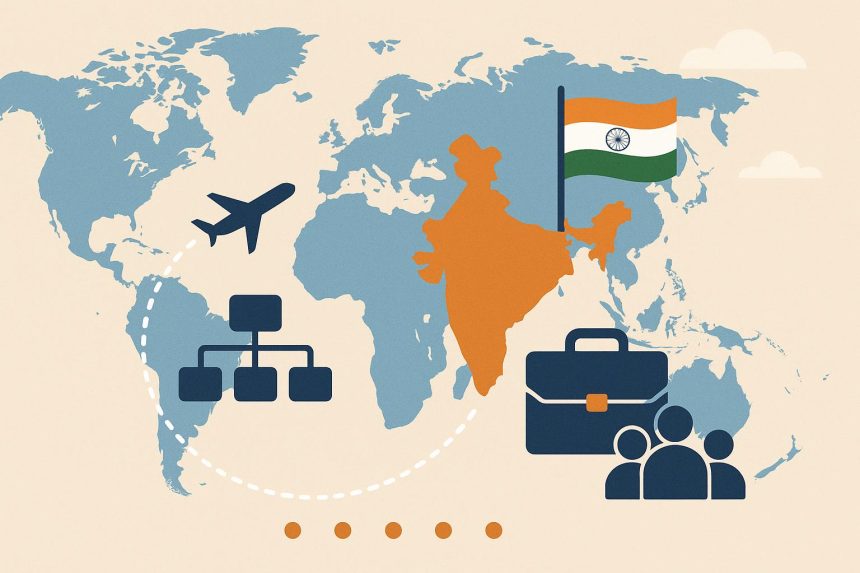
Global companies do not always need to establish an Indian subsidiary before building a team in India.
In 2026, businesses have several ways to test the market, hire early employees, support customers, and build operational capacity before committing to a full local entity. The right approach depends on team size, how closely workers will be managed, whether the company expects to generate local revenue, and how permanent the India expansion is likely to become.
For many companies, the most practical strategy is to separate two decisions that were once treated as one: entering the Indian market and setting up an Indian entity.
Those decisions can happen at different stages.
TL;DR
- Companies can begin hiring in India before establishing their own subsidiary.
- Early-stage options include contractors, outsourcing, an Employer of Record, or a local entity.
- Contractors suit genuinely independent work, while outsourcing works better for vendor-managed projects or functions.
- An EOR can support dedicated employees when the company does not yet have an Indian entity.
- A PEO is generally more relevant after a company already has its own local entity.
- Businesses should review payroll, employee classification, management control, cost, and long-term expansion plans before choosing a structure.
- Entity setup may become more appropriate once headcount, revenue, customer activity, or long-term investment in India increases.
Why Companies Test India Before Setting Up an Entity
India can be attractive for several reasons, but not every company knows at the start how large its local operation will become.
A software company may want to hire a few engineers. A professional-services business may need analysts. A SaaS company might want customer success or implementation staff closer to clients in Asia.
In each case, opening a subsidiary before the first hire can be a bigger commitment than the immediate business need requires.
A phased market-entry strategy gives companies time to answer practical questions first:
- Can we recruit the talent we need?
- Will this team remain small or grow quickly?
- Do we need employees or independent specialists?
- Will we eventually sell or sign contracts locally?
- Do we need an office?
- How much internal HR and payroll infrastructure will be required?
- Is India becoming a long-term operating location or simply a talent market?
The answers can shape whether an entity is needed immediately or later.
What Are the Main Ways to Build a Team in India?
Companies generally have four broad options.
| Model | Best suited for | Local entity needed? |
|---|---|---|
| Independent contractor | Specialist or project-based work | No |
| Outsourcing | Vendor-managed project or function | No |
| Employer of Record | Dedicated employees before entity setup | No |
| Local entity | Larger, long-term Indian operations | Yes |
A PEO may also become relevant once the company already has its own Indian entity and wants external support with HR and payroll administration.
The important point is that these options solve different problems.
Option 1: Hire Independent Contractors
Contractors can be useful when the work is genuinely independent.
This may include:
- short-term consulting
- technical advisory work
- a defined development project
- specialist design work
- research assignments
- project-based implementation
Contractors usually have more control over how they deliver the work and may serve several clients.
The risk appears when a contractor begins to work like an employee.
For example, if someone works full time for one company, reports to an internal manager, follows fixed schedules, uses company processes, and remains in the same role for a long period, the arrangement may need closer review.
Companies should therefore choose contractor status based on the actual working relationship, not simply because it is faster to arrange.
Option 2: Use an Outsourcing Partner
Outsourcing is a different model.
Here, the company hires a service provider rather than an individual employee. The provider manages its own team and delivers an agreed service, project, or business function.
This can work well for:
- software development projects
- customer support
- finance operations
- back-office processes
- technical support
- research
- managed IT services
The advantage is that the client does not need to build the entire function internally.
The trade-off is control.
If the company wants individual team members fully integrated into its own workflows, reporting lines, culture, and performance systems, outsourcing may feel too distant.
Option 3: Hire Through an Employer of Record
An Employer of Record, or EOR, is often used when a company wants dedicated employees but does not yet have its own Indian entity.
The EOR becomes the legal employer. The client company manages the employee’s actual work.
That typically means the EOR supports areas such as:
- employment contracts
- payroll
- statutory administration
- onboarding
- benefits
- leave records
- employee documentation
- offboarding
The client still decides:
- what the employee works on
- who they report to
- how priorities are set
- how performance is managed
- how the role fits into the wider team
This makes the model different from outsourcing.
The employee works as part of the client’s organisation in practical terms, even though the formal employment relationship sits with the EOR.
Where Does a PEO Fit?
A Professional Employer Organization generally becomes more relevant once the company already has a local entity.
This is why companies should understand the difference between PEO vs EOR before choosing a provider.
| Question | EOR | PEO |
|---|---|---|
| Local entity required | No | Usually yes |
| Legal employer | EOR | Client or co-employment structure |
| Best use | Hiring before entity setup | Supporting an existing entity |
| Payroll support | Yes | Yes |
| HR administration | Yes | Yes |
| Market-entry fit | Strong | Limited without entity |
If the company does not yet have an Indian entity, an EOR is usually the more relevant model to evaluate.
If the entity already exists, a PEO may be useful for reducing the administrative burden on the local HR team.
Which Roles Should Companies Hire First in India?
There is no standard first team.
The right answer depends on why the company is entering India.
Common early roles include:
- Software engineering: Useful when a company wants to expand product-development capacity.
- Data and AI: Relevant for businesses building analytics, machine-learning, or automation capabilities.
- Finance and accounting: Often added as companies centralise or expand global operations.
- Customer success: Helpful when supporting customers across Asian time zones.
- Business operations: Analysts, project coordinators, and operations specialists can support distributed teams.
- Product and QA: These roles can complement engineering teams without requiring a full local office.
- Sales support: Some companies begin by adding research, pre-sales, or account-support capacity before building a larger commercial team.
The first few hires should usually address a clear business need rather than simply taking advantage of available talent.
How to Choose a Hiring Partner for the First India Team
The cheapest provider is not automatically the right one.
Companies comparing the BEST EOR to hire first employee in India should look at the full operating model behind the service.
A practical review should include:
- Who employs the worker locally?
Find out whether the provider uses its own Indian entity or relies on another local partner. - How does payroll work?
Ask about payroll cycles, payslips, reimbursements, deductions, and payroll corrections. - Who issues the employment contract?
The provider should be able to explain how contracts are created and how amendments are handled. - How are benefits managed?
Companies should understand both statutory requirements and any additional benefits being offered. - What support do employees receive?
Payroll and leave questions should not become a recurring burden for the client company’s HR team. - What does the total cost include?
Review more than the headline monthly fee. Deposits, foreign exchange charges, benefits, onboarding, and offboarding may affect the overall cost. - Can employees move later?
If the company establishes its own Indian entity later, the transition process should be understood from the start.
For example, Asanify operates through its own Indian entity and supports employment contracts, payroll, statutory administration, onboarding, benefits, leave, and offboarding, while clients continue to manage employees’ daily work and performance.
What Should Companies Plan Before Making the First Hire?
Before making an offer, companies should have clarity on a few operational basics.
Define the employment model
Decide whether the role is genuinely independent, outsourced, or part of the internal team.
Understand the full employment cost
Salary is only one part of the cost. Benefits, statutory obligations, provider fees, payroll administration, and other employment costs may also apply.
Prepare remote onboarding
New employees should know how they will receive equipment, system access, training, documentation, and team introductions.
Set reporting lines early
Cross-border employees need clear managers, responsibilities, and decision-making authority.
Plan for growth
A structure that works for two employees may not be the best choice for 50.
Companies should know what would trigger a review of the current model.
When Does Setting Up an Indian Entity Make More Sense?
An EOR or contractor model does not need to be permanent.
Entity setup may become more attractive when the company’s Indian operation becomes substantial.
Possible triggers include:
- growing headcount
- significant local revenue
- local customer contracts
- long-term office plans
- banking requirements
- more complex local operations
- the need for greater control over employment infrastructure
- a clear multi-year commitment to India
There is no universal headcount at which a company must move to its own entity.
A team of ten supporting global operations may have very different needs from a team of ten generating local revenue and signing Indian contracts.
The decision should reflect the actual business model.
A Practical Phased Approach to India Expansion
For many companies, India expansion can happen in stages.
| Stage | Typical approach |
|---|---|
| Exploring the market | Contractors, advisers, research |
| First dedicated hires | EOR or selected contractors |
| Building a small team | EOR with structured payroll and HR processes |
| Growing local operations | Review entity economics |
| Large or permanent presence | Local entity may become more appropriate |
This approach allows the business to learn before committing to larger infrastructure.
It also prevents the company from treating entity setup as the first step when it may actually be a later-stage decision.
Common Mistakes to Avoid
Companies entering India should avoid a few recurring mistakes:
- Hiring before choosing the right worker classification: The working relationship should determine the structure.
- Using contractors simply because they are easier to onboard: Convenience is not a substitute for the correct model.
- Treating outsourcing and employment as the same thing: One builds an external service relationship, while the other builds an internal team.
- Comparing providers only on price: Local infrastructure, payroll quality, employee support, and transition options matter too.
- Ignoring the future entity decision: Companies should know what growth would make their current model inefficient.
- Leaving onboarding until the employee starts: Remote employees need clear systems, managers, documentation, and access from day one.
Conclusion
Entering the Indian market no longer has to begin with setting up a subsidiary.
Global companies can test the market, hire specialised talent, and build an initial team through contractors, outsourcing partners, or an Employer of Record before deciding whether a local entity is justified.
The right model depends on how the worker will actually operate, how much control the company needs, the expected size of the India team, and how permanent the expansion is likely to become.
For many businesses, the sensible path is gradual: start with the structure that fits today’s needs, then move to a local entity when the scale and economics make that investment worthwhile.
FAQs
Can a foreign company hire employees in India without setting up an entity?
Yes. Depending on the situation, a foreign company can use an Employer of Record to employ workers in India without immediately establishing its own local entity.
Is an EOR the same as outsourcing?
No. With an EOR, the employee generally works directly within the client’s team. With outsourcing, the service provider usually manages delivery of the work.
Can a company use contractors instead?
Yes, when the work is genuinely independent. Companies should avoid using contractor arrangements for roles that operate like regular employment.
What is the difference between an EOR and a PEO?
An EOR can employ workers where the client does not have a local entity. A PEO generally supports a company that already has one.
When should a company establish an Indian entity?
Entity setup may make more sense once local headcount, revenue, customer activity, office requirements, or long-term operational commitment becomes significant.
What should companies check before choosing an India hiring partner?
Review local entity structure, payroll processes, contracts, benefits, employee support, total cost, and how easily employees can transition if the company later establishes its own entity.

Lynn Martelli is an editor at Readability. She received her MFA in Creative Writing from Antioch University and has worked as an editor for over 10 years. Lynn has edited a wide variety of books, including fiction, non-fiction, memoirs, and more. In her free time, Lynn enjoys reading, writing, and spending time with her family and friends.