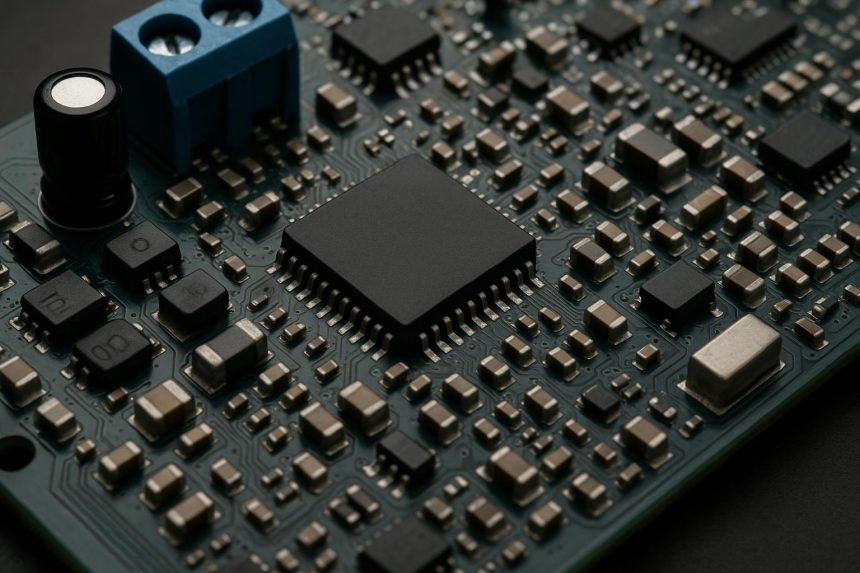
Modern electronics keep getting smaller, but the number of design decisions inside them is not shrinking with the enclosure. A connected sensor, access-control module, or smart-home controller may contain a microcontroller, wireless radio, power-management circuitry, and several protection components on a board that fits in the palm of a hand.
In that environment, even a small switching diode deserves more attention than its size suggests. Designers naturally start with electrical ratings such as reverse voltage, current, and switching speed. But as PCB space becomes tighter, package shape, internal configuration, routing, and assembly can matter almost as much as the headline specifications.
Consider a compact connected sensor mounted near a doorway. It has a microcontroller, a wireless transceiver, a few digital inputs, and an external connector carrying signals from a switch or sensor. A switching diode may be used to steer a signal, block unwanted current, or help protect an input from a voltage excursion.
Electrically, that sounds simple. Physically, the board may have very little space left.
Small Components Can Create Large Layout Decisions
A single diode can occupy only a few millimeters, but the way it fits into the circuit can influence much more than its own footprint.
On the doorway sensor board, one input may need a single diode close to the connector. Another section may require two diode junctions in a much tighter area. Both circuits may use fast switching diodes, yet the physical solutions can be very different.
That difference matters because component selection and PCB layout increasingly happen at the same time. A part that looks suitable in a component database may still force awkward routing, consume too much board space, or complicate assembly.
As products become smaller, engineers are often choosing not just an electrical function, but also the physical form in which that function appears on the board.
A Single Diode Can Still Be the Simpler Choice
The LL4148 is a useful example of a traditional small-signal switching diode adapted for surface-mount production. It is commonly available in a MiniMELF-style package and is intended for fast switching applications.
In the sensor module, an LL4148 fast-switching diode can make sense when the circuit needs one discrete diode at a clearly defined point, such as a signal-steering or low-current protection path.
There is value in that simplicity. One schematic symbol maps directly to one physical diode, routing is easy to follow, and troubleshooting remains straightforward. An engineer looking at the board can quickly understand where the diode sits in the signal path.
The package still matters. MiniMELF devices have a cylindrical body rather than the flat shape used by many transistor-style SMD packages. That does not make them difficult to use, but it means placement, footprint design, and assembly behavior should be considered alongside the electrical specification.
Integration Can Save Space, but Only When the Circuit Fits
Now consider another part of the same board where two fast switching diodes are required and PCB area is tighter.
A BAV99 dual switching diode takes a different approach. It integrates two diode junctions into a compact three-pin SOT-23 package instead of using two separate single-diode packages.
That can reduce component count and save board area. It may also shorten some internal connections and make the layout cleaner.
But integration is useful only when the internal diode configuration already matches the circuit.
Saving one package on the PCB means little if the two junctions are connected internally in a way that forces awkward routing or prevents the intended circuit from working. In that case, a smaller component creates a larger design problem.
This is the broader lesson: integration is not automatically better. It works best when the internal structure of the component fits the schematic rather than forcing the schematic to adapt to the package.
Routing Becomes Part of the Component Choice
On a crowded PCB, even the location of a tiny diode can matter.
Return to the doorway sensor. The external connector may sit near the edge of the board, while the microcontroller and radio sit farther inside. If a protection or steering diode is placed too far from the signal it is meant to control, the routing itself becomes part of the problem.
Longer traces introduce unwanted electrical effects, while tight routing around radios and digital signals can create additional design compromises. Engineers therefore consider factors such as junction capacitance, leakage, trace length, and physical placement together rather than treating the diode as an isolated item on the bill of materials.
This is especially important around external inputs and communication lines, where the board layout can influence how effectively a small protection or switching device performs its job.
The smaller the board becomes, the harder it is to separate “component selection” from “layout design.”
Part Numbers Still Need Context
Component databases can make the first comparison much faster, particularly when engineers are checking package style, diode configuration, electrical ratings, or possible equivalents.
CNChipDepot is one example of a source that can help narrow the field, but database results are still only the beginning. The manufacturer datasheet remains essential for confirming polarity, footprint, internal configuration, operating limits, and behavior under the actual conditions of the circuit.
That becomes even more important when replacing a part from another manufacturer. Familiar family names may suggest similar behavior, but they do not guarantee identical mechanical details or electrical characteristics.
Older BOMs also deserve the same scrutiny. A diode that worked well in a previous product may not remain the best choice after a redesign introduces a smaller PCB, denser routing, or a different assembly process.
The Package Is Becoming Part of the Specification
There is little value in declaring one switching diode universally better than another. LL4148 and BAV99 illustrate the broader point.
One gives the designer a straightforward single-diode solution. The other places two switching junctions into a compact package and can save space when its internal configuration fits the circuit.
As electronics get smaller, a component is no longer defined only by what it does electrically. The space it occupies, the connections inside it, and the layout it creates around itself increasingly become part of the specification.

Lynn Martelli is an editor at Readability. She received her MFA in Creative Writing from Antioch University and has worked as an editor for over 10 years. Lynn has edited a wide variety of books, including fiction, non-fiction, memoirs, and more. In her free time, Lynn enjoys reading, writing, and spending time with her family and friends.