Renewables supplied 16.7% of global final energy consumption in 2011. By 2021, that figure had climbed to 18.7%. Oil moved the opposite direction: its share of global energy demand peaked at 46% five decades ago and fell below 30% for the first time on record in 2024. Two trend lines, one crossing under the other, and the numbers behind both are more concrete than the general sense that a transition is underway.
Two Lines Moving in Opposite Directions
The renewables climb has been gradual rather than explosive. REN21’s Global Status Report puts renewable sources at 16.7% of global final energy consumption in 2011. A decade later, the share had reached 18.7%, per the IEA’s tracking of total final energy consumption. The IEA’s own forecast puts the figure at nearly 20% by 2030.
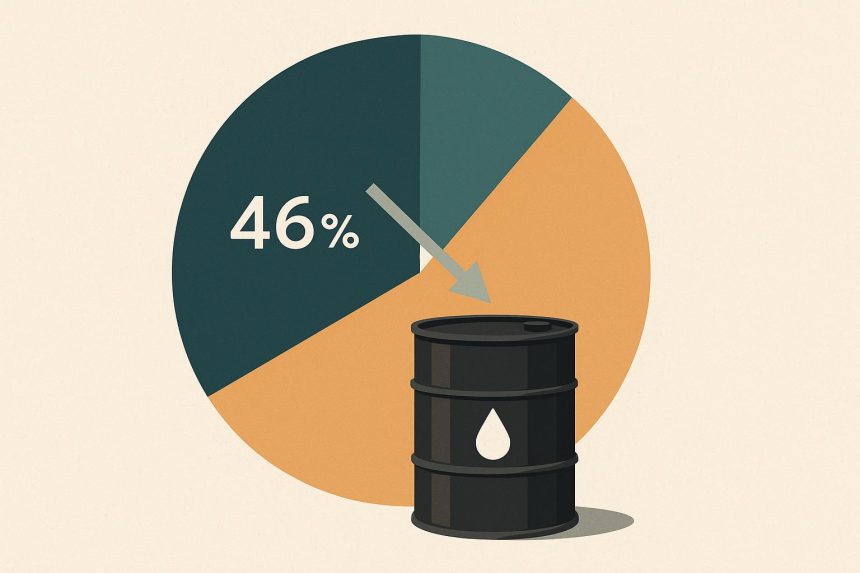
Oil’s line runs the other way. Oil’s share of total energy demand fell below 30% for the first time ever in 2024, 50 years after it peaked at 46%. Demand for oil, in absolute barrels, is still rising in most scenarios. What’s shrinking is oil’s share of a growing pie, while renewables and other sources take a larger slice of the same pie.
IEA’s Own Forecasts Don’t Agree With Each Other
Where that trajectory goes next depends on which scenario is right. The IEA itself has published sharply different answers within the same year. Under the agency’s Stated Policies Scenario, oil demand plateaus around 2030 at roughly 105.5 million barrels a day. Electric vehicles are projected to displace 5.4 million barrels a day of that demand by the end of the decade, up from about 1 million in 2024.
Under the IEA’s separate Current Policies Scenario, the picture looks different. Global oil demand rises from 100 million barrels a day in 2024 to 105 million by 2035 and 113 million by 2050. Prices are projected above $100 a barrel by mid-century. The gap between the two scenarios comes down largely to how fast electric vehicle adoption and renewable power capacity actually grow relative to current policy commitments. Neither scenario is a prediction. Both are the range producers are planning against.
Some Producers Have Far More Room Than Others
The fiscal exposure isn’t evenly distributed among oil-producing economies, and the numbers on that are sharper than the demand forecasts. Hydrocarbons account for roughly 60% of budget revenues and 70% of exports across Gulf oil producers as a group. The average fiscal breakeven oil price across those economies, the price needed to balance the budget, reached $83.20 a barrel in 2024, up $10 from 2020.
That average masks a wide spread. Producers that built up gas exports, sovereign wealth reserves, or non-oil revenue bases can absorb a lower price for longer. Producers still fiscally structured around a single, high-breakeven oil price have far less room. Bahrain illustrates the gap. Its projected fiscal breakeven price nears $167 a barrel by 2030, more than double the region’s average, and the most exposed position of any Gulf economy tracked.
Both Forecasts Agree on One Thing
None of the specific forecast numbers above will turn out to be exactly right. Both IEA scenarios agree on one direction: renewables’ share keeps rising in every version of the future the agency has modeled. They also agree on the mechanism doing the displacing. Electric vehicles, renewable power capacity, and gas substitution, not any single policy or event. The producers positioned to withstand either version of that future are the ones whose fiscal math doesn’t depend on oil holding its current share. The ones that haven’t made that adjustment are betting on the version of the numbers that requires the least change, which is also the version with the least room for error.

Lynn Martelli is an editor at Readability. She received her MFA in Creative Writing from Antioch University and has worked as an editor for over 10 years. Lynn has edited a wide variety of books, including fiction, non-fiction, memoirs, and more. In her free time, Lynn enjoys reading, writing, and spending time with her family and friends.