


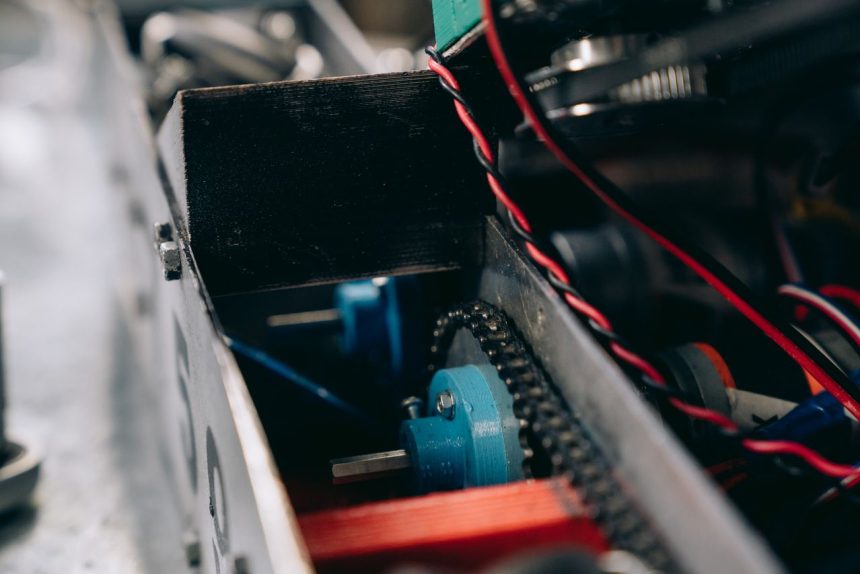
Two machines can perform the same task, operate at similar speeds and deliver comparable results, yet produce very different levels of noise. One runs with a barely noticeable hum, while the other generates constant vibrations, rattling or a high-pitched whine.
The difference is not always related to the size or power of the equipment. Mechanical design, component geometry, material selection and manufacturing accuracy all influence how much noise a machine produces during operation.
Understanding these factors is particularly important in applications where quiet operation contributes to comfort, usability or working conditions, from office equipment and medical devices to industrial automation.
Where Does Mechanical Noise Come From?
Most mechanical noise begins with vibration. Whenever components rotate, slide, engage or change direction, they generate forces that can cause parts of the machine to vibrate.
These vibrations travel through shafts, bearings, housings and supporting structures. Some are transmitted into the surrounding air as audible sound.
Electric motors, gears, fans and bearings can all contribute to the overall noise level, although their influence varies according to the design and operating conditions.
A high-pitched whine, for example, may originate from the interaction between gear teeth, while a low-frequency rumble can be associated with rotating components or structural vibrations.
Importantly, noise does not necessarily indicate a malfunction. Even correctly designed and maintained machines produce some sound. The objective is to limit unwanted vibrations and prevent them from becoming excessive.
How Gear Design Influences Noise
Gears are essential components in countless machines, but their operation can also generate vibrations.
As gear teeth engage and disengage, small variations in the forces transmitted between them create dynamic loads. These variations depend on several factors, including tooth geometry, rotational speed, applied torque and manufacturing accuracy.
Different gear configurations also have distinct operating characteristics.
Spur gears, for example, are widely used because of their relatively simple construction and efficient power transmission. However, their tooth engagement can generate noticeable noise, particularly at higher speeds or when manufacturing inaccuracies affect contact between the teeth.
Helical gears provide more gradual engagement, with contact developing progressively across the tooth surface. This characteristic can contribute to smoother and quieter operation under suitable conditions.
Neither solution is universally preferable. The correct choice depends on load requirements, available space, operating speed, efficiency and other design constraints.
The Importance of Manufacturing Precision
Even a carefully designed transmission can become noisy if its components do not match the intended geometry.
Small deviations in tooth profiles, spacing or alignment can alter how forces are distributed during operation. Instead of engaging consistently, components may experience uneven contact and fluctuating loads.
Surface quality also deserves attention. Roughness and imperfections can influence friction and vibration, although their effect depends on the type of gear and the operating conditions.
Precision manufacturing therefore plays an important role in achieving predictable mechanical behaviour.
Accurate machining, appropriate finishing processes and dimensional inspections help ensure that components operate as intended.
This becomes especially relevant in compact equipment, where limited installation space and small component dimensions can make the effects of manufacturing and assembly errors more significant.
Worm Gear Transmissions and Smooth Operation
Worm gear systems offer another example of how transmission geometry can influence mechanical noise.
These mechanisms typically consist of a screw-shaped component, known as a worm, which engages with a mating gear wheel. Unlike many conventional gear arrangements, their operation involves a substantial amount of sliding contact between the interacting surfaces.
The progressive engagement can support smooth, relatively quiet motion, making worm gear transmissions suitable for applications where controlled movement and acoustic performance are important.
However, their behaviour depends on more than geometry alone.
In worm screw manufacturing, accurate thread geometry, dimensional tolerances and surface finish are important because they influence how consistently the worm engages with its mating wheel.
Material combinations and lubrication must also be considered. The sliding contact generates friction and heat, which can affect efficiency, wear and noise if the system is not designed and maintained correctly.
Worm gears are therefore not automatically quieter than every alternative. Their suitability depends on the complete transmission design and the conditions in which they operate.
Bearings, Lubrication and Assembly Matter Too
Gear geometry is only one part of the acoustic behaviour of a machine.
Bearings support rotating shafts and help maintain their correct position. When bearings are worn, incorrectly installed or subjected to unsuitable loads, they may generate additional vibration and noise.
Lubrication is another important consideration. An appropriate lubricant helps separate contacting surfaces, reduce friction and limit wear.
Its effectiveness depends on factors such as viscosity, operating temperature, speed and load. Insufficient or unsuitable lubrication can increase friction and accelerate component deterioration.
Assembly quality is equally relevant.
A precision-manufactured gear may still perform poorly if shafts are misaligned, bearings are incorrectly positioned or the supporting structure lacks sufficient rigidity.
For this reason, reducing noise requires attention to the interaction between components rather than focusing on individual parts in isolation.
Why the Machine Structure Makes a Difference
The same mechanical components can generate different audible noise levels depending on the structure in which they are installed.
A housing, panel or supporting frame may amplify particular vibrations through resonance. Conversely, a suitably designed structure can help limit their transmission.
Mounting methods, material stiffness and the distribution of mass all influence this behaviour.
For example, a motor mounted on a lightweight panel may cause that panel to vibrate, making the equipment seem louder than the motor alone would suggest.
Designers can address these effects through structural reinforcement, appropriate mounting arrangements and vibration isolation where suitable.
The aim is not simply to enclose the source of noise, but to understand how vibrations travel through the entire machine.
Quiet Operation Starts with Good Engineering
Achieving quieter machinery rarely depends on a single component or technical solution.
Gear geometry, manufacturing accuracy, bearings, lubrication, assembly and structural design all contribute to the final result. Their relative importance changes according to the application and its operating conditions.
A quieter machine is not necessarily more efficient or durable, but excessive noise can sometimes reveal problems involving friction, wear, misalignment or vibration.
Considering acoustic behaviour during the design process, rather than treating it only as a problem to solve after assembly, makes it easier to identify suitable components and avoid unnecessary sources of noise.
Ultimately, quiet operation is the result of understanding how mechanical parts interact, from the smallest precision component to the structure of the complete machine.

Lynn Martelli is an editor at Readability. She received her MFA in Creative Writing from Antioch University and has worked as an editor for over 10 years. Lynn has edited a wide variety of books, including fiction, non-fiction, memoirs, and more. In her free time, Lynn enjoys reading, writing, and spending time with her family and friends.