

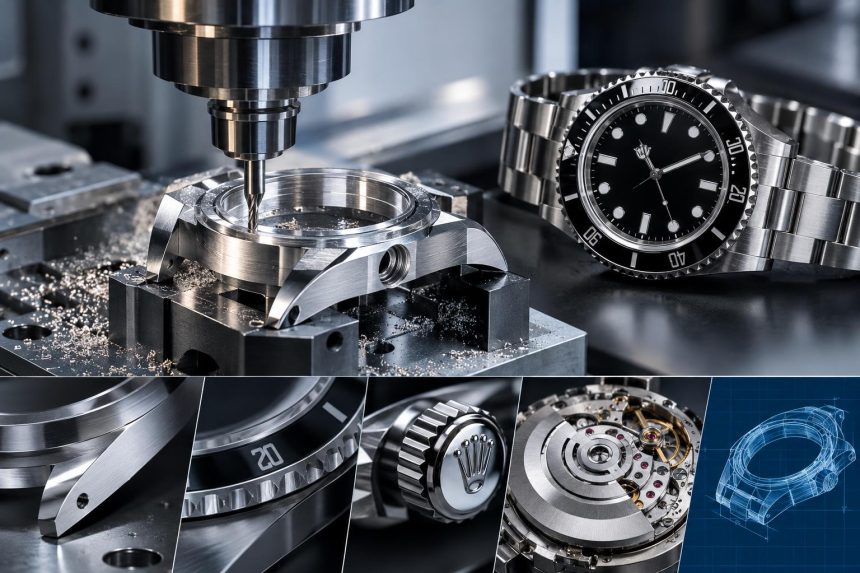
For connoisseurs seeking a flawless Rolex super clone, understanding the role of advanced CNC engineering reveals why modern high-end alternatives are virtually indistinguishable from their Swiss retail counterparts.
In the evolution of alternative horology, the barrier between standard replicas and elite timepieces has always come down to microscopic precision. Early generations of replica watches suffered from uneven case lines, misaligned bezels, and poorly sealed casebacks. Today, the landscape has been completely revolutionized by Computer Numerical Control (CNC) machining.
1. The Digital Blueprint: From 3D Laser Scanning to CAD/CAM
Achieving true 1:1 geometry begins long before a single piece of metal is cut. Master alternative watchmaking facilities utilize high-resolution 3D optical scanning and laser profilometry to map genuine luxury timepieces down to the micron.
Every contour of a classic Oyster case—from the curvature of the integrated lugs to the precise angle of the polished chamfers—is translated into a Computer-Aided Design (CAD) file. Advanced CAM (Computer-Aided Manufacturing) software then plots the toolpaths, instructing multi-axis machines on how to sculpt raw metal billets with absolute repeatability.
2. 5-Axis Milling and 904L Oystersteel
Genuine luxury sports watches require robust, highly corrosion-resistant alloys like 904L Oystersteel, which is notoriously difficult to shape due to its dense, tough metallurgical properties.
To machine this material accurately, advanced facilities deploy state-of-the-art 5-axis CNC milling machines. Unlike traditional 3-axis machines that operate on flat planes, 5-axis systems allow the cutting tool to approach the workpiece from multiple angles simultaneously. This dynamic movement ensures that complex, sculpted geometries—such as crown guards, tapered bracelet links, and curved case flanks—are cut in continuous fluid motions, eliminating the human error and asymmetry typical of older manufacturing methods.
3. Controlling Critical Tolerances and Sealing Interfaces
A watch case is more than just a pretty exterior; it is a pressurized housing designed to protect a complex mechanical movement. CNC technology excels at controlling critical internal tolerances, including:
- The Crystal Seat: Machined to exact flatness and depth so the sapphire crystal compresses evenly against the gasket without stress fractures.
- Caseback Threads: Cut with pristine pitch geometry to ensure the caseback engages smoothly over its full length, maintaining structural water resistance.
- Bezel Retention Grooves: Ensuring bi-directional or uni-directional ceramic bezels rotate with the exact click resistance and zero play found on genuine models.
Without the micron-level accuracy provided by CNC automation, integrating high-end components—such as specialized Rolex swiss eta clone movements—would be impossible, as even a 0.02 mm deviation can cause movement instability or crown stem misalignment.
4. Setting the Foundation for Hand-Finishing
While CNC machines provide the absolute structural shape of the watch, elite craftsmanship relies on a hybrid approach: machine precision followed by meticulous hand-finishing.
Because CNC milling leaves a predictable, uniform surface micro-texture, specialized artisans can apply precise directional brushing (such as the signature satin grain on watch lugs) and mirror-polishing (zaratsu-style polishing) without altering the underlying geometry. The crisp lines separating brushed surfaces from polished bevels remain razor-sharp precisely because the CNC machining laid a flawless structural foundation.
Conclusion
The mastery of CNC technology has permanently shifted the standards of the alternative watch market. By replacing manual guesswork with automated, multi-axis micro-machining, modern manufacturers can replicate the exact dimensions, weight distribution, and mechanical harmony of legendary luxury timepieces. For enthusiasts, this technological leap ensures that a high-grade super clone delivers not only the visual elegance of a genuine icon, but also the structural integrity required for daily wear.

Lynn Martelli is an editor at Readability. She received her MFA in Creative Writing from Antioch University and has worked as an editor for over 10 years. Lynn has edited a wide variety of books, including fiction, non-fiction, memoirs, and more. In her free time, Lynn enjoys reading, writing, and spending time with her family and friends.