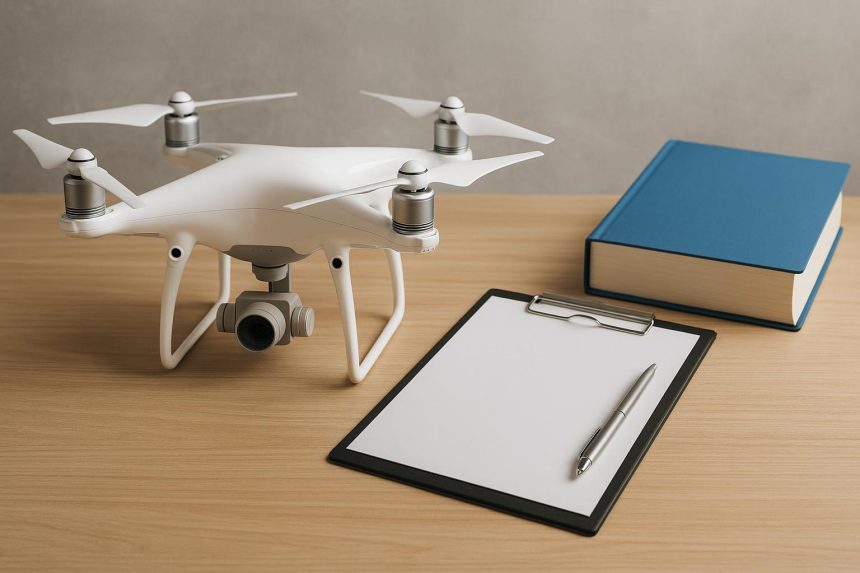
The drone circling a cell tower or drifting over a construction site usually belongs to someone on the clock. Commercial drone work stopped being novel a while ago. Utilities inspect power lines with it, surveyors map job sites with it, roofers check hail damage with it, and film crews get shots that used to need a helicopter. The flying itself is the straightforward part. What nobody watching from the ground ever sees is the paperwork that has to exist before and after every job.
For a company that flies for money, being able to prove a flight was legal matters as much as the flight going well. Months later, someone may ask who was at the controls, whether the aircraft was registered, whether the airspace was cleared, and what the crew did to manage the risk. That someone is usually a regulator, a client, or an insurance carrier, and the request rarely lands at a convenient moment. Having the answer ready is the difference between a five-minute reply and a bad afternoon.
Keeping that record straight is enough of a job that many operators have moved it off spreadsheets and into drone operations software like FlybyOps, which holds flights, equipment, documents, and incident reports in one workspace. A disciplined folder system can work too. Either way, the questions underneath are the same: what has to be kept, why, and for how long. Here’s the practical version.
What makes a drone flight “commercial”
The dividing line is purpose, not payment. If a flight supports a business in any way, even a single photo you plan to use on a company website, it counts as commercial and falls under a set of Federal Aviation Administration rules known as Part 107. Recreational flying has its own lighter track. Almost everything a professional does lives on the Part 107 side.
The baseline isn’t complicated. The person flying needs a Remote Pilot Certificate, which means passing the FAA’s aeronautical knowledge test, being at least sixteen, and being able to read and speak English. The drone has to be registered with the FAA, which currently costs five dollars and lasts three years, and since 2023 most drones have to broadcast Remote ID so they can be identified in the air. Flights in controlled airspace need authorization first, usually granted almost instantly through a system called LAANC. Certificates don’t last forever either, so pilots complete recurrent training every couple of years to stay current. None of that is the hard part. The hard part is producing evidence, later, that every box was checked on the day.
The records behind a single flight
Start with the credentials. A compliant operation can show the pilot’s current certificate, the aircraft’s registration and marking, and any airspace authorization the flight required. If the job called for a waiver, to fly beyond visual line of sight or otherwise outside the standard limits, that approval belongs in the file too.
Then there’s the flight itself. A useful flight record captures more than date and duration. It notes the location, the specific aircraft and pilot, takeoff and landing points, how long the drone was airborne, what it was carrying, the weather at the time, and who else was on the crew. Those hours matter twice over, because they roll up against both the pilot, for currency, and the individual airframe, for maintenance. That leads to the next set of records: the service history for each drone, battery cycle counts, firmware versions, and inspection dates, all tied to the specific serial number rather than to the fleet in general.
Two more records round it out. A risk assessment for the job, written before takeoff, showing what could go wrong and what the crew planned to do about it. Plenty of US operators borrow the five-by-five severity and likelihood grid from European drone regulation for this, simply because it’s easy to explain and easy to defend. And an incident record, filed against the specific flight if anything goes sideways: a lost link, a near miss, a hard landing, contact with anything other than air. On top of all of it sit the documents a client asked for, which usually means proof of insurance, signed confidentiality agreements, and training records for the assigned pilot.
Why the record matters more than the flight
Three groups care about this file, and each cares about a different corner of it. Regulators want to see that the rules were followed: that the pilot was certified, the aircraft registered, the airspace cleared, and the flight kept inside its authorized limits. A ramp check or a follow-up inquiry goes very differently for an operation that can hand over clean records than for one reconstructing them from memory.
Clients and insurers apply their own pressure. Serious clients now write requests for proposals that ask directly for compliance frameworks, certification tracking, insurance coverage, and incident procedures, and “we have a drone and a pilot” no longer wins that work. Insurance carriers, meanwhile, have grown sharper every year about what counts as evidence of managed risk. An underwriter looking at a coherent risk register, a maintenance log tied to real airframes, and an incident trail is looking at a very different renewal than one handed a shrug. The record is what turns a claim of professionalism into something a stranger can verify.
What changes when one pilot becomes ten
A single pilot flying for a single client can run the whole thing from a notebook and a shared drive, and honestly, that’s fine. The strain shows up with scale. Add a second pilot and the team has to track who flew what, which a shared spreadsheet handles badly the moment two people edit it. Add a second client and confidentiality becomes a real problem, because a pilot assigned to one company’s site shouldn’t be able to browse another client’s files, and site NDAs often require exactly that separation.
Time makes it worse in a quieter way. A client asks for documentation from six months ago and the spreadsheet has been overwritten a dozen times since, with no history of what it said back then. A staffer leaves and takes the context with them, handing a successor a folder structure nobody else understands. This is the point where operators start looking for a single place that enforces who can see what and keeps a record that can’t be quietly rewritten after the fact. The tooling is a means to an end. The end is being able to answer questions about work that happened long ago, accurately, without a scramble.
FAQ
Do commercial drone pilots have to keep a flight log?
The FAA doesn’t require a single universal logbook, but commercial operators must be able to prove compliance, including pilot credentials, aircraft registration, Remote ID, and airspace authorizations, plus flight details when they’re relevant. Most professional teams keep detailed logs anyway, for their own management as much as for regulators.
How long should drone records be kept?
It varies by record type. Flight records are commonly held for around two years, while maintenance and incident records often need to stay on file longer, sometimes for the life of the aircraft. Many operations default to five years as a margin for insurance or state-level questions.
What is the difference between a flight log and an audit log?
A flight log records what happened in the air: who flew, where, when, and for how long. An audit log records what happened to the records themselves, showing who created, changed, or deleted an entry and when. One proves the operation; the other proves the integrity of the paperwork.
Do you need a separate certificate for every drone?
No. The Remote Pilot Certificate belongs to the pilot, not the aircraft, so one certified pilot can fly any eligible drone. Each drone is registered separately, though, and pilots have to keep their certificate current through recurrent training every couple of years.
Can a small operator get by with spreadsheets?
For one pilot and one client, yes. Spreadsheets start breaking down once several pilots share them, once one client’s data has to stay hidden from another client’s crew, or once someone asks for records old enough that the sheet has already been rewritten past them.
The quiet part of the job
Seen from the ground, a commercial drone flight looks like the whole operation. Seen from the inside, it’s the short, visible tip of something mostly made of records. As the industry matures, that hidden part is turning into the thing clients and regulators judge an operator by, well before they ever see the footage. The companies that treat the record as seriously as the flight are the ones that keep their contracts, their coverage, and their good standing when someone finally asks to see the file.

Lynn Martelli is an editor at Readability. She received her MFA in Creative Writing from Antioch University and has worked as an editor for over 10 years. Lynn has edited a wide variety of books, including fiction, non-fiction, memoirs, and more. In her free time, Lynn enjoys reading, writing, and spending time with her family and friends.