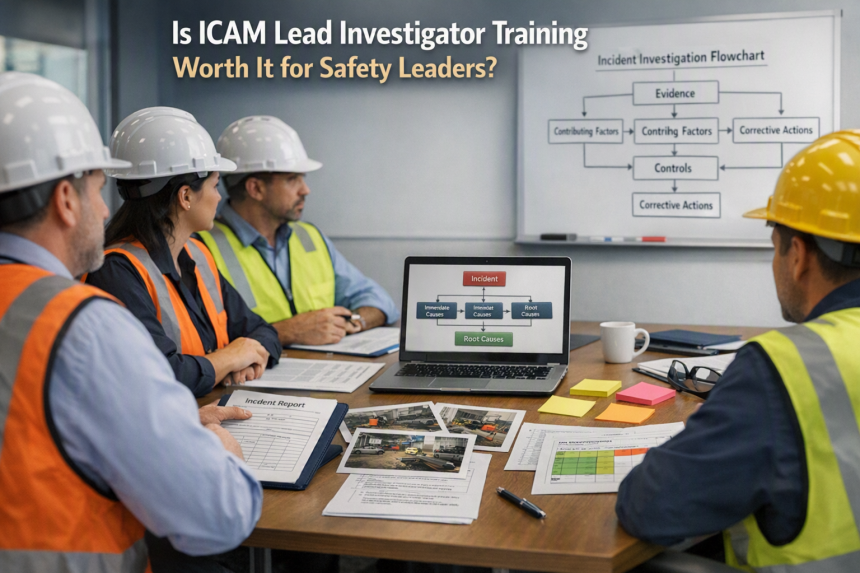
Is ICAM Lead Investigator Training Worth It for Safety Leaders?

Lynn Martelli
Lynn Martelli

A workplace incident can look simple from the outside. Someone made a mistake, a process failed, equipment broke, or a supervisor missed something. But safety leaders know the uncomfortable truth: serious incidents are rarely caused by one thing.

They are usually the result of several small gaps lining up at the wrong time.

That is why incident investigation training matters. Not because it helps your organisation write a better report, but because it helps you understand what really happened, why it happened, and what needs to change to mitigate the risk of recurrence.

For safety leaders, the question is not just whether ICAM Lead Investigator Training is useful. The better question is whether it helps you make better decisions when the pressure is high, the facts are unclear, and people are looking for answers.

In this article, you will learn what ICAM Lead Investigator Training involves, who it suits, where it adds value, and when it may not be necessary.

Table of contents

  • What is ICAM Lead Investigator Training?
  • Why safety leaders need more than basic investigation skills
  • What makes ICAM different from a standard incident review?
  • Key benefits for safety leaders
  • When ICAM training is worth the investment
  • When it may not be the right fit
  • How to decide whether your team needs it
  • Final thoughts for safety leaders

What is ICAM Lead Investigator Training?

ICAM stands for Incident Cause Analysis Method. It is a structured investigation approach used to identify not only what went wrong, but the broader contributing factors behind an incident.

Rather than stopping at the immediate cause, ICAM encourages investigators to look at areas such as:

  • Task conditions
  • Individual and team actions
  • Workplace environment
  • Organisational systems
  • Communication gaps
  • Training and supervision
  • Risk controls
  • Management decisions

This is important because many workplace investigations fall into the trap of blaming the person closest to the incident. That might feel neat and quick, but it rarely leads to meaningful mitigation of risk.

For safety professionals who are expected to lead complex investigations, an ICAM lead investigator course can provide a more structured way to plan interviews, collect evidence, analyse causes, and recommend corrective actions.

The Health and Safety Executive also notes that effective investigations help organisations understand what went wrong and identify risks they can avoid in future. In other words, the value is not just in explaining the past. It is mitigating the risk of repeat harm.

Why safety leaders need more than basic investigation skills

Basic incident reporting usually answers simple questions:

Basic incident report

Strong incident investigation

What happened?

Why did it happen?

Who was involved?

What conditions influenced their decisions?

What rule was broken?

Why did the control fail?

What action was taken?

Will the action actually mitigate the risk of recurrence?

Is the form complete?

Has the organisation learned something useful?

For minor incidents, a simple report may be enough. But for serious injuries, high-potential near misses, repeated failures, or regulator-sensitive events, safety leaders need stronger investigation capability.

Safe Work Australia explains that notifiable incidents include serious injuries, illnesses, deaths and dangerous incidents, and that notification helps identify causes and mitigate the risk of similar events in other workplaces.

That is where formal ICAM investigation training can be useful. It gives safety leaders a common framework for moving beyond surface-level fixes and into deeper system learning.

What makes ICAM different from a standard incident review?

A standard review often focuses on the most visible failure. For example:

  • The worker did not follow procedure
  • A guard was missing
  • A vehicle entered the wrong zone
  • A permit was incomplete
  • A contractor misunderstood the task

Those details matter, but they are only part of the story.

ICAM asks a broader set of questions:

  • Was the procedure practical in real working conditions?
  • Did workers receive the right training and supervision?
  • Were production pressures influencing shortcuts?
  • Was the risk assessment current?
  • Were previous warning signs missed?
  • Did leadership decisions shape the conditions on the day?
  • Were controls designed well, or were people expected to compensate for weak systems?

This matters because corrective actions are only useful if they address the real cause. If the investigation simply says “retrain the worker”, but the actual issue is poor job design, unclear supervision, fatigue, or weak contractor management, the same incident can happen again.

The UK Health and Safety Executive’s human factors guidance makes a similar point: investigations should consider why human failures occurred, and finding underlying causes is key to mitigating similar accidents.

Key benefits for safety leaders

ICAM Lead Investigator Training can be worthwhile when safety leaders need to improve the quality, consistency and credibility of incident investigations.

1. It creates a consistent investigation process

When every supervisor or manager investigates incidents differently, the quality of findings can vary widely.

One report may focus on behaviour. Another may focus on equipment. Another may miss organisational factors completely.

ICAM gives teams a shared structure, which helps improve:

  • Evidence collection
  • Interview planning
  • Timeline development
  • Cause analysis
  • Report writing
  • Corrective action quality
  • Leadership review

This consistency is especially useful in larger organisations where multiple sites, departments or contractors are involved.

2. It helps reduce blame-based thinking

Blame is one of the biggest barriers to a good investigation.

When people feel they are being blamed, they become defensive. They may withhold information, minimise details, or avoid reporting near misses altogether.

A structured investigation method helps shift the conversation from “Who caused this?” to “What made this possible?”

That change matters. It helps build trust and makes it easier to uncover weak signals before they become serious incidents.

3. It improves corrective actions

Poor investigations often produce weak corrective actions, such as:

  • Remind staff of the procedure
  • Conduct refresher training
  • Reissue the safety alert
  • Tell workers to take more care
  • Update the form

These actions may have a place, but they are often too shallow on their own.

A stronger investigation looks for actions that improve the system, such as:

  • Redesigning a task
  • Improving isolation controls
  • Changing supervision arrangements
  • Updating contractor onboarding
  • Fixing confusing procedures
  • Improving fatigue management
  • Reviewing equipment suitability
  • Strengthening leadership accountability

For safety leaders, this is where ICAM can deliver real value. Better investigations lead to better controls, and better controls reduce repeat risk.

4. It supports better communication with leaders and regulators

After a serious incident, senior leaders want clear answers. Regulators may also ask for evidence that the organisation understood the event and took suitable action.

A well-structured ICAM investigation can help safety leaders explain:

  • What happened
  • What evidence was considered
  • What contributing factors were identified
  • What controls failed or were missing
  • What actions have been recommended
  • How those actions will be tracked

This makes the investigation more credible and easier to defend.

5. It builds confidence in difficult conversations

Incident investigations are not just technical exercises. They involve people.

Safety leaders may need to interview injured workers, supervisors, contractors, witnesses and managers. They may need to ask uncomfortable questions without making people feel attacked.

Training can help investigators become more confident in:

  • Asking open questions
  • Managing emotional conversations
  • Separating facts from assumptions
  • Avoiding leading questions
  • Handling conflicting accounts
  • Keeping the investigation fair and objective

These skills are often overlooked, but they can make or break the quality of an investigation.

When ICAM training is worth the investment

ICAM Lead Investigator Training is likely to be worth it if your role involves leading or reviewing serious workplace investigations.

It is especially useful for:

Role or situation

Why ICAM can help

Safety managers

Provides a structured method for complex investigations

HSE advisors

Improves evidence collection and cause analysis

Operations leaders

Helps connect safety events to real work conditions

Site supervisors

Builds confidence in early investigation steps

Contractor managers

Supports clearer investigation of multi-party incidents

High-risk industries

Helps manage events with serious potential consequences

Organisations with repeat incidents

Identifies deeper system issues behind recurring events

It can also be valuable when an organisation has technically completed investigations but keeps seeing the same types of incidents happen again.

That is often a sign that investigations are finding symptoms, not causes.

When it may not be the right fit

ICAM training is useful, but it is not always necessary for every worker or every organisation.

It may be more than you need if:

  • Your role only involves reporting minor hazards
  • You do not lead or participate in investigations
  • Your workplace has very low operational risk
  • You only need a basic awareness of incident reporting
  • Your organisation already has trained lead investigators available

In those cases, a shorter awareness course or internal reporting process may be enough.

It is also worth remembering that training alone will not fix poor safety culture. If leaders ignore findings, delay corrective actions, or punish people for speaking honestly, even the best investigation method will struggle.

ICAM works best when it sits inside a mature safety system where leaders are willing to learn from uncomfortable findings.

How to decide whether your team needs it

Before investing in ICAM Lead Investigator Training, safety leaders should ask a few practical questions.

Ask these questions first

  • Are your incident reports identifying repeat causes?
  • Do your corrective actions actually reduce recurrence?
  • Are investigations too focused on worker behaviour?
  • Do supervisors feel confident interviewing witnesses?
  • Are serious near misses investigated properly?
  • Do leaders trust the quality of investigation findings?
  • Are actions tracked through to completion?
  • Does your organisation learn across sites or teams?

If the answer to several of these questions is “no”, then ICAM training may be a strong investment.

Look for signs your current process is too shallow

Your investigation process may need improvement if reports often include phrases like:

  • “Worker failed to follow procedure”
  • “Lack of awareness”
  • “Human error”
  • “Complacency”
  • “Take more care”
  • “Retraining required”

These phrases are not always wrong, but they are rarely enough.

A strong safety leader asks, “What made that error more likely?” That question is where better learning begins.

Final thoughts for safety leaders

So, is ICAM Lead Investigator Training worth it?

For safety leaders involved in serious incidents, high-potential near misses, complex operations or repeated failures, the answer is usually yes.

The value is not just in learning a new investigation model. The real value is in building the discipline to look deeper, ask better questions, and recommend actions that change the conditions behind incidents.

A good investigation does more than explain what went wrong. It helps your organisation become harder to hurt.

That is why ICAM training can be a worthwhile step for safety leaders who want to move from compliance-based reporting to genuine organisational learning.

Share This Article