Reed Harradine is a collegiate football specialist currently playing for the University of Southern Mississippi while pursuing a Bachelor of Science in Accounting and Finance. Reed Harradine serves as the first-string kicker and kickoff specialist for the Golden Eagles and previously competed at Grambling State University as both a kicker and punter. His path to football began in competitive soccer, where he developed as a goalkeeper through elite programs such as the Olympic Development Program and the Elite Competitive National League before helping Mountain Brook High School win a state championship. At age 14 he began training in football under Coach Mike McCabe at the nationally recognized One On One Kicking program, where he developed the technical foundation for punting and placekicking. Harradine continues to refine these specialist skills while mentoring younger athletes and preparing for future opportunities in football.
Techniques of Receiving a Snap, Dropping, and Punting
According to former Oakland Raiders’ standout Ray Guy, a successful punt on the gridiron starts with proper positioning on the field. With experienced pro and collegiate snappers, this involves the punter setting up about 15 yards behind the line of scrimmage, maximizing distance from oncoming rushers. At the high school level, punters typically shorten this to around 12 yards, to be safe, as accuracy and length are issues.
The proper setup position is with the punting foot directly lined up behind either the ball or with the middle of the snapping center’s backside. It’s best to stay balanced, loose, and relaxed, as one wants to keep options open when adapting to a snap errantly high, low, or off-line. The body leans slightly forward, knees flexed, arms by the sides, anticipating movement in a forward direction.
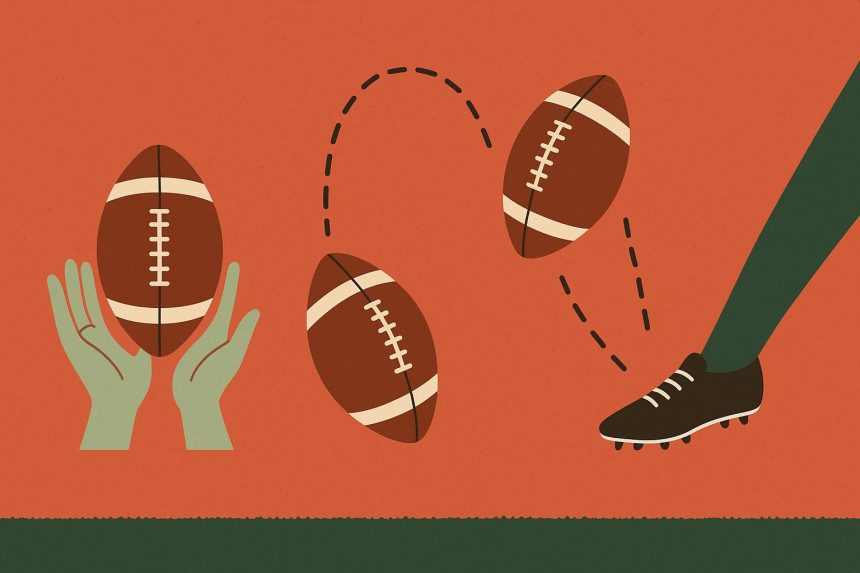
As the ball is snapped, the punter leans to meet the ball, outstretched arms, and keeping gaze on the ball as he catches it. At this point, he identifies the ball position by its laces, adjusts the laces to an upward orientation (molding), and readies himself for the kick.
The drop involves the punter dropping the properly aligned ball on the foot. As it descends, it stays in the same position, with the front of the ball angled inward, laces pointing toward the shoulder’s outside edge. The ball meets the foot, which is arcing upward in the opposite direction, at just the right height and angle.
Consistency in the drop is extremely important, and typically occurs just as the punter is making his second step forward, gaining momentum for the third step that yields an upward kicking motion and ball contact.
One distinct type of kick in the pro punter’s arsenal is the coffin corner punt. This is driven at a relatively low trajectory, with minimal hang time, toward either corner. The aim is to send the ball out of bounds at around the five-yard line. Effectively, it pins the receiving team back near their own end zone, with nearly the full field to traverse for a touchdown.
In order to accomplish such a kick, the punter, on his approach, holds the ball just a little lower and longer than usual, leading up to drop and kick. In certain cases, the punter is too far away to accomplish an out-of-bounds punt. He aims at landing the ball in bounds, where it will (hopefully) bounce and roll off the field before the opposing team can field it.
In recent years, coffin corner punts have become less common, reflecting a taller and more athletic blocker, capable of reaching the low-trajectory kick. That said, it’s on display in mission-critical moments: in the recent Super Bowl LX, Seattle Seahawks’ punter Michael Dickson expertly employed such a 40-yard punt in pinning the New England Patriots down on their two-yard line.
Another challenging punt is when kicking out of the end zone. Here, the punter is initially positioned near the endline and could inadvertently move his foot back, adjusting to the snap, and be ruled out of bounds.
To compensate, the punter shortens his distance from the snapper: when the line of scrimmage is within the five-yard line, the oncoming rush will be coming from a shorter-than-usual distance. With a shortened approach, his steps cover less distance, while still achieving a rhythmic, fast, stepping pattern and proper get-off time for a long, clean punt.
About Reed Harradine
Reed Harradine is a collegiate football kicker and kickoff specialist for the University of Southern Mississippi, where he studies accounting and finance. He previously competed at Grambling State University as a kicker and punter and is a member of the National Society of Leadership and Success. Originally a competitive soccer goalkeeper, Harradine transitioned to football at age 14 and trains with the nationally recognized One On One Kicking program. He also mentors young specialists in Birmingham, Alabama.

Lynn Martelli is an editor at Readability. She received her MFA in Creative Writing from Antioch University and has worked as an editor for over 10 years. Lynn has edited a wide variety of books, including fiction, non-fiction, memoirs, and more. In her free time, Lynn enjoys reading, writing, and spending time with her family and friends.