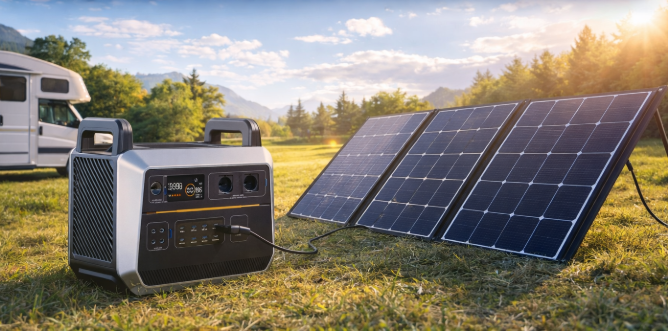
With the rise of camping, RV travel, and home backup power needs, portable power stations are becoming increasingly popular. Solar charging adds even more flexibility to these devices. As long as there’s sunlight, you can recharge your power station outdoors without relying entirely on the grid or wall outlets.
Compared to traditional generators, solar charging is quiet, clean, and low-maintenance, making it ideal for outdoor activities and emergency power. More and more users now pair their portable power stations with solar panels for a more stable and sustainable power supply.
1. What You Need for Solar Charging
A basic solar charging system usually consists of three parts: a solar panel, a portable power station, and the connecting cables.
The solar panel converts sunlight into electricity and stores it in the power station. Most modern power stations feature MPPT (Maximum Power Point Tracking), essentially an “intelligent manager” that maximizes charging efficiency and minimizes wasted sunlight.
When connecting, pay attention to two things: the compatibility of connectors and voltage matching. Most solar panels use MC4 connectors, while power stations may have XT60 or other ports. For example, the Piforz PF2000 uses an XT60 port for solar charging.
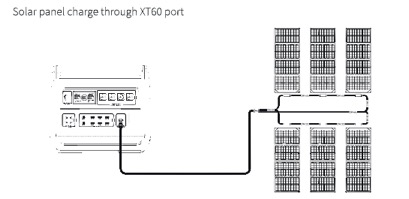
Also, make sure the solar panel is placed under direct sunlight. Shadows can drastically reduce efficiency. In short: correct connectors + sufficient sunlight = stable charging.
2. How to Set Up Solar Panels for Charging
Connecting a solar panel to a portable power station is straightforward. First, check the supported solar input voltage and maximum power of the power station to ensure the solar panel operates safely. Then, use the proper cables to connect the panel to the station.
After connecting, place the panel in a sunny location and angle it toward the sun as much as possible. Most power stations automatically detect solar input and display the current charging power on the screen. You can adjust the panel’s angle to optimize efficiency.
3. Series vs Parallel Solar Panel Setup
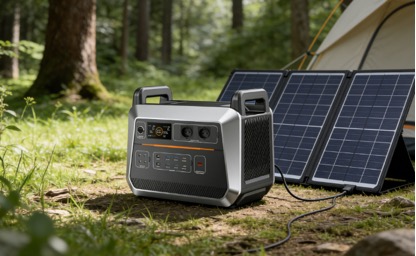
When using multiple solar panels, you can connect them in series or parallel. Series connections increase voltage, while parallel connections increase current. In practice, parallel setups are more common because they boost overall power output while maintaining stable voltage.
Regardless of the method, ensure the final voltage does not exceed the power station’s allowed input range.
4. Factors That Affect Solar Charging Speed
Solar charging speed is influenced by several factors, including sunlight intensity, panel angle, weather conditions, and the panel’s conversion efficiency. Long cables can also cause some energy loss.
As a result, real-world charging times are usually slightly longer than theoretical calculations.
5. Common Solar Charging Mistakes to Avoid
Common mistakes that reduce solar charging effectiveness include using an incompatible voltage range, choosing a panel with too low power, placing panels in the shade, or using incompatible connectors.
By understanding your device specifications and setting up the system correctly in advance, these issues can be avoided.
6. FAQ
Q1:What size solar panel do I need for a portable power station?
A: Smaller capacity power stations can pair with lower-power panels, while larger stations require higher-power solar systems.
Q2: Do solar panels need direct sunlight to charge a power station?
A:Direct sunlight is ideal for maximum efficiency, but panels can still charge on cloudy days or in partial shade, albeit at much slower speeds.
7. Conclusion
Solar charging makes portable power stations even more practical for outdoor and emergency use. By choosing the right panel wattage, connecting devices correctly, and optimizing panel placement, you can maximize charging efficiency and ensure reliable off-grid power.

Lynn Martelli is an editor at Readability. She received her MFA in Creative Writing from Antioch University and has worked as an editor for over 10 years. Lynn has edited a wide variety of books, including fiction, non-fiction, memoirs, and more. In her free time, Lynn enjoys reading, writing, and spending time with her family and friends.