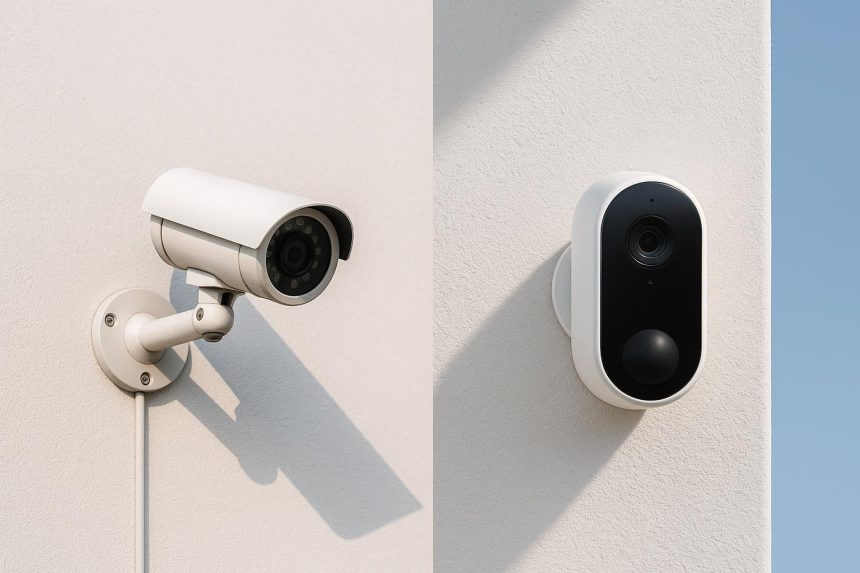
Cameras and video doorbells now lead home security adoption. Parks Associates reports that 43% of U.S. internet-enabled households own a security solution and 32% subscribe to a security service, with much of the recent growth coming from cameras and video doorbells rather than full alarm systems.
Ownership, though, is not the same as protection. A camera that records an event without responding to it leaves the response up to the homeowner, usually after the fact. Security system providers like Vivint are designing their cameras to act at the moment an issue is detected.
Where the Standard Camera Stops
Most consumer cameras follow a fixed sequence: the device registers movement, sends a notification, and waits. The homeowner opens the app, reviews the footage, and decides whether to act. The camera’s work ends at detection.
That sequence has a cost. Every alert is a judgment call: is it a threat, a delivery, a neighbor, or an animal? Cameras without person-specific detection can raise that question many times a day, and that volume of alerts trains people to stop reading the notifications with a careful eye. At the same time, the small interval between detection and a user response is a large enough window for a package to be taken or a door to be forced open.
Deterrence Requires a Consequence
Research from the University of North Carolina at Charlotte found that about 60% of convicted burglars would choose a different target after spotting signs of an alarm or surveillance. But not all systems are created equal, and a system known for recording alone doesn’t carry the same expectation as a smart system that responds immediately.
A 40-year meta-analysis in Criminology & Public Policy found that CCTV schemes paired with active monitoring led to less crime than passive recording alone. What separated the effective systems was the ability to act before an intruder reached the door, through audio, lighting, or a monitoring center alert. The same principle carries into the home: a camera that can respond in real time, with audio or lighting, acts while an incident is still unfolding, instead of only documenting it afterward. The cameras proactively respond and deter crime without needing external assistance.
Modern cameras have improved detection itself. Person detection, AI identification, and alert filtering cut false alarms and narrow notifications to events that matter, but in many cases the response to these improved detections still depends on someone seeing the alert in time. A thief stealing a package at 6 a.m. can act unimpeded if the notification sits unread while the homeowner is still asleep inside. The detection may have worked, but the response never came.
Moving the Response Back to the Device
Proactive deterrence closes that window by taking the homeowner out of it. Automated audio warnings and lighting triggers let the system respond on its own the moment someone steps onto the property. For most homes, that design matters more than camera resolution or field of view.
Vivint builds its cameras around this approach, pairing on-device detection with automated deterrence and a 24/7 monitoring center. A system that can warn, illuminate, and deter acts at the point of approach, while the outcome is still open, while a recording only describes an event that has already happened.
About Vivint
Vivint is a U.S.-based smart home security company that builds systems to act on threats rather than only record them. Its product range covers indoor, outdoor, and doorbell cameras, sensors, safety alarms, and smart home controls, managed through a single app and backed by 24/7 professional monitoring.

Lynn Martelli is an editor at Readability. She received her MFA in Creative Writing from Antioch University and has worked as an editor for over 10 years. Lynn has edited a wide variety of books, including fiction, non-fiction, memoirs, and more. In her free time, Lynn enjoys reading, writing, and spending time with her family and friends.