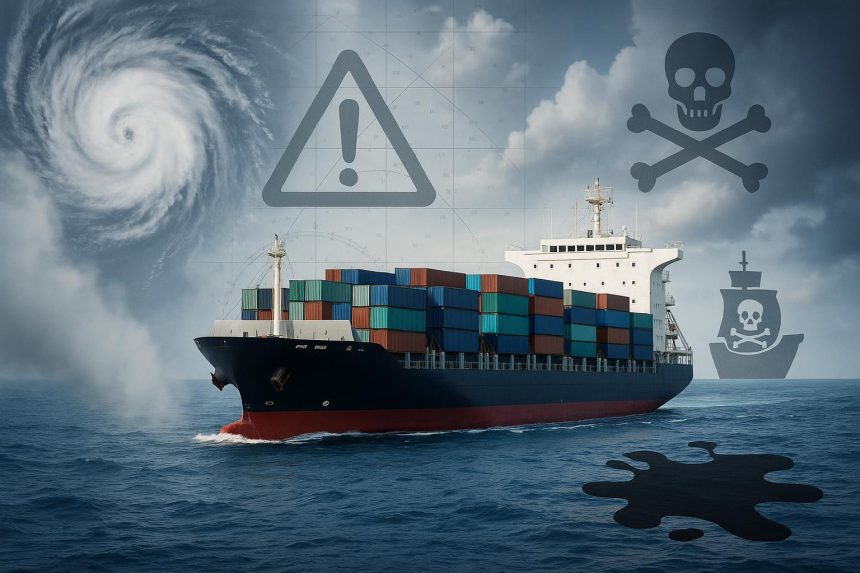
The global maritime shipping industry is the lifeblood of international trade, moving over 80% of the world’s goods by volume across narrow waterways and vast oceans on their way to ports around the globe. However, operating across vast open oceans introduces logistical and technical hurdles that terrestrial businesses rarely encounter.
Success for maritime decision-makers depends on navigating these operational pressures through meticulous planning and the strategic use of technology to maintain a link to the shore.
Operating Beyond Consistent Coverage
The most immediate challenge for any blue-water vessel is the absence of traditional infrastructure. Once a ship moves beyond the sight of land, it leaves behind the safety net of cellular towers and terrestrial fiber-optic networks. These coverage gaps create significant friction for reporting and coordination.
Simple tasks like updating a manifest or coordinating a mid-ocean transfer become complex hurdles without a stable link, leading to costly delays and administrative bottlenecks.
Safety and Incident Response
At sea, time is the most valuable commodity during an emergency. Reliable communication is the cornerstone of the Global Maritime Distress and Safety System (GMDSS) protocols.
Whether responding to a medical emergency on board or navigating a mechanical failure, timely communication ensures that shore-based support can be mobilized instantly. Negligent operators can lead to catastrophic accidents, such as the Francis Scott Key Bridge collapse. Greater operational visibility (knowing exactly where every vessel is and its current status) allows for safer, data-driven decision-making that protects both the crew and the cargo.
Monitoring and Operational Oversight
Modern fleet management is increasingly data-intensive. Companies rely on real-time monitoring to optimize fuel consumption, track engine performance, and refine routing based on current conditions.
To maintain this level of oversight beyond coastal coverage, fleets utilize satellite internet to bridge the digital divide. This connectivity enables a constant stream of telemetry data to reach headquarters, ensuring proactive – rather than reactive – asset management.
Weather Disruption and Supply Chain Uncertainty
Maritime operations are at the mercy of a volatile environment. Severe weather patterns and geopolitical disruptions can throw even the most efficient schedule into disarray. Resilience in the face of these uncertainties requires agility.
When a ship must suddenly reroute to avoid a storm or a closed port, resilient connectivity enables the immediate synchronization of new plans across the entire supply chain, mitigating the ripple effect of delays.
Cost and Reliability Planning
Maritime operators must balance the high cost of offshore technology with the need for near-perfect uptime. Reliability planning requires a scalable support structure capable of handling diverse routes and data demands.
Choosing systems that offer high availability and global support ensures that the vessel remains connected in the harshest conditions. Ultimately, planning for reliability reduces the operational surprises that can erode profit margins and damage a company’s reputation for dependability.

Lynn Martelli is an editor at Readability. She received her MFA in Creative Writing from Antioch University and has worked as an editor for over 10 years. Lynn has edited a wide variety of books, including fiction, non-fiction, memoirs, and more. In her free time, Lynn enjoys reading, writing, and spending time with her family and friends.