Expanding into global markets requires more than translating text – it requires adapting your entire customer experience to local languages, cultures, expectations, and regulatory standards. This is where localization services come into play, helping enterprises tailor their products, software, websites, marketing, and support content to international audiences while maintaining brand consistency and accuracy.
In today’s digital-first economy, localization services have become essential for SaaS companies, e-commerce brands, enterprise software providers, gaming companies, and global consumer businesses. With hundreds of vendors on the market, selecting the best option requires understanding each platform’s strengths, methods, technologies, and suitability for different project sizes and industries.
What localization services do
Localization services specialize in adapting digital products for global audiences by going beyond word-for-word translation. Their purpose is to ensure that language, tone, imagery, UI/UX, formats, and features feel native to each target market.
While providers differ in specialization, their core responsibilities generally include:
1. Linguistic Services (Translation, Editing, Transcreation)
Localization companies offer a full suite of linguistic solutions tailored to different types of content:
a) Translation
- Human translation performed by certified linguists
- Domain-specific translation (legal, medical, technical, software)
- Glossary and terminology management
- Consistent brand tone across all languages
b) Editing & Proofreading
- Grammar, syntax, and style corrections
- Ensuring accuracy, readability, and natural flow
- Removing inconsistencies and mismatches
c) Transcreation
Used for marketing, ads, landing pages, and creative campaigns.
Transcreation involves:
- Adapting creative meaning, not just words
- Rewriting slogans and marketing copy for local culture
- Ensuring emotional resonance
For example, an English slogan “Unlock Your Potential” may be transcreated into a culturally relevant version instead of being translated literally.
2. Software, App & UI Localization
Localization services make digital interfaces feel native to each target audience.
This includes:
- Localizing interface strings (menus, tooltips, button labels)
- Handling placeholders, pluralization rules, variables
- Maintaining UI constraints to prevent overflow
- Providing screenshot-based context for translators
- Localizing error messages, alerts, system prompts
Advanced providers also support continuous localization where strings update automatically via Git or API.
3. Website Localization & Multilingual SEO
Web localization goes beyond text and includes full digital adaptation:
- Translating website copy, metadata, menus, and CTAs
- Localizing SEO titles, descriptions, and schema markup
- Adapting keywords to local search intent
- Optimizing for local search engines (e.g., Yandex, Baidu, Naver)
- Adapting layout and design for RTL languages (Arabic, Hebrew)
- Managing multilingual CMS workflows
This ensures content ranks well and reads naturally.
4. Multimedia Localization (Audio, Video, Interactive Content)
Localization services also adapt multimedia assets for global users:
- Subtitles and closed captions
- Voiceover and dubbing using local voice actors
- Lip-sync and timing alignment
- Localization of on-screen text (motion graphics, animations)
- Video UI translation (in-app tutorials, onboarding videos)
This is especially important for e-learning, gaming, SaaS onboarding, and marketing video content.
5. Localization Engineering
A crucial component for SaaS, enterprise software, mobile apps, and complex platforms.
Localization engineers handle:
- Extracting and preparing translatable strings
- Managing file formats (JSON, YAML, XLIFF, PO, STRINGS, RESX, etc.)
- Creating internationalization-ready code (i18n)
- Reintegrating translated files into builds
- Fixing encoding issues and formatting bugs
- Running linguistic QA on staging environments
This ensures the localized product works properly, not just reads properly.
6. Functional & Linguistic QA (LQA/FQA)
After translation, localization providers run quality testing to ensure everything appears correctly in the final product.
QA checks include:
- Button and label text fit
- Layout issues, truncation, crashes due to long strings
- RTL alignment (e.g., Arabic)
- Broken placeholders
- Incorrect date/time/number formats
- Translation errors in context
- Style and tone consistency
QA ensures the user interface feels truly native.
7. Internationalization (i18n) Consulting
Before localization happens, experts help brands make products ready for multilingual expansion.
This includes:
- Ensuring code supports Unicode
- Separating text from code
- Preparing design layouts for flexible text
- Setting up pluralization rules
- Supporting locale formats for dates, units, currencies
- Implementing translation keys and namespaces
Many SaaS companies skip this step and end up paying much more later—good providers prevent this.
8. Continuous Localization (Automation & Dev Integration)
Modern localization services integrate directly into development workflows:
- CI/CD integration (GitHub, GitLab, Bitbucket)
- Automating string extraction
- Automatically updating translated files after every build
- Translation memory reuse across versions
- API-driven workflows for fast updates
This makes localization scalable for SaaS teams deploying weekly or daily updates.
9. Glossary, Style Guide & Terminology Management
Localization providers create and maintain key linguistic assets:
- Multilingual glossaries of approved terms
- Style guides specifying tone, formality, writing style
- Terminology databases for product names
- Brand voice guidelines
- Consistency checks across all languages
This ensures unified branding across product, marketing, and support content.
10. Localization Project Management
A major part of localization services is operational:
- Assigning translators and QA teams
- Defining workflows and review processes
- Managing timelines, budgets, and deliverables
- Coordinating engineering, design, and content teams
- Implementing change control during product updates
Project managers ensure smooth execution of complex multilingual programs.
11. Cultural Adaptation & Market Suitability Review
Localization teams evaluate whether content aligns with local expectations and norms.
They adapt:
- colors, images, and symbols
- humor, tone, and idioms
- product features and onboarding flow
- measurement units, currency, and formats
- content for cultural sensitivity or legal restrictions
This avoids embarrassing mistakes and builds trust with customers.
12. Compliance & Regulatory Localization
This includes adapting content to meet legal requirements in each region:
- GDPR, CCPA, LGPD compliance messaging
- Consumer rights disclosures
- Age rating adjustments in gaming
- Medical/clinical content compliance
- Financial disclosure standards
- E-learning accessibility (WCAG)
Enterprise-level localization is often impossible without compliance expertise.
Key benefits
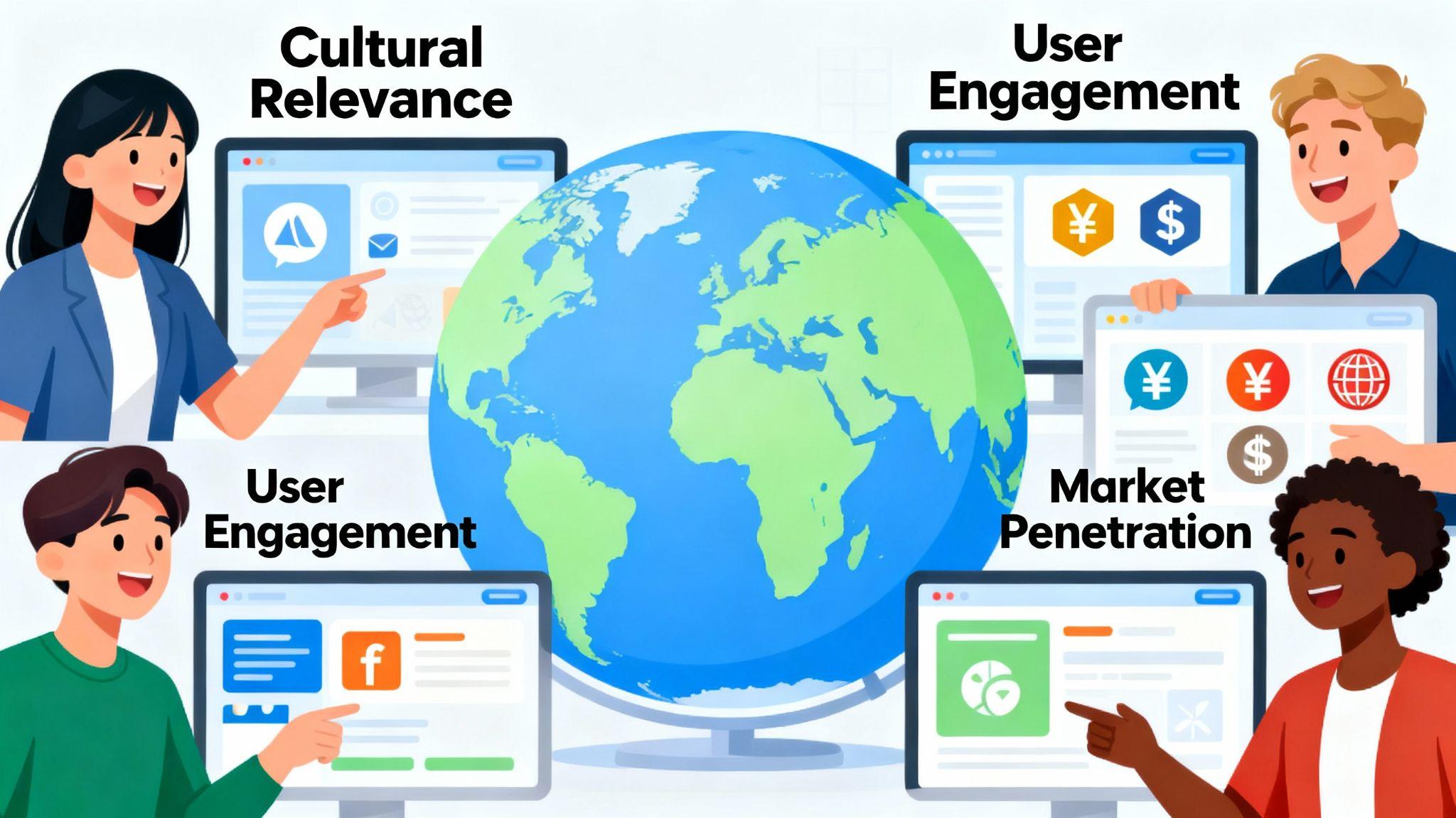
Choosing a reliable localization partner provides organizations – especially enterprise brands – with a wide range of measurable advantages:
1. Increased Global Reach
Localized content significantly boosts engagement, conversions, and user adoption in new markets.
2. Better User Experience
Users prefer products that feel native to their culture, language, and expectations.
3. Faster Market Entry
Localization providers streamline translation, QA, workflows, and engineering tasks, enabling brands to launch internationally much faster.
4. Brand Consistency Across Cultures
Style guides, glossaries, and centralized workflows ensure a cohesive brand voice worldwide.
5. Compliance & Market-Specific Requirements
Localization experts help companies comply with:
- local consumer laws
- data privacy standards
- content regulations
- accessibility guidelines
6. Higher Conversion Rates
Localized landing pages, product descriptions, and checkout flows perform better than generic translations.
7. Scalability for SaaS and Enterprise
Modern providers automate translation workflows, integrate with code repositories, and support dozens of file formats.
Localization isn’t just a translation cost – it’s a growth engine that impacts revenue, UX, market share, and long-term competitiveness.
What is localization and its services with examples?
Localization is the process of adapting digital products and content for specific countries or linguistic regions so they feel native to local users. It goes beyond translation by modifying elements such as format, culture, legal requirements, tone, and even functionality.
Here are examples across industries:
Website Localization Example
A U.S. e-commerce brand expands into Germany:
- Product descriptions are translated
- Prices are displayed in EUR
- Measurements change from inches to centimeters
- Legal compliance text is added
- Local payment methods (SOFORT, Giropay, PayPal DE) are integrated
- German SEO keywords are applied
Software Localization Example
A SaaS tool launches in Brazil:
- UI strings are adapted to Brazilian Portuguese
- Button text is shortened so it fits UI constraints
- Customer support scripts are localized
- Local date formats (DD/MM/YYYY) are applied
Mobile App Localization Example
A fitness app enters Japan:
- UI characters are adapted to Kanji/Katakana
- Illustrations and colors are adjusted to cultural expectations
- Voice-over instructions are recorded by Japanese speakers
- Social sharing features integrate with LINE
Marketing Localization Example
A global ad campaign is adapted for France:
- Headlines are recreated to match local humor and creativity
- Cultural references are swapped for relevant equivalents
- CTA wording is adjusted for tone and politeness norms
The 10 Best Localization Services
Below is a curated list of the top localization platforms and agencies trusted by enterprise teams, SaaS companies, and global brands.
Each service has distinct strengths – some specialize in workflow automation, others excel in human translation, multimedia, or software engineering.
1. Crowdin
Crowdin is one of the leading cloud-based localization platforms – ideal for SaaS, mobile apps, websites, and continuous localization workflows.
Best for: Tech companies and enterprises scaling to 10–100+ languages.
Key features:
- API-first architecture
- Integration with GitHub, GitLab, Bitbucket
- Figma and design localization
- AI translation + human review
- Version control for localization projects
- Enterprise automation workflows
2. TransPerfect
One of the largest localization agencies worldwide.
Best for: Enterprise organizations needing full-service, human-first localization.
Strengths:
- 10,000+ linguists
- Multimedia, legal, and compliance localization
- Interpretation, e-discovery, and translation
3. Lionbridge
Well-known for language AI, enterprise translation, and software localization.
Best for: Global brands requiring scale and accuracy.
Highlights:
- AI-enhanced translation
- Software QA
- Managed localization teams
4. RWS (SDL Trados)
A major player in enterprise translation and CAT (computer-assisted translation) tools.
Best for: Large-scale documentation and website localization.
Capabilities:
- Trados Studio CAT tool
- Linguistic asset management
- Neural machine translation
5. Lokalise
A modern localization management platform built for tech teams.
Best for: SaaS companies and app developers.
Features:
- Automation rules
- Integration with code repositories
- Collaborative online editors
6. Smartling
A cloud-based localization platform with strong creative translation and automation.
Best for: Marketing teams and global consumer brands.
Benefits:
- AI + human linguists
- Glossary and style guide support
- Workflow automation
7. Phrase (formerly PhraseApp)
A flexible localization platform with excellent developer tools.
Ideal for: Tech companies with complex JSON/YAML workflows.
Highlights:
- String context screenshots
- API and CLI tools
- Machine translation engines
8. Gengo (by Lionbridge)
Crowd-based translation marketplace.
Best for: Fast, affordable translations.
Use cases:
- Product descriptions
- Social media
- User reviews
9. Tomedes
A global translation agency known for personalized service.
Best for: Mid-sized businesses and custom projects.
Strengths:
- 24/7 live service
- Business documents
- Video localization
10. MotionPoint
Specializes in website localization and automated content replacement.
Best for: Large websites needing continuous updates.
Advantages:
- Proxy-based website translation
- Automated content detection
- Fast multilingual site rollout
How much does localization typically cost?
Localization pricing depends on multiple variables:
- language pairs
- content type
- complexity
- industry specificity
- urgency
volume
Translation cost (per word):
- Standard translation: $0.08–$0.15/word
- Technical or software translation: $0.15–$0.30/word
- Transcreation: $0.25–$0.60/word
Software & app localization:
- $30–$90/hour for engineering
- $2,000–$25,000+ per project
Website localization:
- $3,000–$50,000+ depending on size
Multimedia localization:
- Subtitles: $5–$12 per minute
- Voiceover: $50–$300 per finished minute
Localization platforms (SaaS):
- $50–$400/month for SMB plans
- $1,000–$50,000/year for Enterprise
Costs vary widely depending on whether you choose a platform-only solution, human translation, or a fully managed enterprise service.
FAQs about localization services
1. What is the difference between translation and localization?
Translation focuses on words and sentences.
Localization adapts the entire experience – language, images, UI, formats, tone, legal requirements, and cultural norms.
2. Which industries need localization?
- SaaS & technology
- E-commerce
- Gaming
- Media & streaming
- Finance
- Healthcare
- Manufacturing
- Hospitality
- Education
Any business operating across borders benefits from localization.
3. How long does localization take?
Timeline depends on project scope:
- Simple website: 1–3 weeks
- App or SaaS platform: 1–3 months
- Full enterprise expansion: ongoing
Modern platforms (e.g., Crowdin, Lokalise) accelerate timelines significantly.
4. Do I need a localization platform or an agency?
Choose a platform if you want automation, developer tools, and integration with your code.
Choose an agency if you need human translation, creative adaptation, or complex multimedia.
Most enterprises use both.
5. How do I choose the best localization service?
Focus on:
- supported file formats
- integrations
- translation quality
- automation workflows
- scalability
- cost
- industry specialization
For tech products, choose a platform like Crowdin, Lokalise, or Phrase.
For enterprise-scale translation, choose TransPerfect, Lionbridge, or RWS.
6. Is AI translation good enough?
AI translation is extremely helpful for:
- first drafts
- internal content
- repetitive UI strings
But human review is essential for:
- marketing
- high-stakes UI flows
- compliance
- legal documents
- creative content
Final Thoughts
If your company plans to expand globally in 2026 and beyond, investing in the right localization service is essential. Whether you're a fast-growing SaaS startup or a large enterprise, the ten localization platforms and agencies listed above offer the tools and expertise necessary to unlock international growth, improve user experience, and enter new markets successfully.

Lynn Martelli is an editor at Readability. She received her MFA in Creative Writing from Antioch University and has worked as an editor for over 10 years. Lynn has edited a wide variety of books, including fiction, non-fiction, memoirs, and more. In her free time, Lynn enjoys reading, writing, and spending time with her family and friends.