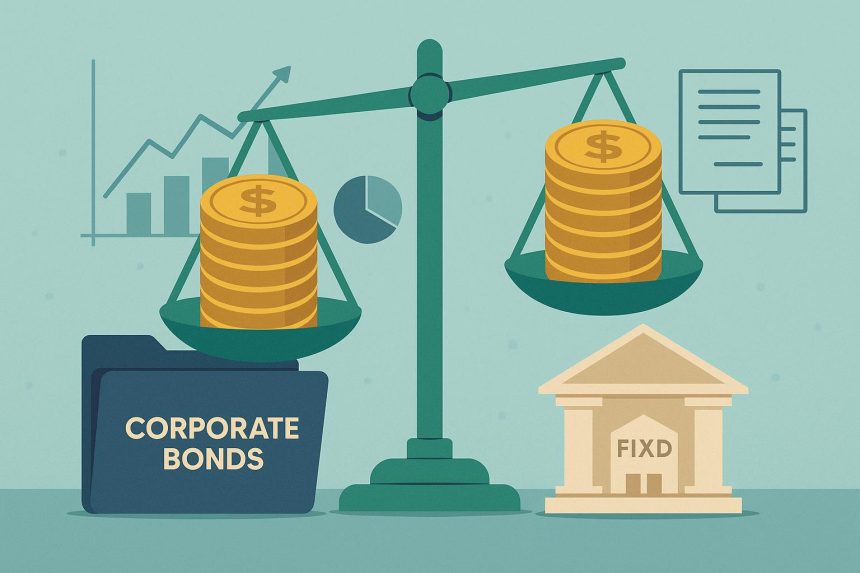
When people think “long term”, they often imagine a straight road—steady income, predictable growth, fewer surprises. That’s exactly why two options keep coming up in Indian households: Fixed Deposits (FDs) and Bonds (Corporate Bonds).
Both are usually considered relatively stable than equities. But they’re structured differently. An FD is a promise from a bank/NBFC. A corporate bond is a loan you give a company. The experience, the risks, the liquidity, and even the tax impact—everything changes based on which one you pick.
If you’re trying to decide between corporate bonds vs fixed deposits, here’s a simple way to look at it.
How Do Fixed Deposits (FDs) Actually Work?
An FD is as straightforward as it gets. You invest a lump sum for a fixed tenure, and the bank/NBFC pays you a pre-decided interest rate. You don’t worry about market movement, interest-rate cycles, or daily price changes.
In simple terms:
You lend money → the bank/NBFC pays you interest → on maturity, you get principal + interest.
That’s why FDs are popular: you know what you’re signing up for on Day 1.
What Are Corporate Bonds?
Corporate bonds are how companies borrow money from investors (including retail). When you buy a bond, you’re lending money to the issuer company. In return, the company pays periodic interest (often called the coupon) and repays the principal on maturity.
Now here’s the part that feels different from an FD: listed bonds can be traded, so their price can move up or down based on interest rates, demand/supply, and the issuer’s perceived financial strength.
Corporate Bonds vs Fixed Deposits: How Do They Compare?
1) Returns: The First Big Difference
FDs:
FD returns are locked in. Predictable. No drama. But in most cycles, the upside tends to be limited. We’re in a falling interest rate cycle and in such scenarios, typically, FDs are the first ones to taka a interest rate hit.
Corporate bonds:
Corporate bonds often offer higher yields than FDs because the borrower is a company (not a bank deposit product), and you’re taking a credit risk. Over a long horizon, that higher rate can matter—especially for investors who care about steady cashflows.
2) Risk: What Can Actually Go Wrong?
FDs:
For bank FDs, a strong comfort point is deposit insurance. Under DICGC, deposits are insured up to ₹5 lakh per depositor per bank (including principal + interest). DICGC+1
Important nuance: NBFC FDs are not covered by DICGC. Ujjivan SFB
The bigger “silent risk” with any FD is inflation. If inflation stays higher than your FD rate for long periods, your money grows, but your purchasing power may not.
Corporate bonds:
Two risks matter most:
- Credit/Default risk: the company may delay or miss interest/principal payments. Credit ratings help you gauge this, but they’re not guarantees. Investors must check all parameters before investing in a corporate bond.
- Interest-rate/market risk: if interest rates rise, existing bond prices can fall (especially if you plan to sell before maturity).
So yes—bonds can be relatively stable compared to equities, but they’re not the same kind of stable as a fixed deposit.
3) Liquidity: How Easily Can You Exit?
FDs:
You can break an FD early, but usually with a penalty (reduced interest or charges).
Corporate bonds:
Listed bonds can be sold on an exchange, which can be useful if you need liquidity. But liquidity varies—some bonds trade actively, others don’t. In a stressed market, even good issuers can see lower liquidity.
4) Taxes: Where Long-Term Investors Should Pay Attention
FDs:
FD interest is added to your income and taxed as per your slab. On TDS, the thresholds have been revised in recent years; for FY 2025–26, multiple sources reflect the higher TDS threshold being applied (commonly cited as ₹50,000 for non-seniors and ₹1,00,000 for seniors for bank FD interest). Ujjivan SFB+2cleartax+2
(You still declare interest income in ITR even if no TDS is deducted.)
Corporate bonds:
- Interest income is typically taxed like regular income (similar to FD interest).
- Capital gains apply if you sell the bond in the market. Holding-period rules were simplified from 23 July 2024—listed securities generally use a 1-year long-term holding threshold. Press Information Bureau+1
Exact tax treatment can depend on the instrument category and how the transaction is structured, so it’s safer to keep this section principle-based rather than quote one “universal” rate. It is always recommended to check with your CA/tax advisor before investing and taking a decision based on your tax slab.
Key Differences
| Feature | Corporate Bonds | Fixed Deposits |
|---|---|---|
| Returns | Often higher, varies by issuer/rating/tenor | Fixed and predictable |
| Risk | Credit risk + market/interest-rate risk; higher rated bonds (AAA) have seen zero default in last few years as per a recent CRISIL report | Lower volatility; bank deposits insured up to ₹5 lakh per depositor per bank DICGC |
| Liquidity | Can sell listed bonds (liquidity varies) | Early withdrawal possible with penalty |
| Tax | Interest taxed as slab; capital gains may apply on sale Press Information Bureau | Interest taxed as slab; TDS thresholds apply Income Tax India |
| Issuer | Companies | Banks / NBFCs |
So, What Should a Long-Term Investor Choose?
This usually comes down to a very personal preference, temperament and an investor’s appetite.
FDs may suit you if:
- You want predictability and minimal moving parts.
- You don’t want to track issuer health or market prices.
- You’re building a stable “base” bucket for future expenses or just starting out.
Corporate bonds may suit you if:
- You’re comfortable taking measured credit risk for potentially better returns.
- You’re willing to check basics like issuer profile, rating, and maturity.
A Balanced Approach (What Many Investors Actually Do)
In reality, a lot of experienced investors don’t treat this as a boxing match. They combine both.
- FDs can act like the steady foundation—simple, familiar, low-noise.
- High-quality corporate bonds can add a return boost—without forcing you into equity-like volatility.
The trick is not to chase the highest number on the screen. In fixed income, discipline often beats excitement.

Lynn Martelli is an editor at Readability. She received her MFA in Creative Writing from Antioch University and has worked as an editor for over 10 years. Lynn has edited a wide variety of books, including fiction, non-fiction, memoirs, and more. In her free time, Lynn enjoys reading, writing, and spending time with her family and friends.