Modern businesses operate in a world where communication is constant, immediate, and fragmented. Customers move effortlessly between apps, websites, inboxes, physical locations, and support channels, often within the same hour. From the outside, these interactions feel fluid. From the inside, many organizations struggle to keep pace.
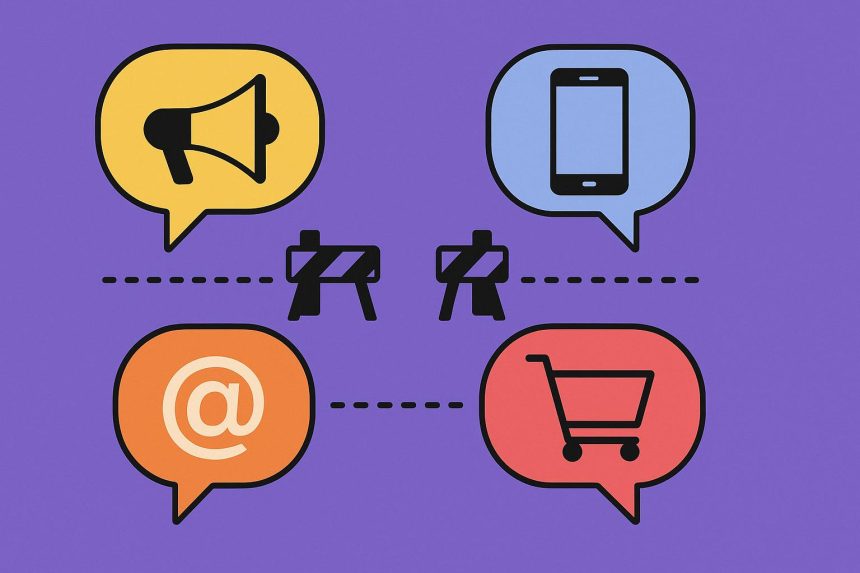
What often breaks down is not technology itself, but coordination. Marketing channels exist, campaigns run on schedule, and data is collected in abundance. Yet customers still experience brands as disjointed or inconsistent. The problem is rarely a lack of effort. It is that the channels are no longer talking to each other.
The Illusion of Being Everywhere at Once
Most businesses today operate across multiple platforms by default. Email, social media, paid ads, content marketing, customer support tools, and in-store experiences all serve a purpose. On paper, this looks like comprehensive coverage. In practice, it can become a collection of parallel efforts rather than a cohesive system.
Teams are often structured around channels rather than outcomes. One group manages social media, another oversees email, while sales and support operate in separate systems entirely. Each team optimizes for its own metrics, sometimes without visibility into what the others are doing. The result is activity without alignment.
How Fragmentation Shows Up for Customers
From a customer perspective, fragmented marketing feels subtle but frustrating. A promotion referenced in an email may not exist on the website. Support agents may lack context from recent campaigns. Messaging can shift tone depending on the channel, creating confusion about what a brand actually stands for.
These inconsistencies erode trust over time. Customers do not expect perfection, but they do expect coherence. When brands fail to recognize prior interactions or repeat information unnecessarily, it signals disorganization. In competitive markets, that perception alone can drive people elsewhere.
The Difference Between Presence and Connection
Being present across channels is not the same as being connected. Many organizations confuse volume with effectiveness, assuming that more touchpoints automatically create stronger engagement. In reality, disconnected touchpoints often dilute impact rather than strengthen it.
A connected strategy requires shared context. Information gathered in one place should inform actions elsewhere. This is where the distinction between multichannel activity and an omnichannel marketing approach becomes meaningful. One focuses on reach, the other on continuity.
Why Internal Silos Persist
Despite widespread awareness of these issues, silos remain common. One reason is organizational complexity. As companies grow, systems multiply. Tools are added to solve specific problems, not always with integration in mind. Over time, the stack becomes difficult to unify.
Another factor is incentive structure. Teams are rewarded based on channel-specific performance rather than shared outcomes. Without aligned goals, collaboration becomes optional instead of essential. Even when data is technically accessible, it may not be actively shared or interpreted collectively.
The Role of Data Without Context
Modern businesses collect enormous amounts of customer data. Clicks, views, purchases, support tickets, and engagement metrics are tracked continuously. Yet data alone does not guarantee insight. Without context, it can reinforce fragmentation rather than resolve it.
When each channel interprets data in isolation, patterns are missed. A behavior that seems insignificant in one system may be critical when viewed across the full customer journey. Alignment requires not just shared dashboards, but shared understanding of what the data represents.
Customer Experience as an Operational Outcome
Customer experience is often discussed as a brand or marketing concept, but it is fundamentally operational. The experience customers have is shaped by how well systems, teams, and processes communicate internally. External clarity depends on internal coherence.
Organizations that prioritize connected experiences tend to invest in workflows that span departments. This does not mean every team uses the same tool, but that systems are designed to exchange information meaningfully. The goal is continuity, not uniformity.
When Messaging Drifts From Reality
One of the most damaging effects of disconnected channels is message drift. Marketing promises one thing, while operational realities deliver another. This gap is rarely intentional, but it becomes costly when left unaddressed.
Customers are quick to notice when a brand’s messaging does not match their experience. Over time, this disconnect undermines credibility. Trust is built not through clever campaigns, but through consistency across every interaction, expected or otherwise.
Reframing Channels as Shared Touchpoints
A more sustainable approach treats channels as shared touchpoints rather than isolated assets. Each interaction contributes to an ongoing relationship, not a standalone conversion opportunity. This shift changes how success is measured.
Instead of asking whether a campaign performed well in one channel, teams begin asking whether the overall experience moved the relationship forward. This perspective encourages collaboration and reduces redundant or conflicting efforts.
The Cost of Delayed Alignment
When alignment is postponed, inefficiencies compound. Teams duplicate work, customers receive mixed signals, and opportunities to deepen engagement are missed. Over time, these costs exceed the investment required to improve coordination.
More importantly, delayed alignment affects adaptability. Businesses that lack connected systems struggle to respond quickly to changes in customer behavior or market conditions. Agility depends on visibility, and visibility depends on integration.
Building Toward Coherence
Achieving coherence does not require a complete overhaul overnight. Many organizations make progress by starting small. Identifying a few critical customer journeys and ensuring continuity across them can yield immediate improvements.
Leadership plays a key role in this process. When alignment is treated as a strategic priority rather than a technical challenge, teams are more likely to collaborate. Clear expectations around shared ownership of the customer experience help break down long-standing silos.
Technology as an Enabler, Not a Fix
While technology is essential, it is not a solution on its own. Tools can support integration, but they cannot replace communication or shared intent. Without cultural alignment, even the most advanced platforms fail to deliver cohesion.
Successful organizations view technology as an enabler of better decisions, not a shortcut. They invest in systems that support transparency and accountability across teams, while remaining flexible enough to evolve.
A Shift in How Success Is Defined
Ultimately, resolving disconnected marketing requires a shift in how success is defined. Short-term channel metrics must be balanced against long-term relationship health. This does not mean abandoning performance measurement, but contextualizing it.
When teams understand how their work contributes to a larger narrative, alignment becomes more natural. Channels begin to support one another instead of competing for attention or resources.
Moving Forward With Intent
Marketing channels stop talking to each other when organizations grow faster than their internal coordination. Reversing that trend requires intention, not perfection. Small steps toward shared understanding can significantly improve how a brand is experienced.
In a connected economy, coherence is no longer optional. Businesses that invest in alignment create experiences that feel deliberate and trustworthy. Those that do not risk being heard everywhere, yet understood nowhere.

Lynn Martelli is an editor at Readability. She received her MFA in Creative Writing from Antioch University and has worked as an editor for over 10 years. Lynn has edited a wide variety of books, including fiction, non-fiction, memoirs, and more. In her free time, Lynn enjoys reading, writing, and spending time with her family and friends.