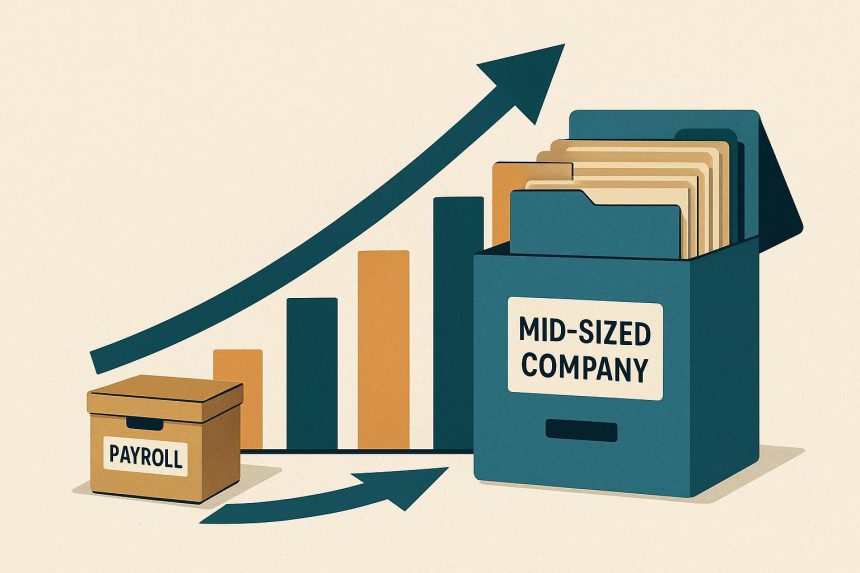
Most companies don’t choose their first payroll system strategically. They choose it quickly.
In the early days, the priority is simple: pay employees accurately, stay compliant, and avoid unnecessary overhead. For a small team operating in one state, a straightforward payroll tool usually works just fine.
Growth changes that equation.
By the time a company reaches 75, 100, or 200 employees, payroll is no longer just an administrative task. It becomes part of a broader operational system tied to compliance, finance, benefits, hiring, and employee experience. What once felt efficient can start to feel limiting.
Outgrowing a payroll provider isn’t unusual. In many cases, it’s a sign the business has matured.
The Early-Stage Advantage — and Its Limits
Early-stage companies value simplicity. They want fast setup, predictable pricing, and basic tax automation. Advanced reporting, multi-state compliance tools, and deep integrations rarely feel urgent.
At that size, workarounds are manageable. If something requires a manual export or spreadsheet reconciliation, it doesn’t consume much time.
The issue is that early decisions often stay in place longer than they should. Systems that were chosen for convenience can quietly become structural constraints.
Growth Introduces Complexity
As organizations expand, payroll touches more parts of the business.
Hiring across state lines introduces new tax and reporting requirements. Benefits administration grows more layered. Finance teams need clearer forecasting visibility. Operations teams want tighter onboarding workflows. Leadership wants workforce data that informs planning decisions.
A payroll system that once operated independently now needs to integrate with time tracking, recruiting software, accounting tools, and benefits platforms.
This is typically where friction appears.
Manual reconciliation increases. Reporting feels limited. Data lives in multiple systems. Support response times start to matter more because the stakes are higher.
None of these issues is catastrophic on its own. Together, they signal that the infrastructure may no longer match the organization’s scale.
When Fragmentation Becomes Risk
As companies grow, they often build their HR stack piece by piece. A time-tracking tool here. A recruiting platform there. A benefits system layered on later.
If payroll doesn’t integrate cleanly with these tools, administrators end up acting as the bridge between systems. Information has to be checked, re-entered, or verified manually.
Over time, that fragmentation increases the risk of errors and compliance exposure. It also slows down internal processes. Onboarding takes longer. Reporting requires extra effort. Strategic planning becomes harder when workforce data isn’t centralized.
This is often the moment when leadership starts looking more seriously at how leading HR platforms compare, evaluating whether a more unified system would reduce operational drag and support the company’s next stage of growth.
The conversation shifts from “Is payroll working?” to “Is payroll working for where we’re headed?”
Cost Is More Than the Monthly Fee
One reason companies delay switching providers is cost sensitivity. A new platform may appear more expensive on paper.
But subscription pricing rarely reflects the total cost of staying with an underpowered system.
Hidden costs can include:
- Administrative hours spent on manual reconciliation
- Limited reporting that slows financial planning
- Increased compliance risk
- Employee frustration with outdated interfaces
When evaluated holistically, upgrading infrastructure often becomes less about spending more and more about operating more efficiently.
The Employee Experience Factor
Payroll systems are frequently evaluated from the administrator’s perspective. But employees interact with them regularly — to access pay stubs, update tax forms, manage direct deposits, and enroll in benefits.
As headcount grows, even small usability issues can generate significant internal noise. A system that felt “good enough” for 20 employees may feel clunky at 150.
Modern payroll platforms increasingly emphasize clean design, mobile accessibility, and self-service workflows. For growing organizations, reducing friction at the employee level can meaningfully reduce HR workload.
Implementation Anxiety — and Timing It Right
Switching payroll providers is rarely effortless. Data migration, system setup, and training require coordination. For lean teams, that disruption can feel daunting.
But delaying the transition indefinitely can create larger challenges later. Moving during a stable growth phase is typically far easier than waiting for a compliance issue or operational bottleneck to force the decision.
The key is recognizing the inflection point early — when friction is noticeable but manageable.
A Sign of Organizational Maturity
Outgrowing a first payroll provider isn’t a failure of the original decision. Early-stage tools serve a purpose. They enable speed and simplicity when that’s what matters most.
Mid-sized companies operate differently. They require stronger compliance infrastructure, tighter integrations, clearer reporting, and systems that scale with hiring plans.
At that stage, payroll is no longer just about processing payments. It’s part of the company’s structural foundation.
Recognizing when your infrastructure needs to evolve — and responding deliberately rather than reactively — can prevent operational friction from turning into systemic risk.
For growing organizations in 2026 and beyond, payroll maturity isn’t about complexity for its own sake. It’s about alignment between systems and scale.

Lynn Martelli is an editor at Readability. She received her MFA in Creative Writing from Antioch University and has worked as an editor for over 10 years. Lynn has edited a wide variety of books, including fiction, non-fiction, memoirs, and more. In her free time, Lynn enjoys reading, writing, and spending time with her family and friends.