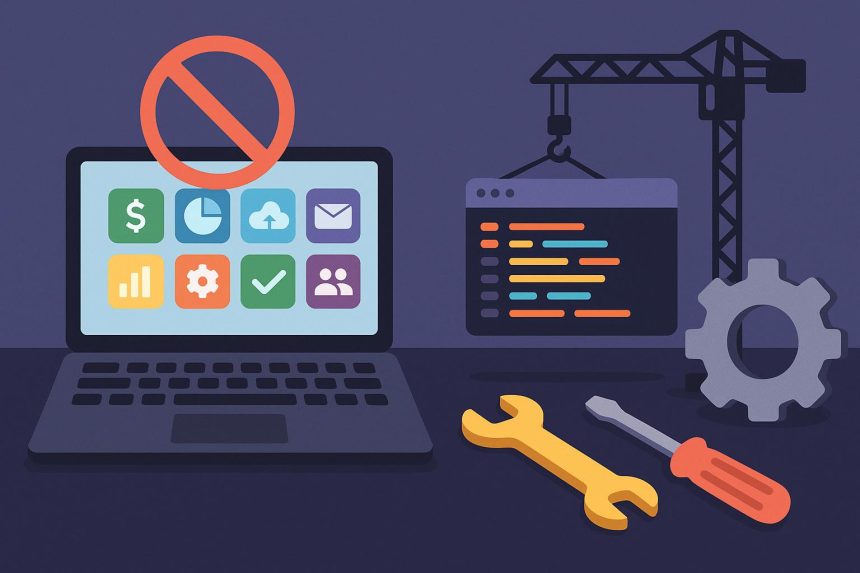
Go check your credit card statement right now.
Scan for anything that costs between $9 and $29. How many do you see? There’s a project management tool you haven’t opened in three weeks. There’s a social media scheduler you forgot about. There’s a “productivity” app that you swore would change your life but just ended up being another place to lose your to-do list.
We are living in the era of “Death by a Thousand Subscriptions.”
The Software-as-a-Service (SaaS) model is brilliant for companies but terrible for us. It relies on the fact that $10 feels like “nothing,” so we sign up. But when you stack five or six of these tools together, you aren’t just losing money; you are renting your own professional life.
The dirty secret of the SaaS industry is that you are paying for 100% of the features, but you probably only use about 5% of them.
You pay for Salesforce, but you only use it to store email addresses. You pay for Asana, but you only use it as a checklist. You pay for Airtable, but you only use it as a pretty spreadsheet.
It is time to stop renting “bloatware.” With the rise of the personal ai agent, we have entered a new phase of the internet where it is faster, cheaper, and smarter to build your own micro-tools than to rent a massive platform.
Here is why (and how) you should start cancelling your subscriptions.
The “Gym Membership” Fallacy
SaaS companies build software for the “Average User.” But the Average User doesn’t exist.
To justify their pricing, they have to pack their apps with features. They add team collaboration tools, complex reporting dashboards, API integrations, and AI assistants.
This is like joining a luxury gym that costs $200 a month because it has a sauna, a pool, and a rock climbing wall—even though you only ever use the treadmill.
When you use a personal ai agent to generate an app, you are building a home gym. You only build the treadmill because that is all you need.
If you are a freelance writer, you don’t need a complex CRM with “Lead Scoring” and “Pipeline Visualization.” You just need a list of editors, their email addresses, and a checkbox that says “Paid?”
By building this specific tool yourself, you strip away the noise. You get a piece of software that loads instantly, does exactly one thing perfectly, and costs you $0 in monthly fees.
The “Data Hostage” Situation
The other danger of SaaS is that they hold your data hostage.
Have you ever tried to leave a project management platform? They make it incredibly hard to export your data. They want to lock you in. If you stop paying, you lose access to your own history.
When you generate your own app, you own the database. You are the architect. Your data isn’t locked behind a paywall; it is sitting in a system you control. This concept of “Data Sovereignty” is becoming crucial for small businesses and freelancers who realize that their client lists and project histories are their most valuable assets.
How to Replace the “Big Three”
Let’s look at three common subscriptions you can likely kill today by generating a replacement.
1. The CRM (Salesforce, HubSpot, Pipedrive)
The Cost: $25 – $100/month. The Replacement: A “Client Relationship” Mini-App. The Prompt:
“Build a Client Tracker. I need to store Name, Company, Email, and ‘Last Contacted Date’. Create a view that shows me anyone I haven’t spoken to in 30 days so I can follow up.”
The Result: You get a clean list. No clutter. Just a system that reminds you to email people. It performs the core function of a CRM (relationship maintenance) without the overhead.
2. The Social Media Scheduler (Buffer, Hootsuite)
The Cost: $15 – $50/month. The Replacement: A “Content Pipeline” App. The Prompt:
“Create a Content Calendar. I need fields for ‘Post Idea’, ‘Platform’ (Twitter/LinkedIn), ‘Status’ (Draft/Published), and ‘Publish Date’. Show me a calendar view of my upcoming posts.”
The Result: You have a dedicated space to brainstorm and track your content. While it might not auto-post to the API (yet), for many creators, the organization is the hard part, not the posting. You just saved $300 a year.
3. The Inventory Tracker (TradeGecko, Netsuite)
The Cost: $50 – $500/month. The Replacement: A “Stock Room” App. The Prompt:
“I run a small candle shop. Build an inventory app. I need to track ‘Scent Name’, ‘Wax Amount (lbs)’, ‘Wicks Count’, and ‘Finished Candles’. Add a button to deduct materials when I make a batch.”
The Result: A perfectly tailored manufacturing system that matches your exact production process, not a generic retail workflow.
The Psychological Shift: From Consumer to Creator
The biggest barrier to doing this isn’t technical; it’s psychological.
We have been trained to think that “software” is something we buy from a store, like milk. We have been trained to think that we aren’t smart enough to build our own tools.
But the personal ai agent changes the physics of software creation. It turns English into Code. If you can describe your problem, you can build the solution.
Once you build your first tool—once you realize you can replace a $20 subscription with a 30-second conversation—it becomes addictive. You start looking at every area of your business and asking: “Why am I paying for this? I could build something better this afternoon.”
Conclusion: Audit Your Workflow
Here is your homework.
Look at your bank statement. Pick one SaaS tool that you are “meh” about. Maybe it’s that habit tracker you never use, or that expensive note-taking app.
Cancel it.
Then, open Macaron and tell the agent what you liked about that tool and what you hated. Ask it to build you a replacement.
You will likely find that the tool you build is not just cheaper—it’s better, because it was made for an audience of one.

Lynn Martelli is an editor at Readability. She received her MFA in Creative Writing from Antioch University and has worked as an editor for over 10 years. Lynn has edited a wide variety of books, including fiction, non-fiction, memoirs, and more. In her free time, Lynn enjoys reading, writing, and spending time with her family and friends.