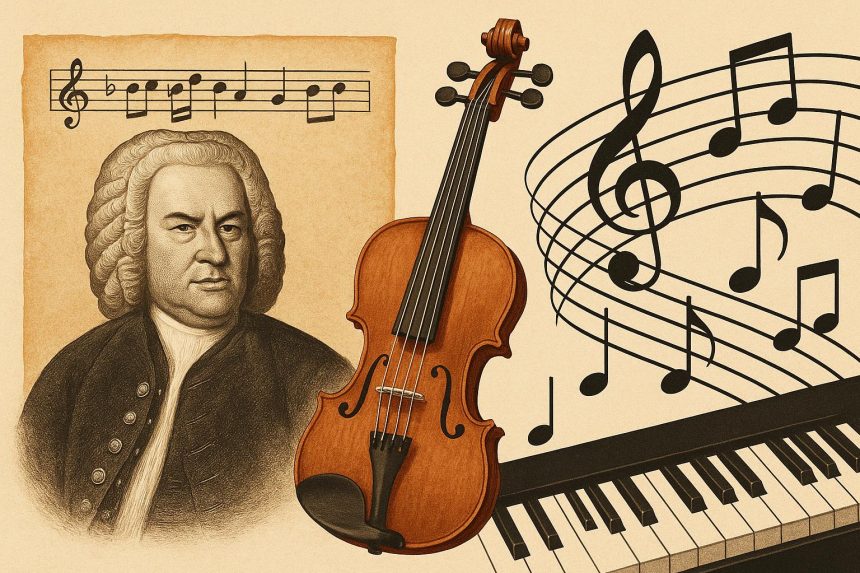
Alexander Apostolopoulos is a New York City based tax attorney who has spent close to 15 years advising public and private companies on complex transactions, including mergers and acquisitions, initial public offerings, and business spin offs. A graduate of Yale College and Harvard Law School, Alexander Apostolopoulos has practiced at Sullivan and Cromwell and later at a major US based multinational law firm, where he served as partner. His work has involved optimizing tax structures and drafting documentation for multi million and billion dollar transactions. Outside his legal practice, he maintains an interest in classical music. The enduring influence of Johann Sebastian Bach on modern composers and musicians reflects the kind of structural discipline and creative interpretation that resonates with those who appreciate both technical mastery and artistic depth.
Examining Bach’s Influence on Modern Music
Johann Sebastian Bach’s music established structural and theoretical foundations that still resonate with composers centuries after his death. Musicians from Mozart to Schoenberg studied his counterpoint, where melodic lines blend into a whole. Bach’s systematic approach to harmony and voice leading inspires later Western musicians to be precise and united. His works were both repertoire and an analytical guide for players studying musical architecture, making him an essential figure in modern composition.
Johannes Brahms and Dmitri Shostakovich adopted Bach’s fugues and preludes to create their own music. Bach’s harmonic innovations and formal clarity helped counteract 19th-century subjectivity and expression. Through his work, the following composers found a structural foundation for their own creativity. These efforts included crafting full preludes and fugues based on Bach’s Well-Tempered Clavier, which was a model for harmonic progression and thematic development.
Jazz musicians have also acknowledged Bach’s impact in ways that may not be immediately obvious to listeners of traditional Baroque music. His keyboard improvisations foreshadowed jazz harmony and spontaneous creativity with jazz-style chord structures and melodic independence. Jazz musicians like Jacques Loussier and John Lewis interpreted Bach’s themes with swing and rhythmic freedom. They demonstrated that Bach’s form and harmonic interplay translated effectively into an improvisation-focused language.
Beyond classical and jazz forms, Bach’s music has found its way into rock, pop, and electronic genres. Progressive rock bands of the late 20th century borrowed Bach’s fugues and difficult keyboard parts to combine Baroque intellectual rigor with modern instrumentation. Even major pop singers have used his motifs, showing his cultural versatility. Using Bach’s themes in electronic and popular music shows love for his work and a sense that they have emotional and artistic value outside of concert venues.
Performers and interpreters have played a significant role in how Bach’s music has shaped modern musicians. 20th-century pianists and harpsichordists like Rosalyn Tureck championed Bach’s keyboard compositions, influencing succeeding composers and performers’ phrasing and articulation. The revival of historically informed performance practice deepened appreciation for his music. It encouraged artists to evaluate Baroque intentions alongside modern sensibilities. These performance options kept Bach’s original texts and growing interpretive approaches in dialogue, inviting modern musicians to reevaluate tradition in light of current artistic principles.
The availability of Bach’s complete works online and in modern editions has further broadened his reach, making his compositions more accessible to musicians worldwide. Online collections and recordings have allowed students and professionals to study his music in unprecedented depth, reviving interest in his musical language. Bach may be studied, recomposed, and recontextualized in a worldwide musical culture due to its accessibility. His music often inspires new ideas rather than being a relic.
Modern musicians often draw from Bach’s approaches without explicit acknowledgment, a testament to how deeply his innovations have permeated musical thought. Linear harmony and thematic development, once innovative in the Baroque era, are now taught to composers and performers. Bach’s musical logic influences jazz, rock, and orchestral compositions in subtle ways. This widespread influence implies that Bach’s legacy lives on in current musical creation as well as direct quotation.
Looking forward, the legacy of Bach offers a platform for reinterpretation rather than mere reverence. Modern composers and musicians reinterpret his work to commemorate history and challenge limits. Modern artists can create new musical forms that reflect our current musical context while referencing Bach by combining his principles with varied cultural influences and modern technology. Bach’s influence is dynamic, inviting debate with modern composers and performers.
About Alexander Apostolopoulos
Alexander Apostolopoulos is a New York based tax attorney and graduate of Yale College and Harvard Law School. Over close to 15 years in practice, he has advised public and private companies on major transactions, including IPOs, mergers, acquisitions, and spin offs. He has represented clients in multi million and billion dollar deals and is a member of the New York State Bar Association. In his free time, he enjoys hiking, rock climbing, cycling, and classical music.

Lynn Martelli is an editor at Readability. She received her MFA in Creative Writing from Antioch University and has worked as an editor for over 10 years. Lynn has edited a wide variety of books, including fiction, non-fiction, memoirs, and more. In her free time, Lynn enjoys reading, writing, and spending time with her family and friends.