Albert Martinez is a municipal construction inspection manager for the City of Greeley, Colorado, where he oversees civil engineering projects spanning water systems, roads, and sewer infrastructure. Albert Martinez built his technical foundation at Oklahoma State University in Stillwater, OK, earning a master’s degree in environmental engineering with a 4.0 GPA after completing undergraduate coursework in civil engineering at the University of Wyoming. Before his current role, Martinez spent several years as a lead environmental engineer at Holly Frontier Refining in Cheyenne, Wyoming, where he supervised permitting and compliance for a large-scale petroleum refinery under state and federal environmental mandates. His engineering background offers useful context for understanding technical questions that arise in municipal infrastructure, including when a project like a city light pole installation requires the sign-off of a licensed professional engineer rather than routine inspection alone.
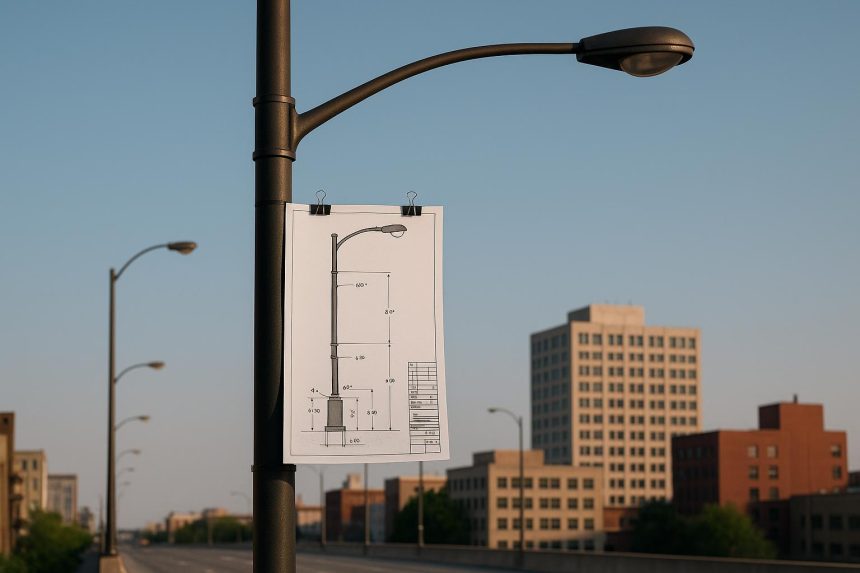
A city light pole may look like ordinary outdoor equipment, but some poles go beyond routine installation work. The difference can come from roadway setting, pole height, foundation type, attached equipment, or wind loading. A licensed professional engineer becomes relevant when those features require engineering judgment before the pole can be treated as a simple fixture.
That distinction matters because city poles sit near traffic lanes, sidewalks, utilities, and maintenance routes. State engineering law connects engineering practice to design, evaluation, planning, and supervision of construction when the work requires specialized engineering knowledge.
When final engineering documents are prepared for construction, public filing, agency approval, or client use, they must carry the seal, signature, and date of the licensee who prepared or directly supervised the work. That seal identifies professional responsibility for the covered engineering scope.
The work then moves through separate project roles. Engineering documents establish the design basis, approved details, calculations, or review needed before installation.
Contractors install the pole, base, wiring, and related parts according to approved plans, technical details, and project requirements. Local officials or city reviewers decide what documents the permit or approval process requires.
The reasons for engineering review often start with the pole’s physical setting. A light standard means the pole and support assembly that hold roadway lighting. A luminaire is the light fixture the pole or arm carries above the road.
State transportation design documents list common light standard heights of 20, 30, 40, and 50 feet, which shows why size and configuration matter.
The foundation can be just as important as the visible pole. A foundation supports the pole and transfers load into the ground.
Foundation plans connect foundation use to pole height, mast arm type, mast arm length, anchor bolts, slope, and soil bearing pressure. When soil or slope conditions fall outside the approved detail, the city may require a special foundation or special design.
Roadway location changes the design question. Light-standard placement rules account for traveled ways, sidewalks, medians, traffic islands, bridges, overhead signs, and utilities.
Those placement limits, especially near a crosswalk, sidewalk, shoulder, bridge, or intersection, make the pole part of the roadway system rather than a stand-alone object.
Attachments add another layer because a pole may carry more than one item. Luminaires can combine with mast arms, signs, signal-related equipment, wiring, or other appurtenances.
Signal design criteria connect wind load to the surface area of attached equipment and its distance from the pole centerline. That support is why added signs or signal arms can change the design basis rather than remain a simple add-on.
Cities and transportation agencies use approved plans to keep common work consistent. An approved plan is a preapproved drawing for work that fits defined conditions, giving designers, installers, and reviewers the same technical reference point.
Plan lists include steel light standards, placement details, foundations, base mounting, wiring details, and sign installation on signal and light standards.
For a city, the key question is whether an accepted detail gives enough support for the exact pole under review. When the answer is uncertain, licensed engineering review gives officials a clearer basis for accepting the design before crews build it in the public right-of-way.
That review links the pole’s approval and installation requirements to the engineering judgment recorded in the final plans. It also keeps the decision tied to the sealed scope rather than to a routine view of the pole as ordinary equipment.
About Albert Martinez
Albert Martinez is a construction inspection manager for the City of Greeley, Colorado, where he leads the city’s Construction Services Program overseeing streets, water, and sewage projects. He holds a master’s degree in environmental engineering from Oklahoma State University in Stillwater, OK, and previously worked as a lead environmental engineer at Holly Frontier Refining in Cheyenne, Wyoming, where he managed regulatory compliance at a large petroleum refinery. He is an active member of the American Water Works Association and the American Society of Civil Engineers, and in his free time enjoys fishing and bow hunting.

Lynn Martelli is an editor at Readability. She received her MFA in Creative Writing from Antioch University and has worked as an editor for over 10 years. Lynn has edited a wide variety of books, including fiction, non-fiction, memoirs, and more. In her free time, Lynn enjoys reading, writing, and spending time with her family and friends.