Pedestrian visibility is the ability of a driver to see, recognize, and respond to a person walking near or across a roadway. Pedestrian visibility depends on more than whether a driver is paying attention. Lighting, crosswalk markings, parked vehicles, road curves, traffic speed, signs, and the position of the pedestrian all affect how early a driver can identify someone in the road.
That distinction matters because pedestrian crashes remain a major road-safety problem.
The National Highway Traffic Safety Administration recorded 7,080 pedestrian deaths in traffic crashes in the last two years. More than 71,000 pedestrians were injured.
A pedestrian was killed in a traffic crash about once every 74 minutes.
The numbers raise a basic question.
Why do drivers fail to see people who are directly in or beside the roadway?
The answer often begins before the pedestrian enters the lane.
What Makes a Pedestrian Difficult to See?
A pedestrian becomes difficult to see when the road environment does not provide enough time or visual information for a driver to recognize the person.
Darkness is one factor.
Road design is another.
Parked vehicles can block the driver’s view of someone waiting to cross. A curve can reduce sight distance. Poor lighting can hide the pedestrian until the vehicle is close. Faded crosswalk markings can make the crossing itself harder to identify.
Federal Highway Administration guidance specifically identifies poor lighting, parked vehicles, and horizontal or vertical roadway curvature as conditions that reduce crosswalk visibility.
The driver still has a duty to watch the road.
The physical road determines part of what the driver has available to see.
Why Are Pedestrian Accidents Different From Car Accidents?
Pedestrian accidents differ from vehicle-to-vehicle crashes because a person on foot has no protective structure around the body.
There is no seatbelt.
There is no airbag.
There is no vehicle frame absorbing part of the impact.
The pedestrian’s body receives the force directly.
That difference explains why a crash at a speed that produces vehicle damage in a two-car collision can produce fractures, head trauma, internal injuries, or death when the other road user is walking.
Speed also affects whether the collision happens in the first place.
A faster vehicle covers more distance while the driver recognizes a pedestrian and begins to react.
Why Does Lighting Matter at Pedestrian Crossings?
Lighting affects the distance from which a driver can recognize a pedestrian.
Streetlights do more than illuminate pavement. Effective pedestrian lighting needs to help drivers distinguish a person from the background.
That becomes important at intersections, bus stops, and midblock crossings where pedestrians and moving vehicles occupy the same space.
The Federal Highway Administration identifies roadway lighting as a proven safety countermeasure.
The agency also notes a wider nighttime problem: roughly half of traffic fatalities occur at night even though only about one-quarter of vehicle travel occurs after dark.
Darkness does not explain every nighttime crash.
Alcohol, fatigue, speed, and distraction also contribute.
But reduced visibility changes the amount of information available to a driver.
Are Marked Crosswalks Enough?
Not always.
A marked crosswalk identifies where pedestrians should cross and alerts drivers to expect them.
Traffic conditions determine whether markings alone provide enough protection.
On multilane roads carrying more than 10,000 vehicles per day, FHWA states that a marked crosswalk by itself is typically not sufficient.
Additional measures can include better lighting, high-visibility markings, warning signs, pedestrian refuge areas, and active warning devices.
This shows why pedestrian safety cannot be reduced to one painted set of lines.
The crossing exists within a larger road system.
What Are High-Visibility Crosswalks?
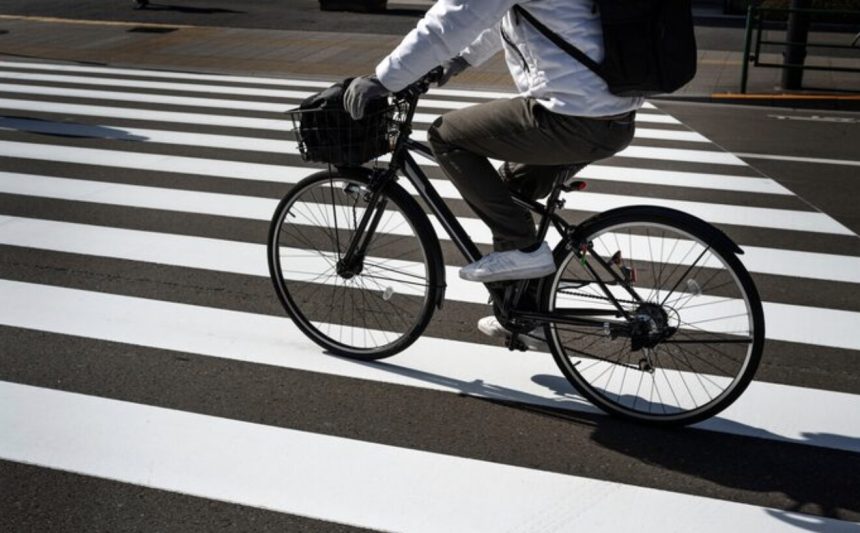
High-visibility crosswalks use pavement patterns designed to stand out more clearly to approaching drivers.
Common designs use broad longitudinal bars rather than two narrow transverse lines.
The purpose is recognition.
A driver who recognizes the crossing earlier has more time to look for a pedestrian.
FHWA field research has examined how crosswalk design, lighting, road characteristics, vehicle speed, traffic, and marking retroreflectivity affect the distance at which drivers detect crossings.
Visibility therefore becomes measurable.
It is not simply a question of whether someone believes the crossing was easy to see.
Why Does Right-of-Way Still Matter?
Visibility and right-of-way address different parts of the same event.
Visibility asks whether the driver could identify the pedestrian.
Right-of-way asks who had the legal priority to proceed.
A pedestrian using a marked crosswalk under a walk signal is in a different position from someone suddenly entering moving traffic against a signal.
Drivers also have responsibilities.
A turning driver needs to check the crosswalk before completing the turn.
A driver approaching a crossing needs to respond when a pedestrian has the right-of-way.
The legal analysis therefore combines physical conditions with human conduct.
What Evidence Shows Whether a Driver Could See a Pedestrian?
Visibility evidence starts with the scene.
Photographs can show the crosswalk.
Video can show the lighting.
Traffic-camera footage could show the pedestrian and vehicle before impact.
Investigators can examine the location of streetlights, signs, parked vehicles, landscaping, construction barriers, and other objects.
The time of day matters.
So does weather.
A crossing photographed at noon might look very different from the same crossing at 10 p.m.
That is why evidence collected close to the time of the crash can carry more information than photographs taken weeks later.
How Does This Apply to a Houston Pedestrian Crash?
Houston combines wide roads, large intersections, freeway frontage roads, commercial areas, neighborhoods, transit stops, and substantial nighttime traffic.
Those environments create different pedestrian visibility problems.
A person crossing a neighborhood street presents one set of conditions.
A pedestrian crossing a multilane arterial after dark presents another.
When visibility, right-of-way, and roadway conditions overlap, determining fault often depends on evidence beyond the driver’s account. Hank Stout, a Houston pedestrian accident lawyer at Sutliff & Stout, notes that traffic-camera footage, witness statements, crash reports, photographs, and signal-timing records can help establish what happened before impact. These records can show whether the pedestrian had the right-of-way, whether the driver had enough time and distance to yield, and whether a malfunctioning signal or unsafe crossing condition contributed to the collision.
That distinction matters because the question is not only who was present.
The question is what each party did and what conditions shaped the crash.
Can a Government Agency Be Responsible for a Dangerous Crossing?
Potential liability involving a public road is more complex than a standard negligence claim against a driver.
Government entities have special rules, notice requirements, and legal protections.
Still, roadway conditions can become relevant when the condition itself contributed to a collision.
Examples include a malfunctioning traffic signal, missing signs, or another qualifying roadway defect.
Evidence needs to establish more than the existence of a problem.
The condition has to connect to the crash.
A faded marking that had nothing to do with the driver’s conduct does not become important simply because it was faded.
Causation remains necessary.
What If a Parked Vehicle Blocks the View?
Parked vehicles create a common visibility conflict.
A pedestrian can be hidden from approaching traffic until stepping beyond the parked vehicle.
The driver then has less time to react.
The same obstruction can work in reverse.
The pedestrian might not see the approaching vehicle.
Road design can reduce this problem by keeping parking away from crossings, improving curb geometry, or creating curb extensions that move pedestrians into a more visible position before they enter the travel lane.
The underlying safety principle is sight distance.
Drivers and pedestrians need enough distance to see each other before their paths intersect.
Why Does Vehicle Speed Change Visibility Risk?
Speed does not literally make the pedestrian less visible.
It reduces the time available to use the visual information.
Suppose two drivers recognize the same pedestrian at the same distance.
The faster driver reaches the crossing sooner.
The vehicle also needs more distance to stop.
That is why speed and visibility often appear together in pedestrian-safety discussions.
A well-lit pedestrian does not eliminate the danger of excessive speed.
Good visibility provides information.
The driver still needs enough time and distance to act on it.
Are Pedestrians Always Protected in Crosswalks?
Pedestrians have legal protections, but they also have responsibilities under state traffic laws.
The exact rule depends on the jurisdiction and circumstances.
Traffic signals matter.
Crossing location matters.
The movements of both the pedestrian and driver matter.
This is why investigators should avoid deciding fault from one fact.
“The pedestrian was in a crosswalk” provides important information.
It does not necessarily provide every fact needed to reconstruct the collision.
The signal phase, vehicle movement, pedestrian movement, and visibility conditions complete the picture.
Why Are Nighttime Pedestrian Crashes So Serious?
Night changes several parts of the driving environment at once.
Drivers see less of the road.
Headlight glare can interfere with vision.
Pedestrians can blend into the background.
Vehicle speeds might remain high because traffic volume is lower.
Federal road-safety research has consistently identified nighttime visibility as a major safety issue.
The problem is not solved by telling pedestrians to wear brighter clothing.
Road design and driver behavior remain part of the equation.
Lighting, markings, signs, crossing design, speed, and attention work together.
What Should Be Documented After a Pedestrian Crash?
Medical care comes first.
After that, evidence should preserve the conditions surrounding the collision when possible.
Useful documentation can include the police report, photographs of the crossing, photographs of the vehicle, witness information, traffic-camera footage, nearby surveillance video, and medical records.
Photographing the wider area is important.
A close image of an injury does not show where the nearest streetlight was.
A photograph of vehicle damage does not show whether a parked truck blocked the driver’s view.
Context explains the collision.
Why Does Early Evidence Matter?
Road conditions change.
A broken light can be repaired.
A parked vehicle moves.
Construction barriers disappear.
Surveillance systems overwrite recordings.
Witnesses become harder to find.
Even pavement markings change over time.
Evidence gathered close to the collision provides a better record of the environment that existed when the crash occurred.
That becomes especially important when each side gives a different account.
Pedestrian Visibility Is a System, Not a Single Decision
It is easy to describe a pedestrian crash as a moment when a driver failed to see someone.
That description is often incomplete.
Why did the driver fail to see the pedestrian?
Was the driver distracted?
Was the vehicle moving too fast?
Was the crossing poorly illuminated?
Did a parked vehicle block sight distance?
Were the pavement markings visible?
Who had the right-of-way?
Could either person have reacted sooner?
Pedestrian safety sits at the intersection of human behavior and road design.
The national numbers show why that relationship deserves attention. Thousands of pedestrians continue to die on American roads each year.
Better attention helps.
Better crossings help.
Better lighting helps.
Lower conflict speeds help.
The strongest safety approach does not choose one explanation.
It looks at the entire environment in which the pedestrian and vehicle were asked to see each other.

Lynn Martelli is an editor at Readability. She received her MFA in Creative Writing from Antioch University and has worked as an editor for over 10 years. Lynn has edited a wide variety of books, including fiction, non-fiction, memoirs, and more. In her free time, Lynn enjoys reading, writing, and spending time with her family and friends.