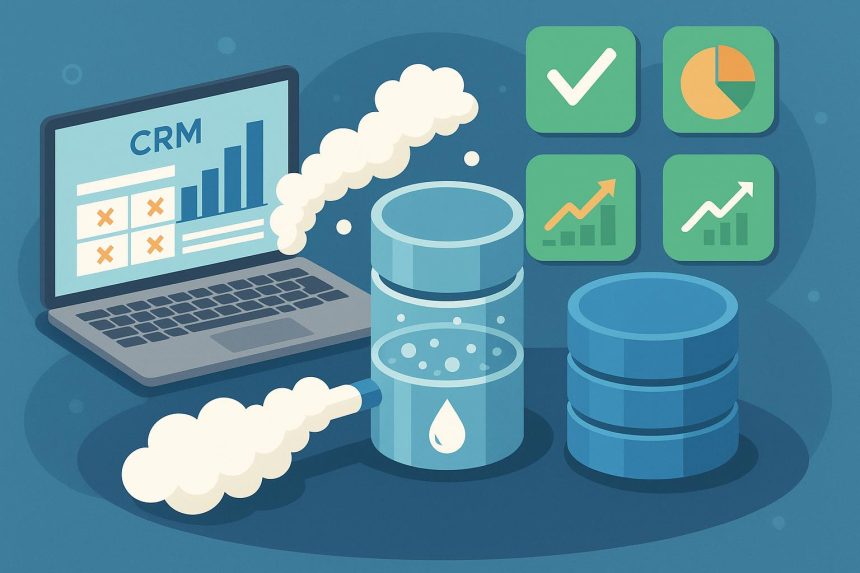
Your CRM looks fine on the surface and that might be the biggest challenge. Nobody’s checking the records that quietly went wrong last quarter. But B2B data keeps changing. A contact who changed jobs, a job title two promotions out of date, a direct dial that stopped connecting back in March.
The dashboards stay green. Reps keep working the list. Forecasts get built on top of it. But the pipeline doesn’t move. This is a data problem. By the time anyone notices, the damage is already priced into your pipeline. That’s the case for treating data cleansing as a standing discipline.
The silent decay nobody puts on the balance sheet
B2B contact databases decay at roughly 2.1% a month, compounding to about 22.5% a year, according to HubSpot’s Database Decay Simulation, which draws on MarketingSherpa research. Some field types fare worse than that aggregate number suggests. This includes email addresses that alone can decay north of 70% annually.
The cost side is just as bad. Gartner has estimated poor data quality costs organizations an average of $12.9 million a year in wasted resources and lost opportunities. Although this figure varies wildly by company size and industry, data decay is a problem that no organization can look away from.
A single aggregate decay number is misleading either way. It understates the risk in fast-moving sectors like SaaS, where job-hopping runs hot, and overstates it in stable, low-churn industries. Your real number depends on who you sell to.
Why the quarterly one-off cleanup keeps failing you
Most teams treat cleanup as an event. Once a quarter, someone exports the database, runs a dedupe script, fixes the obvious junk, and moves on. It feels productive. It doesn’t last.
The reason is simple. Data decay isn’t an event, it’s a condition. Contact data decays continuously, which means the traditional quarterly cycle leaves roughly 17% of records inaccurate at any given moment. The records you scrubbed in January are rotting again by April, and DIY dedupe rules can’t catch a title change or a job move that leaves a record looking perfectly valid.
That’s the trap with one-off CRM cleansing. You’re bailing water, not fixing the leak.
Continuous verification fixes the leak instead. It costs more upfront, and it demands ongoing data ownership that most internal teams struggle to sustain quarter after quarter. Someone has to own the cadence, or you drift right back to bailing.
What good CRM data cleansing actually looks like
There’s no magic button here. A workable data cleansing process comes down to three parts working together, and none of them holds up on its own.
Automated matching handles the volume: fuzzy dedupe, format standardization, validation against verified sources. It’s fast, but it’s also literal, which is how you end up with two different people named John Smith merged into one record.
That’s where a human QA layer comes in, catching the edge cases the algorithm can’t judge on its own. It’s the part most data cleansing services skimp on when they’re cutting costs, and the part that actually separates the good ones from the cheap ones.
The last piece is a refresh cadence based on account segment. High-velocity accounts get checked more often than dormant ones, and compliance checks for CCPA, GDPR, and PIPEDA run continuously instead of getting tacked on at the end.
Even with all three in place, no vendor hits 100% accuracy, and there’s always a tradeoff between speed and thoroughness. Faster turnaround means more noise gets through. Near-perfect records take longer. The vendors worth working with tell you this upfront instead of promising something no one can deliver.
From clean records to sharper decisions and safer AI
Clean data by itself isn’t worth much. What it enables is the point: better decisions.
When your records are accurate, everything built on top of them gets better too. Leads route to the right rep. Forecasts hold up when your board pushes back on them. Territory plans reflect real firmographics instead of best guesses.
That matters even more now that AI models sit on top of CRM data, because they inherit whatever’s already there and reproduce it at scale. IBM’s 2025 Institute for Business Value research found that concerns about data accuracy and bias are one of the top barriers companies cite when trying to scale AI, with nearly half of business leaders naming it. A bad dataset used to mean one wrong report. Now it means a system running thousands of confidently wrong decisions a day.
None of that sticks if the governance falls apart afterward. Clean the CRM this quarter and skip enforcing intake standards next quarter, and the decay just picks back up where it left off. Cleansing resets the problem. It doesn’t solve it permanently.
Where to start without betting the whole budget
Don’t commit to a full program on faith. Start small.
Pull a few hundred of your oldest records and run a sample audit against them. That gives you an actual decay number to bring into a budget conversation, instead of a vague sense that the data feels stale. Size the problem before you fund the fix.
If building a human QA layer in-house isn’t realistic right now, Datamatics Business Solutions Ltd offers ISO 27001-certified data cleansing services. Taking a hybrid approach that includes 80% AI and 20% humans intervention, DBSL offers 95% accuracy. Worth a conversation if your team already has enough on its plate. Write to marketing@datamaticsbpm.com

Lynn Martelli is an editor at Readability. She received her MFA in Creative Writing from Antioch University and has worked as an editor for over 10 years. Lynn has edited a wide variety of books, including fiction, non-fiction, memoirs, and more. In her free time, Lynn enjoys reading, writing, and spending time with her family and friends.