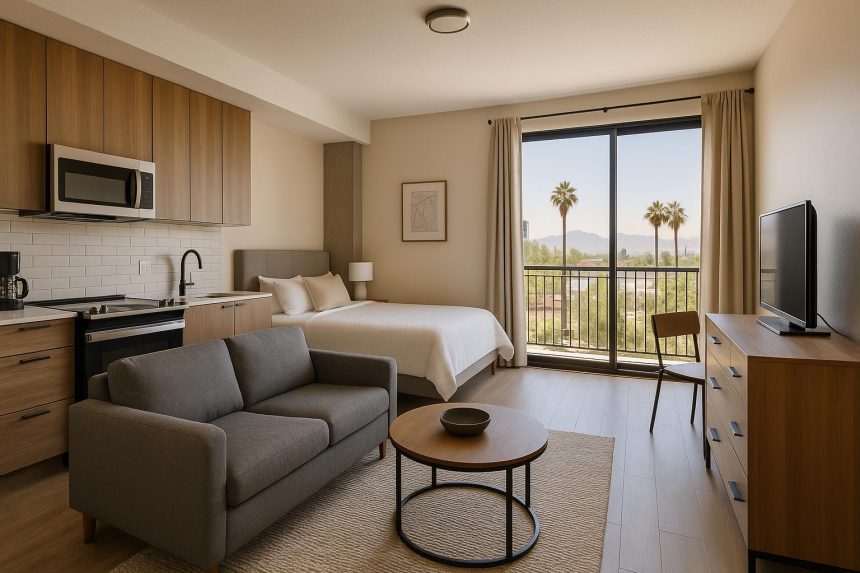
Downtown Phoenix, Evans Churchill, Camelback East Village, Midtown, and Paradise Valley Village currently hold the deepest inventory of furnished studio apartments Phoenix renters can actually move into within days. That’s the short answer. The longer answer is that none of these five is objectively “best” – a renter who picks based on price alone in one neighborhood might end up paying for it later in commute time, or noise, or a lease that’s harder to break than expected.
According to HUD’s FY2026 Fair Market Rent schedule, the baseline rent for a standard studio across the Phoenix-Mesa-Chandler metro is $1,457 a month. That number covers an unfurnished unit and functions as a federal benchmark, not a real listing price – furnished studios, which bundle in utilities, furniture, and shorter lease terms, usually run above it. Still, it’s a useful floor to have in mind before scrolling through listings that all claim to be “priced competitively.”
What Determines the Right Neighborhood?
Commute distance matters more than most renters admit up front. So does noise – a studio that looks perfect in photos can feel unlivable if the street below gets loud after 10 p.m. And lease flexibility tends to get overlooked entirely until someone’s stuck in a 12-month contract for what was supposed to be a three-month work assignment.
A few honest questions before browsing furnished studio apartments in Phoenix tend to save time later:
- Does the daily commute actually require a car, or would transit realistically cover it?
- Is quiet after dark a dealbreaker, or something that can be tolerated for a few months?
- Is this a genuine short stay, or a “temporary” arrangement that’s likely to stretch past a year?
None of these questions have a universally right answer. But sitting with them for five minutes usually narrows five options down to two.
1. Downtown Phoenix: Best for Walkability and Nightlife
Downtown sits at the center of Phoenix’s sports, dining, and entertainment scene – sports fans in particular tend to end up here almost by default. High-rises near Roosevelt Row hold most of the flexible-stay inventory, and buildings like AVE Phoenix Sky have leaned fully into the furnished-studio model, which means skipping the furniture-buying phase entirely for anyone who books there.
How Much Does It Cost to Live Downtown?
Expect pricing above the metro-wide HUD baseline. Demand doesn’t really let up here, between relocating professionals on one side and short-term corporate stays on the other. One detail worth checking before signing anything: whether a parking spot comes with the unit. Several of the older high-rises charge for it as an add-on, and that fee adds up fast on a month-to-month lease.
2. Evans Churchill: Best for Design-Focused Studios
Evans Churchill, just north of downtown, has carved out its own identity around galleries, First Friday art walks, and a renter base that skews younger. Blueground has concentrated a lot of its design-forward, move-in-ready inventory in this specific pocket – which is part of why units here tend to photograph well and, more importantly, actually look like the photos once someone unlocks the door.
3. Camelback East Village: Best for Quiet, Central Living
Camelback East Village lands somewhere between downtown’s energy and the calmer streets further north – not quite suburban, not quite urban core. After dark, it’s noticeably quieter than downtown, but newer buildings in the area still carry the amenity level renters have come to expect from a central address. Screening tends to run stricter here too; buildings marketed toward corporate relocation often ask for more thorough income verification than a typical short-term rental would.
4. Midtown: Best for Commuters and Healthcare Workers
Midtown’s real advantage is geography. Valley Metro Rail runs straight through it, connecting residents to downtown, the airport corridor, and several major hospital campuses without requiring a car – a meaningful draw for healthcare staff on rotating contracts who need housing sorted on short notice, sometimes with only a week or two of lead time.
Population growth plays into that demand as well. The U.S. Census Bureau puts Phoenix’s population at roughly 1.65 million residents, and that scale of growth keeps rail-adjacent neighborhoods busy with commuters who’d rather not deal with a longer drive twice a day. Midtown itself is a bit of an architectural mismatch (mid-century low-rises sit alongside newer managed buildings), so furnished inventory ranges from retro-charming to fully modern, and it’s worth double-checking listing photos before booking, since the gap between the two styles is bigger than it sounds.
5. Paradise Valley Village: Best for Views and Quiet
Paradise Valley Village sits toward the metro’s northern edge, closer to upscale shopping and noticeably calmer than anything further south. Scenery and pace tend to matter more here than walkability – most renters who choose it already know they’ll be driving everywhere.
Is the Higher Rent Worth It?
For remote workers and retirees, usually yes. For anyone commuting to a downtown office five days a week, the extra drive time can outweigh whatever’s saved – or gained – in square footage and quiet.
Comparing the Five Neighborhoods
| Neighborhood | Best For | Commute Style | Noise Level |
|---|---|---|---|
| Downtown Phoenix | Nightlife, walkability | Walk or short rideshare | High |
| Evans Churchill | Design-conscious renters | Short walk to downtown | Moderate |
| Camelback East Village | Upscale, quieter living | Car-dependent | Low-moderate |
| Midtown | Commuters, healthcare shifts | Light rail | Low-moderate |
| Paradise Valley Village | Views, slower pace | Car-dependent, longer | Low |
What Should Renters Verify Before Signing?
Not every listing that says “furnished studio apartments in Phoenix” means the same thing. Some units come stocked down to the cookware; others include a mattress and not much else. The fine print matters more here than it would in a standard unfurnished lease, so a few things are worth confirming directly with the property manager rather than assuming:
- Whether utilities, Wi-Fi, and parking are bundled into rent or billed on top of it
- What the actual minimum lease term is – some buildings allow week-to-week, others hold firm at 30 days
- Who’s responsible if furniture breaks or needs replacing partway through the lease
Skipping these three questions is probably the single most common reason renters end up frustrated a few weeks into a lease that looked fine on paper.
Frequently Asked Questions
What is the average cost of furnished studio apartments Phoenix currently offers?
HUD’s FY2026 data puts the unfurnished studio baseline for the Phoenix metro at $1,457 a month, and furnished units generally price above that since the rate usually folds in utilities and furniture. Pricing swings a fair amount by neighborhood – downtown and Evans Churchill run higher than Midtown or the western suburbs, sometimes by a few hundred dollars.
How long can someone lease a furnished studio apartment in Phoenix?
It depends heavily on the building. Flexible-stay properties like AVE Phoenix Sky and Blueground-managed units often allow stays as short as 30 days, while traditional apartment communities tend to hold to a standard 12-month lease even when the unit itself comes furnished.
Which neighborhood is best for someone without a car?
Downtown Phoenix and Midtown, mainly – Midtown because of direct light rail access, and downtown because most daily needs are within walking distance anyway. Evans Churchill also works reasonably well on foot. Paradise Valley Village and much of Camelback East Village really do require a vehicle.
Are utilities usually included in fully furnished studio apartments in Phoenix?
Sometimes, sometimes not – this is one of those details that has to be confirmed rather than assumed. Some flexible-stay properties bundle utilities, Wi-Fi, and even housekeeping into one flat rate, while more traditional furnished rentals still bill electricity or water separately.
Is it cheaper to rent furnished or unfurnished in Phoenix?
Furnished studio apartments almost always cost more per month than an unfurnished unit of the same size, since furniture and setup get baked into the rate. For a stay under a year, that premium is often still cheaper than buying furniture and reselling it later. Past a year or so, unfurnished tends to win out financially.
Which Phoenix neighborhood has the fastest-growing rental demand?
Midtown and Downtown, largely on the back of healthcare hiring, corporate relocation, and the metro’s broader population growth – Census Bureau estimates put the city at roughly 1.65 million residents, and that growth keeps pressure on centrally located, transit-accessible neighborhoods in particular. Areas closest to the light rail corridor tend to feel it first.

Lynn Martelli is an editor at Readability. She received her MFA in Creative Writing from Antioch University and has worked as an editor for over 10 years. Lynn has edited a wide variety of books, including fiction, non-fiction, memoirs, and more. In her free time, Lynn enjoys reading, writing, and spending time with her family and friends.