In protected agriculture in 2026, climate disasters rather than market volatility pose the biggest operational threat. Standard hoop greenhouses are becoming severe financial liabilities. Featuring sharp peaked geometry, our high-standard Gothic greenhouse structures dissipate snow loads and cut hurricane-force wind drag. Delivering 40–60 kg/m² snow-load capacity and 120 km/h wind resistance, this guide breaks down why switching to multi-span Gothic systems is the strategic ROI choice for serious commercial investors.
Geometry as a Defensive Barrier: Why Gothic Peaks Outperform Arched Roofs
While standard hoop greenhouses (Quonset style) are popular for their lower upfront costs, their rounded roof geometry creates fatal structural weaknesses under the “New Normal” of extreme weather. In contrast, the steep Gothic peak redefines overall structural integrity from a mechanical perspective.
Gravity Utilization: Automatic Snow Shedding
In high-latitude heavy snow zones, the gentle curved roof of a hoop house is a critical flaw. Snow easily accumulates at the central ridge, triggering sudden structural collapse once the moisture content increases. According to 2024 field testing conducted in the cold regions of Canada, Gothic roofs with a pitch steeper than 25° drive snow to slide off naturally before dangerous load thresholds build up.
Commercial value: These tests prove Gothic roofs retain 65% less snow than standard hoop structures, safeguarding full crop yields during once-in-50-year blizzards.
Aerodynamic Design: Wind Resistance at 120 km/h
Large multi-span greenhouses act like giant sails during hurricane seasons. The sharp Gothic peak slices airflow like a scalpel to reduce the wind-facing area. Its parabolic curve converts horizontal wind impact into vertical compressive stress, which is then distributed through the Q235 galvanized frame down to the foundation.
Safety redundancy: This design withstands sustained hurricane-force winds exceeding 120 km/h without experiencing the progressive structural fatigue typical of lighter arched designs.
Scaled ROI of Multi-Span Gothic Greenhouses
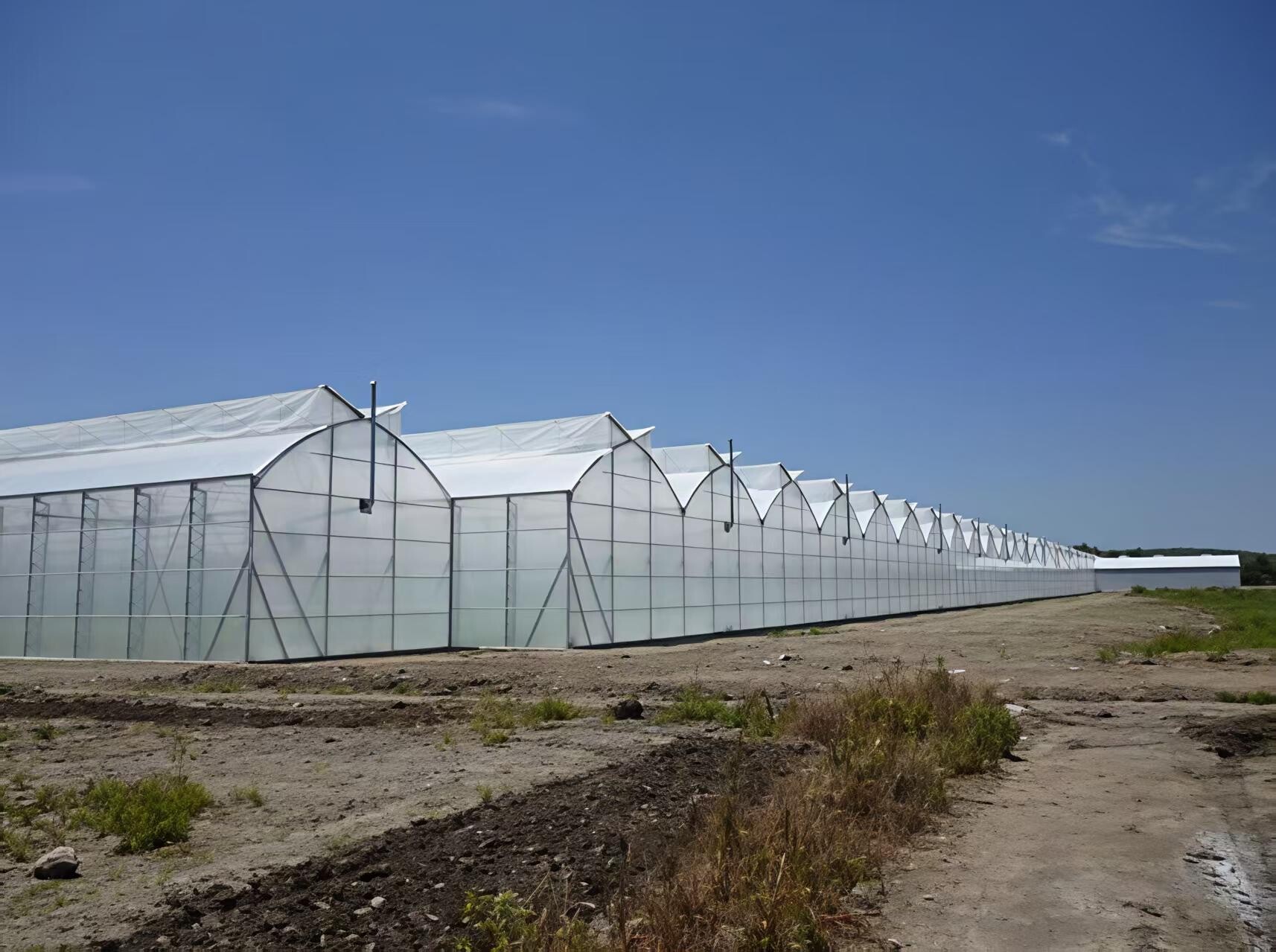
When shifting from trial plots to professional commercial-scale hydroponic Gothic greenhouse systems for hectare-scale cultivation, the architecture must support industrial logistics and high-precision microclimate management.
Benefits of Expanded Vertical Interior Space
The peaked Gothic design naturally raises the central roof height, delivering significant advantages for large-scale operations. A larger internal air volume creates a “thermal buffer” that stabilizes temperature swings. A 2025 operational study by facility managers showed that this increased volume can cut annual HVAC operational expenses by 15–20% by reducing the frequency of heating and cooling cycles.
Automation Integration: The ample overhead clearance accommodates hanging cultivation trellises, harvest robots, and high-intensity LED supplemental lighting arrays without obstructing the airflow.
Condensate Control: Cutting Fungal Disease by 25%
Inside the greenhouse, random condensate drips from flat curved roofs are the primary trigger for gray mold (Botrytis) outbreaks. The steep Gothic slope channels all moisture smoothly down inner wall surfaces to integrated gutters. Research from Wageningen University & Research — Greenhouse Horticulture indicates that this effective drainage reduces fungal disease incidence by 25%, translating to reduced pesticide costs and higher market premiums for premium produce.
Furthermore, modern Gothic structures utilize high-performance anti-drip (AD) coatings on the inner glazing. These hydrophilic layers prevent water from forming opaque droplets, instead creating a continuous thin film that slides into the gutters. This technology, paired with the steep pitch, ensures maximum light transmission (up to 90% PAR) even in high-humidity periods, preventing the 2–3% yield loss typically associated with light-scattering condensation.
2026 Performance Matrix: Gothic vs. Hoop
To help investors benchmark their facility choices, the following decision matrix standardizes performance against modern climate risks.
| Indicator Dimension | Gothic Multi-Span Greenhouse | Standard Hoop Multi-Span | Decision Reference |
| Snow Load Resistance | 40–60kg/m² (Excellent) | 15–20kg/m² (High Risk) | Essential for northern regions |
| Wind Resistance | 120km/h (Hurricane-Force) | 85km/h (Storm-Force) | Required for coastal zones |
| Condensate Management | Full trajectory guided drainage | Random water dripping | Mandatory for flowers & berries |
| Asset Service Life | Over 20 years | 8–12 years | Gothic offers 2x asset retention |
Frequently Asked Questions

Q: What determines the “Over 20-year” service life of your Gothic structures?
A: This longevity is achieved by using Q235 carbon steel treated with an 85-micron hot-dip galvanization process. This provides electrochemical protection against the high-humidity environment common in commercial cultivation. Unlike pre-galvanized pipes that rust within a few years, our skeletons are permanent farm assets.
Q: Is the Gothic structure suitable for tropical monsoons?
A: Absolutely. While often marketed for snow regions, the steep peak is equally effective for shedding heavy monsoon rain, preventing the “puddling” that often tears film on standard arched greenhouses. This rapid evacuation of high-volume runoff prevents structural ponding and ensures internal humidity remains within optimal ranges even during sustained storm events.
Q: Can we integrate automated climate control into a Gothic multi-span?
A: Yes. The rigid truss system is designed to support heavy suspended loads like climate screens and sensor arrays. The integrated truss design accommodates suspended loads of 25–40 kg/m², allowing for the deployment of heavy-duty thermal screens and multi-layer vertical growing rigs without compromising structural safety factors, making it the ideal carrier for modern smart agriculture.
Conclusion: Securing Asset Certainty
In the 2026 agri-business landscape, greenhouse facilities are far more than mere expenses—they act as a hedge against climate disasters. Choosing a Gothic multi-span greenhouse secures consistent production stability for the next two decades.
Explore our range of 2026 climate-resilient solutions or request a professional project consultation and ROI analysis.

Lynn Martelli is an editor at Readability. She received her MFA in Creative Writing from Antioch University and has worked as an editor for over 10 years. Lynn has edited a wide variety of books, including fiction, non-fiction, memoirs, and more. In her free time, Lynn enjoys reading, writing, and spending time with her family and friends.