

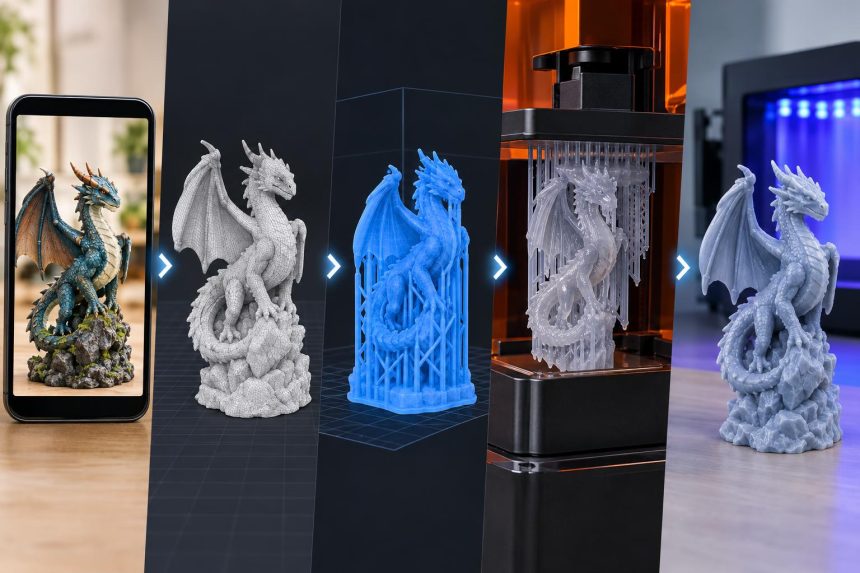
Consumer-grade 3D personalization used to require either a multi-camera photogrammetry booth or weeks of manual sculpting. By 2026, automated browser pipelines have compressed the front end of that workflow into minutes. Services like JuJuBit combine AI-assisted geometry generation with industrial full-color resin fabrication so ordinary buyers can turn photos, original characters, and personal concepts into solid desktop collectibles. Behind that quick online preview, however, sits a multi-stage manufacturing pipeline governed by strict geometric tolerances, material physics, and fulfillment schedules.
Stage One: Input Geometry and 360-Degree Pre-Checkout Review
Every physical print starts as a 2D image—most commonly a single, well-lit front-facing photograph with clear contrast between the subject and the background. Uploading one view means the software reconstructs depth across the front while inferring unseen geometry behind hair, collars, and backpacks. As outlined in the step-by-step overview on the JuJuBit workflow page, rotating the interactive 3D preview across all angles before checking out is the single highest-leverage step a buyer can take.
Data boundaries at this stage matter just as much as camera angles. Standard production slots cover one subject (Solo) or up to two subjects combined (Duo, counting people and pets together), leaving larger group scenes outside single-template prints unless split into pairs. Acceptable inputs cover personal photos, family pets, and original characters; commercial copyrighted characters and licensed intellectual property are excluded. Customer uploads stay scoped to fulfilling that specific order rather than training public AI models.
Stage Two: What Free Pro Refinement Fixes—and What It Leaves Alone
Raw AI-generated 3D meshes almost never pass straight onto a build plate. Thin limbs snap during support removal, inverted polygons confuse slicer software, and floating details break apart under resin weight. To bridge that gap, every physical figurine order goes through JuJuBit’s Free Pro Refinement before fabrication starts.
During refinement, 3D technicians close surface holes, eliminate non-manifold mesh artifacts, and thicken narrow geometry to meet a minimum printable wall thickness of at least 1 mm. Just as important is understanding where that service stops:
- No post-checkout restyling: Refinement prepares the confirmed preview for reliable printing; it does not change poses, swap garments, add new props, or perform subjective aesthetic redesigns after an order is placed.
- Reinforced fragile spans: Narrow blades, staffs, floating ribbons, and eyeglass rims are thickened so they survive post-processing and shipping.
- No transparent resin option: Translucent energy effects and clear eyeglass lenses are either converted into solid opaque geometry or removed during cleanup.
- Micro-text legibility drops: Tiny lettering on baseball caps, patches, or shirt logos blurs below printable resolution and should not be expected to stay readable.
Stage Three: Curing Full-Color Photopolymer Resin Without Post-Print Paint
Once the mesh clears structural review, fabrication shifts from digital voxels to photopolymer chemistry. Rather than printing a blank shell and applying surface coatings later, full-color photopolymer resin pieces have pigments formed directly in full color during resin curing, leaving a clean matte finish.
That manufacturing method creates two optical realities buyers should anticipate:
- Screen brightness vs. ambient light: Backlit monitors emit light, making digital renders look punchier than a matte physical object resting on an office desk. Expect slightly softer, understated tones in hand.
- Matte non-metallic surfaces: Current full-color resin curing cannot produce mirror-like metallic sheen. Chrome badges, gold buckles, and silver trim appear as solid matte colors rather than reflective metal.
Buyers who want to experiment with custom brushwork or metallic hobby acrylics at home can request an unpainted white model in their order notes at checkout.
Sizing Rules, Pricing Tiers, and Fulfillment Separation
Dimensions in custom 3D printing frequently surprise newcomers because every size option—4 cm, 6 cm, 8 cm, or 10 cm—is measured along the model’s longest outer edge, including the display base, weapons, wings, or accessories. Understanding how scale affects visual density prevents mismatched expectations:
| Dimension Tier | Everyday Comparison | Practical Detail Capacity |
| 4 cm (1.6 in) | Roughly an earbuds charging case | Entry compact size (starting from $29.99 for a Solo figurine); subtle facial details simplify |
| 6 cm (2.4 in) | Larger than standard 28 mm tabletop minis | Recommended baseline for custom tabletop RPG characters needing crisp silhouettes |
| 8–10 cm (3.1–3.9 in) | Palm-sized desk collectible | Preferred tier for realistic portraits, milestone keepsakes, and intricate accessories |
Keeping an integrated base is strongly advised for dynamic poses, single-leg stances, or narrow ankles that need extra stability. Pricing rises transparently with height and Solo-versus-Duo configurations, and orders totaling $99 or more receive free standard shipping. If a listing offers standalone digital 3D files instead of physical printing, verify what is selected: digital downloads deliver 3D files by email only and include zero physical shipment.
On the logistics side, fabrication and shipping operate sequentially rather than concurrently. Production runs 7–10 business days, though peak seasonal demand can extend manufacturing queues. Once a piece passes quality control, transit takes 5–12 business days for US standard shipping, 10–25 business days for international standard delivery, or 5–7 business days for global express shipping—remembering that express upgrades accelerate courier transit only without shortening production. Multi-piece orders may dispatch in separate boxes at no extra shipping cost as individual items finish curing, each assigned its own tracking number.
Physical Handling Limits and Order Protections
Treat cured photopolymer collectibles as indoor desk objects rather than utilitarian household gear. The resin is strictly decorative and non-food-safe; never place custom figurines on cakes, desserts, drinks, or food surfaces. Because cured resin begins softening around 50°C (122°F), keep finished pieces off sunny car dashboards, away from heating vents, and out of direct sunlight that fades pigments over time.
Order changes follow strict cutoff windows: cancellations or design edits must be requested before modeling or production starts, while shipping address updates should be submitted within 24 hours and prior to dispatch. After delivery, inspect your package promptly. If transit breakage, visible manufacturing defects, or fulfillment errors occur, email clear photos to JuJuBit support at support@jujubit.ai within 7 days of delivery to arrange a free remake.

Lynn Martelli is an editor at Readability. She received her MFA in Creative Writing from Antioch University and has worked as an editor for over 10 years. Lynn has edited a wide variety of books, including fiction, non-fiction, memoirs, and more. In her free time, Lynn enjoys reading, writing, and spending time with her family and friends.