

A drain that blocks once is an inconvenience, and a drain that blocks three times in a year is a clue about the pipe itself. Each repeat callout spends money on the symptom while the cause stays in the ground, and the maintenance budget absorbs a cost that never appears as a single line item anyone questions. A CCTV drain inspection shows what is happening inside the line.
Why the same drain keeps blocking
The usual response to a blocked drain is a plunger or a drain snake sent down the line. Both force a passage through whatever is obstructing the flow. Clearing can mean less than full removal. A cutting head punches a channel through the mass, water passes, and the drain tests clear on the day. But much of the obstruction stays attached to the pipe wall. Grease still coats the interior, wipes still hang from the same joint, and the channel narrows again over the following weeks until the next tenant complaint arrives. The manager has paid for a hole through the blockage, while the blockage itself remains. So the same unit can book the same job every quarter.
Clearing without a camera also leaves the operator guessing. A drain snake cannot tell a soft plug of grease from a collapsed section of earthenware, because the resistance on the cable feels similar and the operator works by feel. In a fragile older line, an aggressive cutting head can crack a joint that was holding. The repair bill grows, but the diagnosis has not advanced. Repeated clearing of an undiagnosed drain leaves the same problem in place after every callout.
What a camera inspection involves
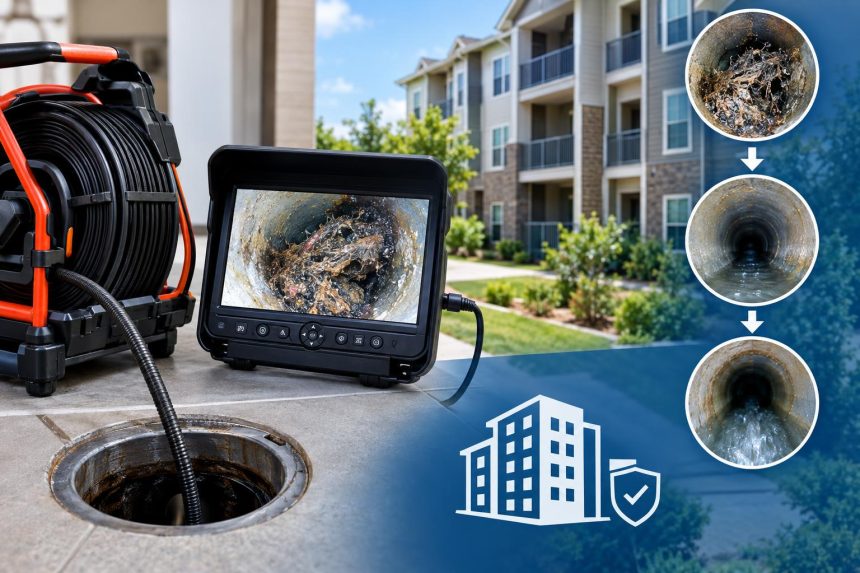
A CCTV drain camera is a high-definition lens and light mounted on a flexible push rod. It goes into the drainage system through an existing access point, such as an inspection opening or a removed toilet. The operator watches a live feed on a monitor while the camera travels the line, and the whole run is recorded so the footage can be reviewed later and filed against the property. The feed gives a continuous view of the pipe’s interior condition. After that, the drain problem can be discussed from what was seen, and the description replaces the estimate.
The most useful part of the setup is often the smallest. A sonde transmitter built into the camera head emits a signal that a handheld receiver picks up at ground level. The operator can then mark the exact position and depth of whatever the lens is looking at. A defect 600 millimeters under a garden bed is a different job from the same defect two meters under a concrete driveway, and locating separates those two quotes before digging starts. Without it, a plumber knows a pipe is broken somewhere along a forty-meter run. With it, the excavation starts at a marked point on the lawn.
Cameras work best on a clean pipe. Hydro jetting uses high-pressure water to scour grease and scale from the walls so the lens can see the surface. On many jobs, jetting and inspection happen in the same visit, one after the other. The camera has limits. It sees the interior of the pipe and nothing beyond the wall, so it cannot show soil movement outside the line. Heavy debris has to be cleared before it shows much at all. A camera survey is a strong diagnostic tool, but it is still one tool.
Reading the footage: debris or structural failure
An experienced operator first sorts out whether the obstruction is something in the pipe or something wrong with the pipe. Grease congealed against the wall, wet wipes snagged on a joint, sanitary products, and food solids settled in a low spot are temporary obstructions. Clearing them is usually a matter of hydro jetting or a similar method. The exact approach and the result depend on what the operator finds and the condition of the pipe. These materials sit in the flow and block it. Once they are gone, the pipe behind them is usually sound.
Structural failures look different on the screen and behave differently after clearing. Tree root intrusion shows up as fine tendrils at a joint or as a dense mass filling the bore. Roots cut back today can regrow toward the same moisture source within a year or two. A bellied section, where the pipe has sagged and holds a permanent pool of water, keeps catching solids no matter how often it is jetted. In that case, the shape of the pipe is the problem. Cracked or collapsed earthenware admits soil into the line, and offset joints catch everything that passes. None of these conditions improves with repeated clearing. The operator can choose the repair method from the footage. When it shows a broken pipe, jetting does not fix it. Paying for jetting in that situation means paying for the same repair twice.
The ground beneath Adelaide homes
Some of what shows up on camera has a local explanation. Adelaide sits on reactive clay soils that swell when they take on water and shrink when they dry out. That seasonal movement transfers stress to anything rigid buried in the ground. Older suburbs are full of earthenware sewer lines laid in short sections with mortar joints. A joint that shifts by a few millimeters opens a gap that roots find quickly. Newer PVC flexes and handles movement better, but the joints between old and new sections remain points where displacement shows up on camera.
Reading that footage well takes familiarity with local soils and local housing stock. The same shadow on the screen can mean a hairline crack in one suburb and a routine joint offset in another. Property managers weighing that kind of interpretation can start by researching a plumbing assessment through a licensed plumber Adelaide property managers use, since the survey only has value if the reading of it matches the ground the pipe is buried in. A camera produces pictures. The diagnosis comes from someone who has watched what this ground does to these pipes over decades.
Footage as evidence when costs are disputed
Recurring blockages in a managed property almost always produce the same argument. The cause decides who pays, and the cause is usually invisible. A tenant who has been flushing wipes sees the problem differently from a landlord who suspects the pipes are simply old. Without documentation, the manager stuck in the middle has nothing to point to. A recorded survey changes that conversation. Wipes and grease in a sound pipe point to usage, while roots and cracking point to wear. The manager stops mediating between two opinions and starts presenting a finding.
The same footage also helps with owners and insurers. Owners approve expenditure faster when they can watch the defect on a screen. A written report gives the manager something to file against the property and something to show an insurer if the blockage has already caused damage inside the home. The footage documents the cause but does not assign legal responsibility by itself; that depends on the facts, the applicable tenancy law and the lease. But evidence shortens the discussions that payment depends on.
From emergency spend to planned capital work
Emergency drain clearing is operational expenditure. It goes unquestioned because each callout is small enough to approve on its own. Across a portfolio over a year, repeat clearing of the same few properties can cost more than the permanent repair, and the manager still owns the defect at the end of it. A camera survey turns an unknown liability into a known one with a location and a price attached. At that point, the repair can move out of the emergency budget and into the capital plan.
The repair options open up once the defect is visible. Pipe relining inserts a resin-impregnated liner into the existing line and cures it in place. It rehabilitates the pipe without excavation and suits defects that sit under driveways or established gardens. Targeted excavation still has its place where a pipe has collapsed completely, and the sonde location keeps the dig small. Either way, the manager can collect like-for-like quotes against the same footage and schedule the work between tenancies, when plumbing work costs least in lost rent.
Properties with a history of blockages earn a place in a preventative maintenance program. Periodic jetting and a repeat survey every year or two can catch root regrowth while it is still a cheap cutting job. Small scheduled costs replace large unscheduled ones, and the emergency calls stop arriving mid-tenancy.
The damage that spreads beyond the pipe
A blocked or cracked drain rarely stays a plumbing problem. Sewage that backs up inside a home damages flooring and cabinetry. A slow leak from a cracked pipe underground can saturate the soil around footings for months before anyone connects the cracking paths to the drain. Persistent moisture inside walls and under floors creates the conditions mold needs. Mold turns a repair job into a remediation job with a tenancy problem attached. Early detection keeps a drainage fault inside the plumbing budget. Each month of delay moves it closer to the building budget.
Keeping the record
The footage remains useful after the repair. Property managers who file each survey against the property, with dates and defect locations noted, build a record of how the drainage is aging. An invoice history cannot match that record. A contractor attending the property for the first time starts from the file, and degradation becomes measurable across the years between inspections. When the property changes hands or the owner asks what condition the assets are in, the answer is already on file.
The properties that gain the most from a camera survey are the ones with a pattern. Two blockages in a year are enough of a pattern to justify a look inside the pipe. That first survey becomes the baseline, and every later decision about the drain can be made with the pipe condition in view.

Lynn Martelli is an editor at Readability. She received her MFA in Creative Writing from Antioch University and has worked as an editor for over 10 years. Lynn has edited a wide variety of books, including fiction, non-fiction, memoirs, and more. In her free time, Lynn enjoys reading, writing, and spending time with her family and friends.