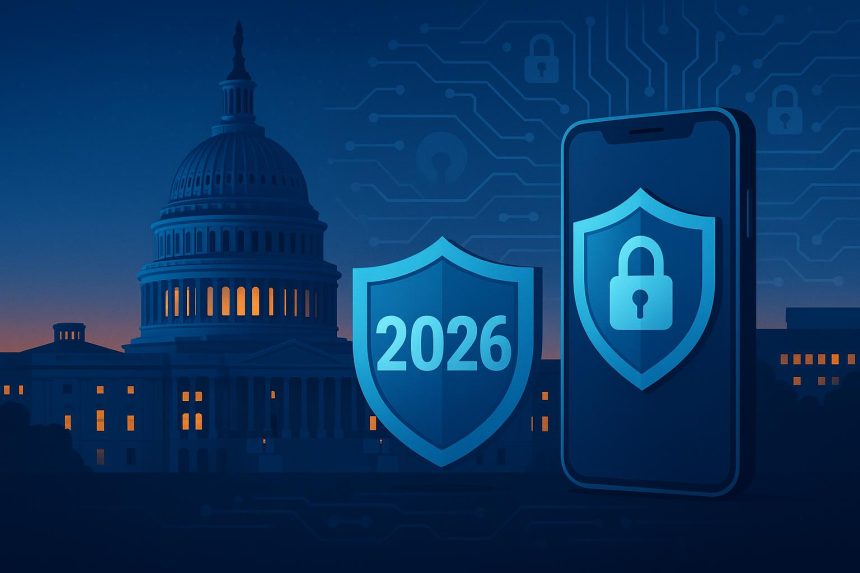
The race for being the best at things has a new goal, and it is not just about who has the coolest interface or the smoothest movements.
In 2026, people are talking about something. If you are looking for a mobile app development company in USA today, you will see that the things they say to get your business look a lot different than they did two years ago. It is no longer about getting new users, it is about keeping those users safe.
Welcome to the time of Government Grade security.
This sounds very serious, like something from a movie about spies. For businesses working today, it is becoming the norm to do so.
Whether you are a company that deals with money in New York or a company that takes care of people in California, the best standard for your software is being made in one place: Washington, D.C.
Why App Developers in DC are Setting the National Standard?
Washington, D.C., has always been a little different in the tech world. For a time, it was seen as the boring part of the tech world compared to Silicon Valley. While California was moving quickly and trying things in D.C. Was moving slowly and keeping things safe.
In 2026, things have changed. Moving quickly and taking risks with data is something that most companies can no longer do.
The DC Tech Hub and Government Grade mobile security are becoming very important. The DC Tech Hub is leading the way in government-grade security. The DC Tech Hub is showing that government-grade mobile security is the way to go.
This is where app developers dc have gained a massive competitive edge. They grew up in the shadow of the Pentagon, the NSA, and the Department of Homeland Security. They’ve been building under the strictest regulatory eyes on the planet for years.
When a D.C.-based team builds an app, they aren’t just thinking about the “Add to Cart” button. They are thinking about FedRAMP compliance, Zero Trust Architecture, and post-quantum encryption.
In 2026, those aren’t just buzzwords for bureaucrats. They are the features that keep your brand out of the headlines for the wrong reasons.
The “D.C. Ripple Effect”
What started as a requirement for government contractors has rippled out into the private sector. If a team is trusted to build a secure communication portal for a federal agency, you can bet they can handle your retail app’s payment gateway.
This “security-first” DNA is exactly why the D.C. tech hub has become the unofficial headquarters for the most secure apps in the country.
The Threat Landscape of 2026: Why “Good” Isn’t Enough
Let’s be real for a second. The hackers of 2026 aren’t just bored kids in basements. They are sophisticated, AI-powered syndicates. They use generative adversarial networks (GANs) to find tiny cracks in your app’s code faster than any human tester ever could.
If your app is built on “standard” security protocols from 2023, you’re basically leaving your front door wide open with a “Welcome” mat. This is why “Government-Grade” is the new benchmark. It implies a level of paranoia that is actually healthy in the current climate.
Zero Trust: The New Default
Remember when you’d log into an app once and have the run of the place? Those days are gone. Government-grade security relies on “Zero Trust.” In simple terms: the app assumes everyone is a threat until proven otherwise—and then it keeps checking.
D.C. developers have mastered this dance. They know how to implement continuous authentication without making the user feel like they’re going through a TSA checkpoint every time they want to check their balance. It’s about seamless friction. It sounds like an oxymoron, but it’s the peak of 2026 engineering.
Post-Quantum Encryption: Preparing for the Future
You’ve probably heard the whispers about quantum computing. In 2026, those whispers have become a roar. While we aren’t quite at the point where quantum computers are cracking every password on earth, we are close enough that the federal government has issued mandates for “Quantum-Resistant” algorithms.
This is where the D.C. influence really shines. Most mobile app development companies are still focused on today’s problems. D.C. developers, by necessity, have to build for the next decade.
By integrating Lattice-based cryptography now, these developers are ensuring that the data your users entrust to you today won’t be decrypted by a quantum processor in 2029. It’s about future-proofing. It’s about peace of mind.
The Human Element: Privacy as a Feature, Not a Chore
We’ve talked a lot about the “how,” but let’s talk about the “why.” Why does your user care?
In 2026, the average consumer is more tech-savvy than ever. They’ve lived through the great data leaks of the early 20s. They’ve seen their identities stolen and their private photos leaked. They are tired.
When you tell a user, “Our app is built by the same teams that secure federal infrastructure,” that carries weight. It builds an immediate bridge of trust. In a world where every app is fighting for attention, trust is the ultimate currency.
Sovereignty Over Data
“Government-grade” also means giving the power back to the user. We’re seeing a massive move toward Decentralized Identity (DID). Instead of your app holding a giant database of user passwords—which is basically a giant bullseye for hackers, D.C. developers are leading the way in “Zero-Knowledge Proofs.”
This technology allows a user to prove who they are without actually giving you their data. You get the verification; they keep their privacy. Everyone wins.
How to Choose the Right Partner in 2026
If you’re sitting there thinking, “Okay, I need this. How do I get it?” you have to be discerning. Not every company claiming to be an “expert” actually understands the nuances of high-level security.
Look for teams that have a footprint in the D.C. area. Look for companies that talk about “Security by Design” rather than security as a final layer added at the end. In 2026, security isn’t the frosting on the cake; it’s the flour. If you don’t bake it in from the start, the whole thing falls apart.
Questions to Ask Your Development Team:
- “What is your approach to Zero Trust Architecture?” If they blink twice, run.
- “How do you handle On-Device AI processing?” (Keeping data on the phone is always safer than sending it to the cloud.
- “Are you using Post-Quantum Cryptographic libraries?” This separates the pros from the amateurs.
The Verdict: Secure or Substandard?
The world has changed. The era of moving and breaking things was fun while it lasted but now we need to grow up. We are responsible for the people who use our software.
The tech hub in Washington D.C. Has shown that you do not have to choose between innovation and security. You can have both. You can create an app that’s not only beautiful and fast but also very secure.
As we move into 2026 the line between government tech and consumer tech will keep getting blurrier. That is a thing. It means an internet for everyone, including your family and business.
Do not accept “good enough.” In 2026 that is an invitation for a data breach. Look to the experts, for guidance. Check out the standards being set in Washington D.C. Build something that will last. Build something that protects people.
At the end of the day your code reflects your reputation. Make sure it is strong and reliable.
Final Thoughts for the Road
Whether you are looking for app developers DC specifically or searching for the best mobile app development company USA has to offer, remember that the “where” matters less than the “how.”
However, it just so happens that the “how” is being perfected in D.C. right now. The lessons learned in the halls of government are now the blueprints for the next generation of global apps.
Stay secure. Stay innovative. And most importantly, keep your users’ trust at the center of everything you build. That is the true secret to success in 2026 and beyond.

Lynn Martelli is an editor at Readability. She received her MFA in Creative Writing from Antioch University and has worked as an editor for over 10 years. Lynn has edited a wide variety of books, including fiction, non-fiction, memoirs, and more. In her free time, Lynn enjoys reading, writing, and spending time with her family and friends.