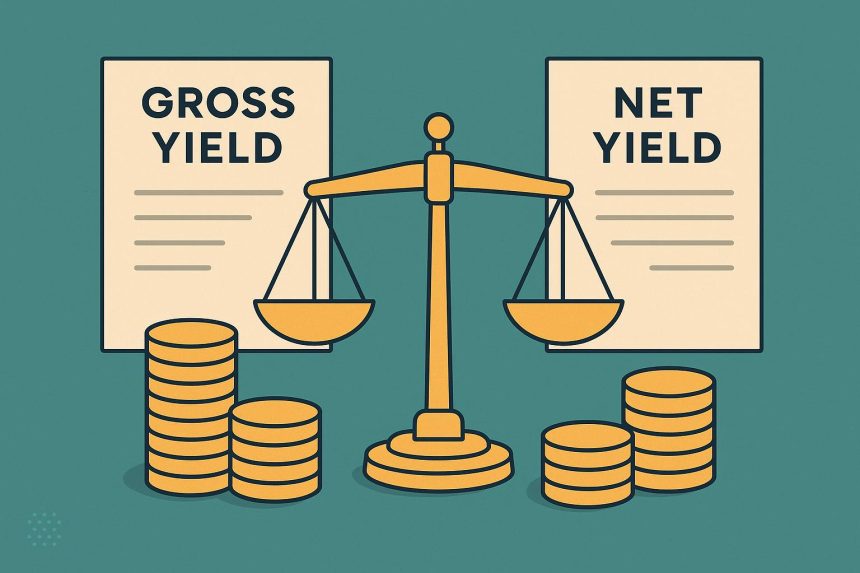
There is a number that almost every DeFi protocol puts front and centre on its homepage: the APY. It is large, it is prominent, and it is designed to attract attention. What it is rarely designed to do is tell the full story.
The gap between the yield a protocol advertises and the yield a depositor actually receives is one of the most overlooked issues in DeFi. Understanding the difference between gross yield and net yield is not optional knowledge for a serious depositor. It is the baseline for making informed decisions about where to put your capital.
This post explains what gross and net yield are, where the value leaks between them, and how Altura approaches yield reporting honestly.
What Is Gross Yield?
Gross yield is the total return generated by a strategy or protocol before any deductions. It is the headline number: how much the protocol earned on the deployed capital, expressed as an annualised percentage.
When a protocol says it earns 20% APY, that figure is typically the gross yield. It represents the raw output of the strategy before fees, token depreciation, gas costs, slippage, and any other friction are accounted for.
Gross yield is useful for understanding the productive capacity of a strategy. But it is not what ends up in your wallet.
What Is Net Yield?
Net yield is what you actually receive after all costs, fees, and value leakage are subtracted from the gross yield. It is the number that matters for your portfolio.
The gap between gross and net yield can be surprisingly large, and protocols have little incentive to make it obvious. Understanding where value is lost between the two figures is essential for evaluating any yield opportunity honestly.
Where the Gap Between Gross and Net Yield Comes From
Protocol Fees
Most yield protocols charge a management or performance fee on the returns they generate. A common structure is a performance fee of 10 to 20 percent of profits. If the protocol generates 20% gross yield and charges a 15% performance fee, your net yield is 17% before other costs.
Some protocols also charge deposit fees, withdrawal fees, or ongoing management fees. These are sometimes disclosed clearly and sometimes buried in documentation. Always check the full fee schedule before depositing.
Token Reward Depreciation
Many protocols express their APY inclusive of token rewards. The challenge is that the value of those tokens is not fixed. If the protocol’s governance token falls 50% in value between when the reward is earned and when you sell it, the real value of that portion of your yield is half what was advertised.
This is one of the most common and least discussed sources of yield inflation in DeFi. A protocol showing 40% APY with 30% coming from token emissions is really showing you 10% plus a bet on their token price. If the token declines, your effective net yield is much lower than the headline suggests.
Gas and Transaction Costs
Every interaction with a smart contract costs gas. Depositing, withdrawing, claiming rewards, and compounding all incur transaction fees. On high-cost chains, these can meaningfully erode net yield, particularly for smaller deposit sizes.
Protocols that require frequent manual claiming and compounding amplify this cost. If you need to pay gas every week to claim and reinvest rewards, the cumulative cost over a year can represent several percentage points of your gross yield.
Slippage and Execution Costs
Behind the scenes, yield strategies involve buying and selling assets, opening and closing positions, and rebalancing allocations. Each of these actions incurs slippage and execution costs that reduce the net yield captured by the protocol. A strategy that looks highly productive on paper can be significantly less so when real-world execution friction is factored in.
Impermanent Loss
For protocols that use AMM-based liquidity provision as a yield strategy, impermanent loss is a real and often underreported cost. When asset prices move significantly from their values at the time of deposit, the LP position underperforms simply holding the assets. The trading fees earned need to outweigh this loss for the strategy to produce a positive net yield.
Protocols that include impermanent loss in their net yield calculations are rare. Most report fee income without netting out the impermanent loss that is simultaneously occurring.
How to Estimate Your True Net Yield
When evaluating any yield opportunity, work through these questions before depositing:
- What percentage of the displayed APY comes from real economic activity versus token emissions?
- What is the full fee structure, including performance, management, deposit, and withdrawal fees?
- Does the strategy involve impermanent loss, and if so, is it netted out of the reported yield?
- How often do I need to claim and compound manually, and what will that cost in gas over a year?
- What happens to the token reward component of the yield if the reward token falls 50% in value?
Walking through these questions honestly will give you a much more accurate picture of the net yield you can expect than the headline APY alone.
How Altura Approaches Yield Reporting
Altura uses a Price Per Share (PPS) model to reflect yield to depositors. PPS rises as the vault generates yield from its strategies. The increase in PPS represents actual, net yield delivered to depositors after the protocol’s strategies have executed.
There are no token emissions included in the PPS calculation. The yield reflected is exclusively from real economic activity: funding rate and basis arbitrage, market making spread capture, and real-world asset strategies. What you see in the PPS is what the vault has actually earned, not a projection inclusive of token rewards that may or may not hold their value.
Fees are disclosed transparently. The withdrawal structure is clear: standard withdrawals within 72 hours at no cost, or instant withdrawals with a 0.10% fee. There are no hidden management fees layered on top.
Compounding is automatic. Because yield accrues directly into the PPS rather than sitting in a separate rewards contract waiting to be claimed, depositors benefit from continuous compounding without paying gas to trigger it.
The Bottom Line
The gap between gross yield and net yield is where a lot of value quietly disappears in DeFi. Protocols have limited incentive to make this gap obvious, which means the responsibility falls to the depositor to ask the right questions.
The most honest yield protocols are the ones where the number you see is the number you get: real economic yield, net of fees, automatically compounded, with no token reward inflation masking the true return.
To understand how Altura delivers transparent, net yield to depositors, visit altura.trade.

Lynn Martelli is an editor at Readability. She received her MFA in Creative Writing from Antioch University and has worked as an editor for over 10 years. Lynn has edited a wide variety of books, including fiction, non-fiction, memoirs, and more. In her free time, Lynn enjoys reading, writing, and spending time with her family and friends.