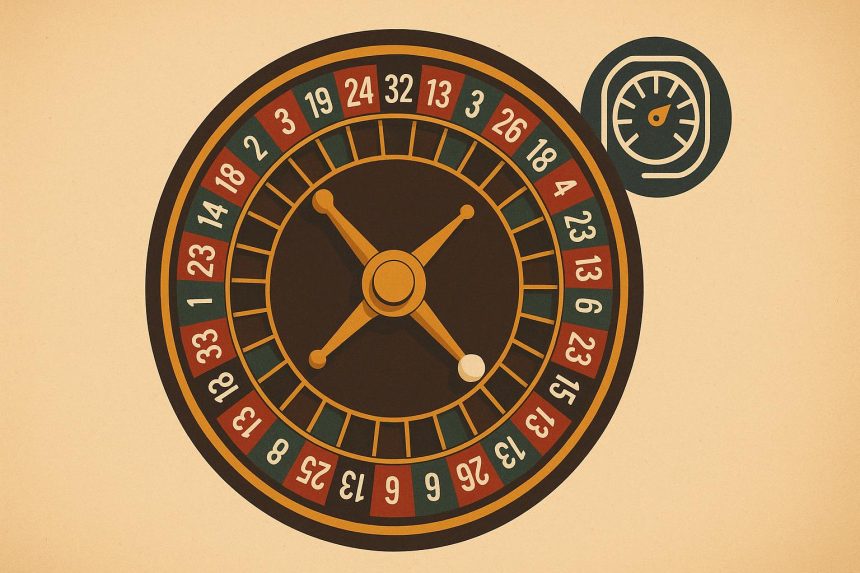
There is an inherent elegance to the circle that no other casino game can replicate. While the modern slot machine has evolved into a sensory assault of licensed characters and flashing neon, the roulette wheel remains an island of minimalist tension. Even in its digital translation, the physics of a small ivory ball rattling against mahogany, replicated through sophisticated HMTL5 canvas animations, taps into a deep-seated human fascination with visible, mechanical luck.
Historically, roulette wasn’t even intended as a game of chance. It began as a failed perpetual motion machine by Blaise Pascal in the 17th century. That mathematical DNA remains embedded in the game today; it is a system of perfect balance and cruel variance. When we engage with roulette online in 2026, we aren’t just playing a game; we are interacting with a digital descendant of a centuries-old physics experiment.
The Testing Experience: Simulating the Physics of Tension
I recently spent an evening stress-testing several high-end “Live Dealer” platforms to see if the digital experience could truly mirror the tactile gravity of a physical table. I deposited $150 using an instant bank transfer, bypassing the usual “pending” friction of older platforms.
The goal wasn’t just to win, but to measure the “emotional latency”, the time between the ball’s release and the moment of cognitive resolution.
The Observation Phase:
- Visual Fidelity: I focused on the frame rate of the wheel. In a poorly optimized environment, the ball “skips,” breaking the immersion. On a top-tier platform, the motion is fluid, mimicking the variable friction of real wood.
- The Emotional Hook: There is a specific “near-miss” window, roughly 1.5 seconds, between the ball slowing down and dropping into a pocket. This is where the dopamine peak occurs.
- The Result: After three hours of sticking to strict outside bets (Red/Black) using a scaled Martingale strategy, I walked away with a $40 profit.
For those looking to move beyond the surface-level graphics and find a platform with audited, high-performance engines, browsing a curated list of the roulette online landscape is the best way to separate the legacy operators from the modern innovators.
The Neuroscience of the “Near-Miss”
Why does roulette hold our attention more effectively than a simple coin flip? The answer lies in the cognitive error of the “near-miss.” When the ball bounces out of your chosen number and lands in the adjacent pocket, your brain doesn’t process it as a total loss. Instead, it classifies it as a “success-adjacent” event.
Neurologically, a near-miss triggers a dopamine release nearly identical to a win. This is the “expert insider” reality check: the wheel is designed to keep you in a state of perpetual anticipation. In the digital realm, this is amplified by high-definition slow-motion replays and zoomed-in camera angles that focus on the ball’s final bounces.
The Sensory Architecture of Sound
We often underestimate how much “trust” in a digital platform is built through audio. When you play roulette online, the audio engineering is doing the heavy lifting. The specific “clack” of the ball is usually sampled from real ivory or ceramic to trigger a sense of physical permanence. If a platform’s audio sounds “tinny” or looped, it’s a red flag for the overall quality of their RNG (Random Number Generator). The best developers treat the soundscape with the same reverence as the payout math.
The 2026 Tech Stack: How Fair Play is Hard-Coded
In 2026, “trust me” is no longer an acceptable business model for operators. The move toward Provably Fair algorithms has changed the landscape. Using cryptographic hashing, players can now verify that the outcome of a spin was determined before they even placed their bet, and that the result wasn’t altered in transit.
Key Concept: Provable fairness uses the “Seed” system. The server generates a secret seed, you provide a client seed, and the combination of the two determines the ball’s resting place. It’s a mathematical handshake that eliminates the possibility of “rigged” software.
Anatomy of a High-Trust Interface
According to recent UI/UX studies from major industry observers, user retention in high-stakes environments relies on three specific pillars:
- Latency Transparency: Showing the user their real-time ping to the live dealer feed.
- History Visualizers: Providing a clear “hot and cold” number map. (Note: While the wheel has no memory, the human brain craves patterns, and providing this data keeps the player engaged).
- One-Click Compliance: A visible, always-on toggle for setting loss limits or taking a time-out.
Comparing Global Standards: The Math of the Layout
As the industry matures, the technical divide between layouts has become a matter of mathematical survival for the player.
| Feature | European Digital | American Digital | French Digital |
|---|---|---|---|
| Total Pockets | 37 | 38 | 37 |
| Zeros | Single (0) | Double (0, 00) | Single (0) |
| House Edge | 2.70% | 5.26% | 1.35% (on even bets) |
| The “Hook” | Balanced variance | High-action, high-risk | The professional’s choice |
The “La Partage” or “En Prison” rules found in French variants are the ultimate “hack” for serious players, effectively cutting the house edge in half when the ball hits zero.
The Verdict: The Future of the Spin
As we move closer to widespread VR integration and “Metaverse” casinos, the line between the physical felt and the digital screen will continue to blur. The most successful operators aren’t just selling a game; they are selling a specific brand of digital atmosphere, one that respects the player’s intelligence, the history of the wheel, and the mathematical integrity of the spin.
Whether you’re playing on a smartphone during a commute or through a high-end desktop setup, the allure of the wheel remains unchanged: it is the perfect intersection of order and chaos.

Lynn Martelli is an editor at Readability. She received her MFA in Creative Writing from Antioch University and has worked as an editor for over 10 years. Lynn has edited a wide variety of books, including fiction, non-fiction, memoirs, and more. In her free time, Lynn enjoys reading, writing, and spending time with her family and friends.