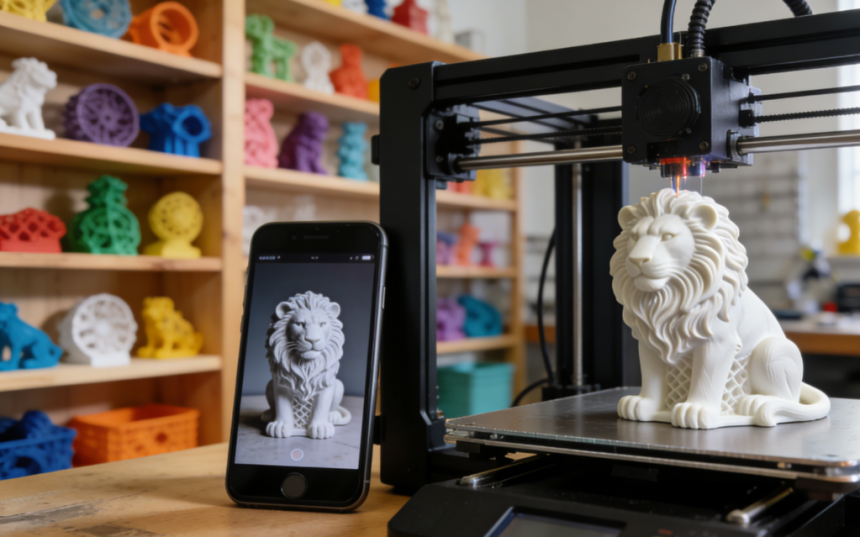
For many hobbyists, the journey from a digital idea to a physical object is blocked by the complexity of 3D modeling. You might find a great image, but turning that flat picture into a three-dimensional file usually requires years of training in specialized software. This is where a professional image to 3D AI tool changes the game, allowing users to bypass manual sculpting entirely.
By leveraging the Direct3D-S2 engine, creators can now upload a single reference photo and receive a high-fidelity mesh in seconds. This “Input to Generate” workflow removes the technical friction, making 3D creation as simple as taking a snapshot.
What Makes a Model “Print-Ready”?
A common frustration in the 3D printing community is the “unprintable” model—files that look good on screen but fail during the slicing process. To succeed, a model must meet specific geometric standards:
🔹 Watertight Mesh: The digital skin must be perfectly closed with no holes.
🔹 Manifold Geometry: Every edge must connect to exactly two faces, ensuring the printer understands what is “inside” versus “outside”.
🔹 Clean Topology: A stable edge flow allows slicing software to calculate smooth print paths without jagged artifacts.
Unlike generic AI generators that produce “hollow” or broken shells, Neural4D utilizes native volumetric logic to ensure every export is mathematically solid and ready for your heat bed.
Three Steps to Your First AI-Generated Print
Creating a custom physical object no longer requires a studio full of designers.
⚡ Step 1: Capture Start with a clear photo of your subject. The Spatial Sparse Attention (SSA) mechanism performs best with consistent lighting, which helps the AI calculate depth more accurately.
⚡ Step 2: Generate Upload your image to the 3D Studio. The system processes the data at 2048³ resolution, capturing fine details that traditional low-poly generators miss.
⚡ Step 3: Export Download your file as an .stl or .obj. Because the output is a watertight mesh, you can drop it directly into your slicer, Cura, PrusaSlicer, or Bambu Studio, without needing manual mesh repair.
Personalized Gifting: The New Era of Customization
The true power of this technology lies in its personal touch. Whether it is turning a child’s drawing into a desk toy or creating a 3D bust of a pet, these details matter. If the initial result needs a slight tweak, Neural4D-2.5 allows for conversational iteration. You can simply tell the AI to “make the base thicker” or “smooth out the surface,” ensuring the final print is exactly what you envisioned.
Final Verdict: Making 3D Creation Accessible to Everyone
We are moving past the era where 3D printing was reserved for engineers. By replacing Brute Force modeling with intelligent algorithmic efficiency, the barrier to entry has vanished. With a reliable image to 3D AI tool, the only limit is the storage space on your shelf.

Lynn Martelli is an editor at Readability. She received her MFA in Creative Writing from Antioch University and has worked as an editor for over 10 years. Lynn has edited a wide variety of books, including fiction, non-fiction, memoirs, and more. In her free time, Lynn enjoys reading, writing, and spending time with her family and friends.