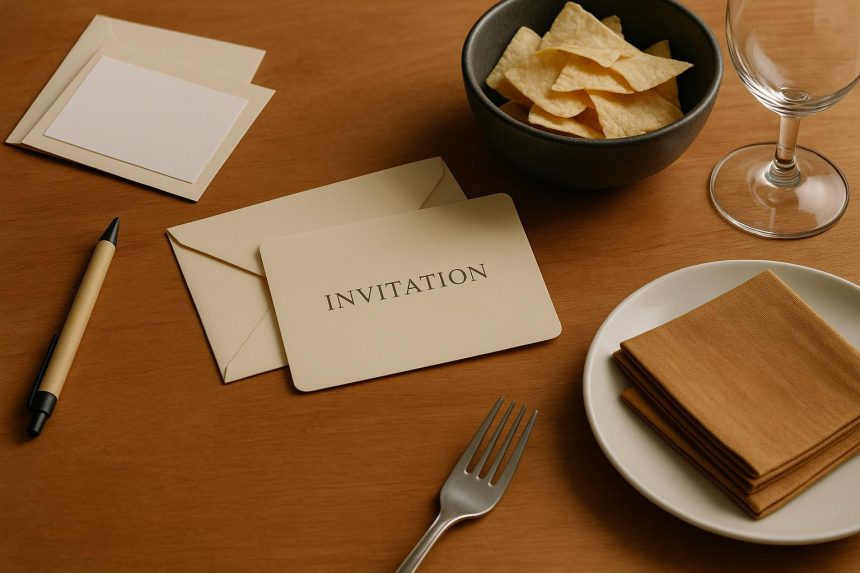
Somewhere around 2015, the group text ate the dinner party. Not literally, but functionally. The thing you used to do (pick a date, write out who’s coming, send something that said this is happening, you’re invited) got compressed into a thread that opened with “hey are people free saturday?” and never really ended. It felt efficient. It was efficient. And it quietly made a lot of gatherings worse.
I’ve watched this happen at my own table and at other people’s. The group-chat plan has a specific failure mode. Nobody commits, because nothing asks them to. The date drifts. Three people thumbs-up a message and two of them forget by Thursday. The whole thing carries the emotional weight of a work poll, so people treat it like one.
Here’s what I think actually happened. We confused informing people with inviting them, and those turn out to be different acts.
An Invitation Is a Signal, Not a Logistics Update
A real invitation does a job a group text can’t. It tells the guest the host took time to make this a thing, and that signal does real work. When someone gets an actual invite to a housewarming or a dinner, one with a date and a reason and their name on it, they read the event as something worth showing up for. When they get “we might do food at ours sunday??” they read it as optional.
Because it is.
The people I know who still throw genuinely good gatherings almost all do one thing: they make the ask feel deliberate. Not formal, necessarily. Deliberate. A graduation lunch, a Friendsgiving, an anniversary dinner for the parents — the events people actually clear their calendars for tend to start with an invitation that looks like the host meant it. The same guest who shrugs at a thread will rearrange their Saturday for a card with their name on it.
This isn’t nostalgia for paper and wax seals. I’m not saying anyone needs letterpress cards for a Tuesday taco night. The point is narrower, and it’s mostly about attention.
Why the Casual Default Backfires
The group text was supposed to lower friction, and in one sense it did. But it lowered the friction so far that the event lost its shape.
Think about what vanishes when there’s no invitation. There’s no clean yes or no. There’s no single place the details live, so the same person asks “wait, what time?” three separate times across the thread. There’s no sense of occasion, which means replies stay vague and your headcount stays a guess until the morning of. Anyone who’s cooked for twelve and watched six people walk in knows precisely how that feels.
Attendance tracks intent, and intent tracks how the ask was made. Ask casually, get a casual response. That’s not a character flaw in your friends. It’s just how people read social cues, and a thread reads as low-stakes by design.
And the cost isn’t only attendance. A fuzzy plan makes everything downstream harder. You can’t give the caterer a number. You can’t ask people to bring a dish without three more rounds of “wait, who’s actually coming?” The host ends up doing by hand all the organizing work a single invitation would have quietly handled.
The Tools Caught Up to the Problem
For years the trade-off felt real. You could send something nice and lose an hour wrestling with design software, or you could fire off a text in ten seconds and accept the chaos. Most people picked the text. Reasonably.
That trade-off has mostly disappeared. The friction that pushed everyone into the group chat has dropped on the other side too. Sending a proper party invitation now takes about as long as composing a careful text, and it comes with the thing the text never had: a real RSVP, one link that holds all the details, a headcount that updates itself as people reply. You describe the event in a sentence and get back something that looks intended, whether it’s a baby shower, a retirement dinner, or a backyard housewarming.
Invitations didn’t get fancier. The cost of sending a good one finally fell low enough that skipping it stopped making sense. The convenience argument used to favor the group chat. It doesn’t anymore.
What This Looks Like in Practice
None of this means abandoning your group chats. Use them for the back-and-forth, the “I’ll bring wine,” the “running ten late.” Threads are good at that.
But the invitation itself, the moment you actually ask people to come, deserves to stand on its own. Pull it out of the chat. Give the event a name, a date, and a yes-or-no. Then watch your RSVP rate. In my experience it climbs, and not by a little, because people respond to being asked properly. The friend who “maybe”s a thread will often give you a firm yes when there’s an actual invitation and a button to press.
The gatherings that stay with you usually weren’t the expensive ones. They were the ones that felt intended. Somebody decided this evening was going to happen, said so clearly, and then it did. That feeling starts earlier than most hosts think. It starts with the invite.
So before the next housewarming or anniversary or just-because dinner, try resisting the reflex to open the group chat first. Send something that says you mean it. The party usually follows.

Lynn Martelli is an editor at Readability. She received her MFA in Creative Writing from Antioch University and has worked as an editor for over 10 years. Lynn has edited a wide variety of books, including fiction, non-fiction, memoirs, and more. In her free time, Lynn enjoys reading, writing, and spending time with her family and friends.