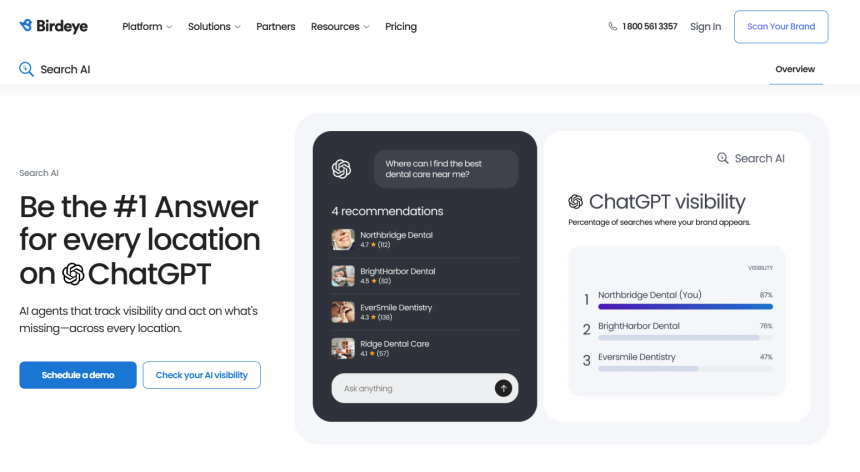
AI-generated answers are rapidly becoming the primary way customers discover and evaluate businesses. Instead of browsing traditional search results, people now rely on tools like ChatGPT, Gemini, and other AI platforms to decide which brands to consider and trust.
This shift creates a new visibility challenge: strong rankings in traditional search are no longer sufficient. If LLM platforms can’t accurately understand or verify your brand, you may not appear in AI-generated answers at all. Visibility now depends on consistent data, credible content, and strong trust signals across the sources AI models use.
For multi-location and enterprise brands, this is a scale problem. Small inconsistencies can impact dozens or even hundreds of locations at once, making AI visibility nearly impossible to manage manually.
In this blog, we highlight five of the best AI search visibility tools for 2026 and explain how they help brands measure and improve their presence across AI-driven discovery.
What really matters for AI search visibility today
Not all visibility tools are designed for how discovery works in 2026. LLMs evaluate businesses differently from traditional search engines, and the tools you use must reflect that shift.
When evaluating AI visibility platforms, businesses should focus on the following core areas:
- AI-driven visibility insights: See how often your brand appears in AI-generated answers and how it’s described.
- Data accuracy and consistency: Identify incorrect or missing business information that limits AI visibility.
- Reputation and trust signals: Understand how reviews, sentiment, and customer feedback influence AI recommendations.
- Scalability: Support multiple locations, markets, or brands without manual effort.
- Ability to act on insights: Improve visibility faster by connecting insights directly to execution.
The most effective AI visibility tools do not just report on performance. They help businesses understand how AI search platforms evaluate them and provide a path to improve those signals over time.
List of Top 5 AI Search Visibility Tools for Enterprise Brands in 2026
1. Birdeye Search AI
Best for: Enterprise and multi-location brands (with 100-10,000+ locations) that need to monitor, manage, and improve AI search visibility with built-in execution and governance.
Birdeye Search AI helps enterprise and multi-location brands understand how AI search platforms surface and describe their brand. As customers increasingly rely on AI-generated answers to make decisions, Search AI provides teams with visibility into how their business appears across experiences such as ChatGPT, Gemini, Perplexity and other AI answer platforms.
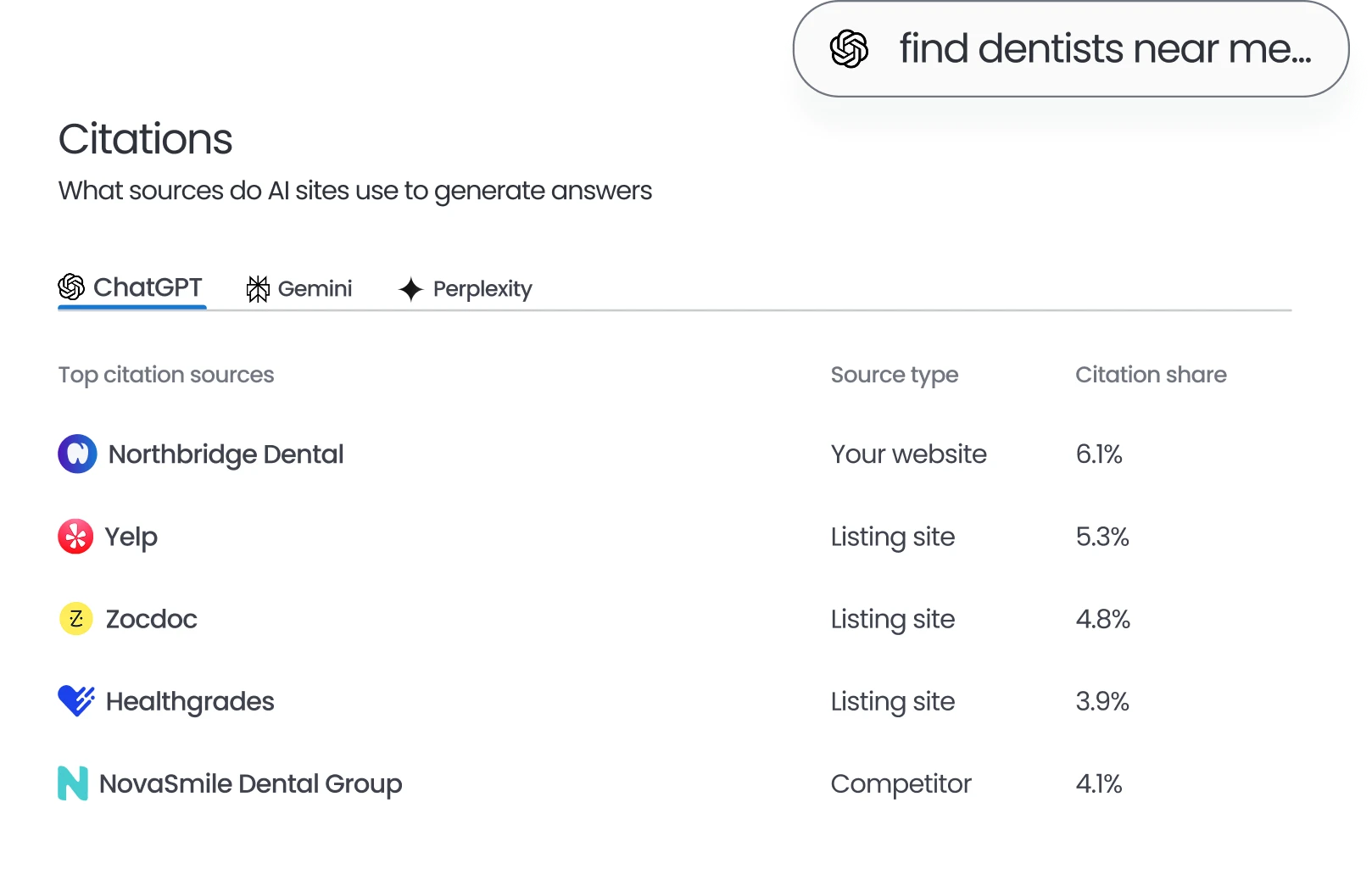
Rather than focusing on traditional rankings, Birdeye monitors how brands and locations are represented in AI-generated answers across markets and prompts. This allows teams to see where visibility is strong, where it is missing, and how AI perception varies across regions.
Core Search AI capabilities
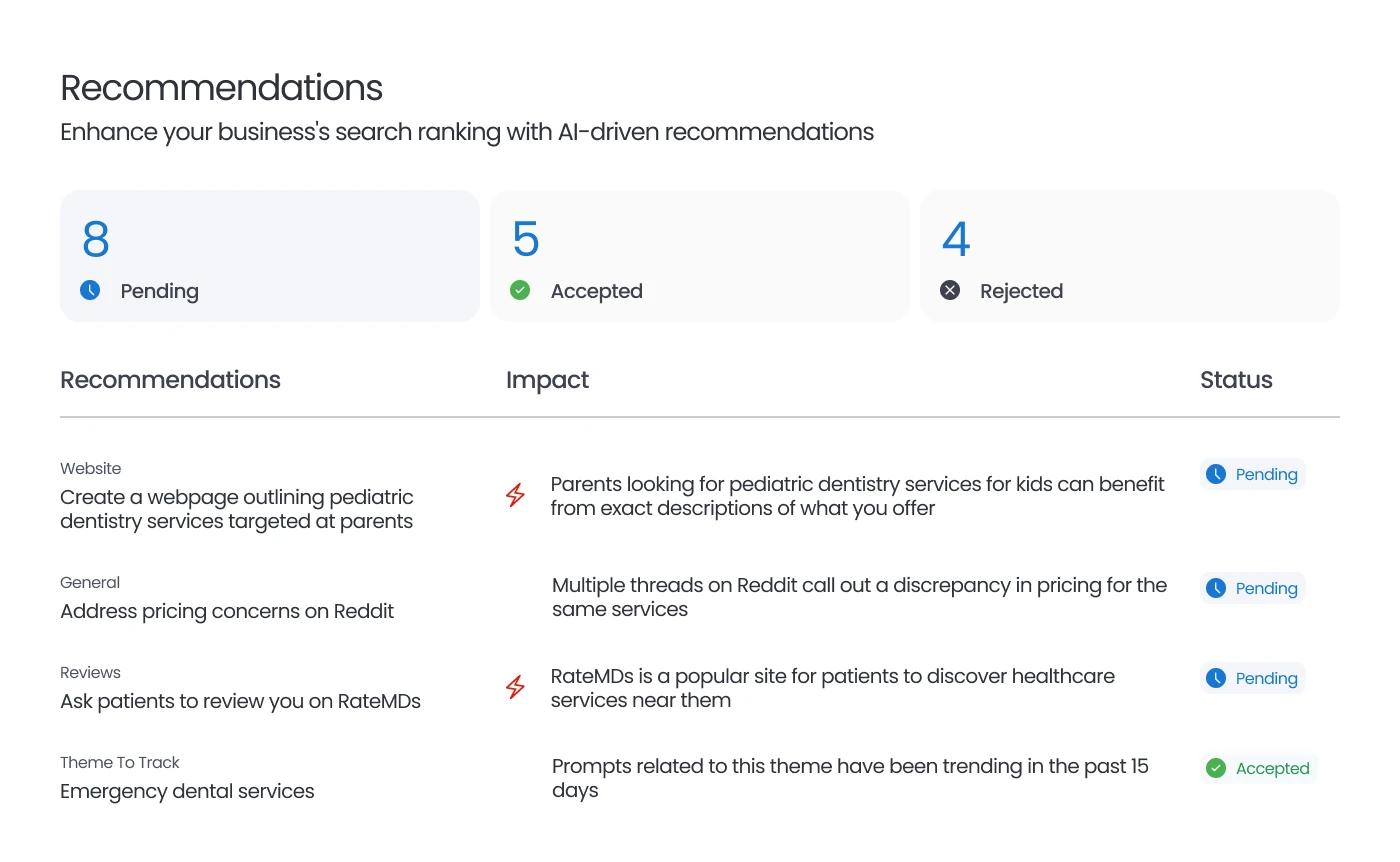
- AI visibility monitoring: Track how often your brand and individual locations appear in AI-generated answers and how that visibility changes over time.
- Competitive benchmarking: Compare AI search visibility against competitors at both the brand and location level across major AI search platforms.
- Citation and source intelligence: Identify which websites, listings, and third-party sources LLM platforms rely on when generating answers about your business.
- Business data accuracy tracking: Monitor how accurately AI platforms present your business information across thousands of locations and flag inconsistencies that reduce visibility.
- Sentiment and message analysis: Understand how AI-generated answers describe your brand, including sentiment, positioning, strengths, weaknesses, and recurring themes.
Birdeye’s agentic platforms that operationalize AI visibility
- Listings Optimization Agent: Keeps location data accurate across maps and directories by identifying missing attributes, duplicates, and outdated information.
- Review Generation Agent and Review Response Agent: Supports review generation and responses at scale to strengthen the trust signals LLM platforms rely on when recommending businesses.
- Social Publishing Agent and Social Engagement Agent: Helps maintain consistent content publishing and engagement across locations to reinforce relevance and freshness signals.
Pros
- Turns AI visibility into action: Connects insights directly to updates across listings, reviews, and content instead of stopping at reporting.
- Built for multi-location scale: Designed to handle hundreds or thousands of locations with centralized control and local visibility.
- Enterprise-grade governance: Role-based access, approvals, and auditability support large teams and complex operating models.
- Reduces manual effort meaningfully: Agent-led automation helps teams resolve visibility issues faster without constant hands-on work.
Cons
- Designed primarily for multi-location and enterprise brands: Organizations with only a few locations may not need the full depth of capabilities.
- Requires initial configuration to unlock full value: Teams need to align workflows, permissions, and brand rules during setup.
Built for enterprise scale
Birdeye is trusted by global enterprises, and it supports role-based permissions, approval workflows, and deep integrations with more than 3,000 CRM, POS, scheduling, and operational systems including Salesforce, HubSpot, and QuickBooks Online. This enables brands to improve AI visibility across thousands of locations while maintaining governance, consistency, and alignment with existing processes.
G2 rating: 4.7/5 (3,800+ reviews)
2. Yext Scout
Best for: Marketing, SEO, and product teams focused on improving AI search discovery and ensuring accurate brand representation across generative search.
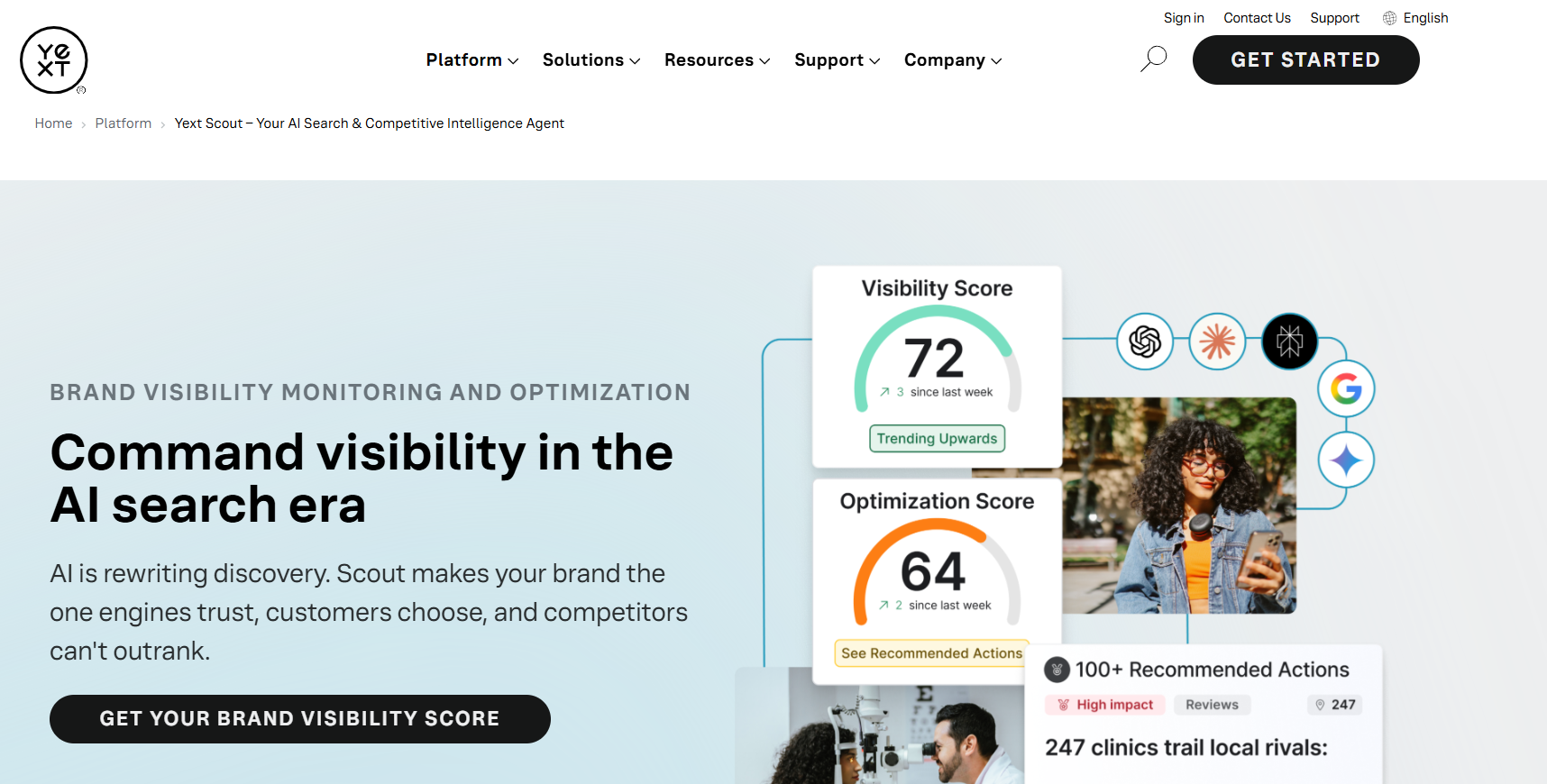
Yext Scout is a generative search and AI discovery platform that helps brands assess how their entities (locations, products, FAQs, services, etc.) are reflected within AI-generated answers and generative search experiences. It connects a brand’s structured knowledge to AI search analysis, enabling teams to measure visibility, answer accuracy, and relevance across AI-driven discovery environments.
Key capabilities:
- Tracks how AI-driven search tools interpret and reflect structured brand knowledge
- Provides insight into entity visibility and accuracy within AI-generated answers
- Helps teams identify gaps between structured data and how AI models represent brand information
Pros
- Strong at evaluating how structured brand data is interpreted within generative search outputs
- Useful for identifying accuracy issues tied to centralized entity management
Cons
- Primarily insight-focused, with limited ability to act on findings beyond structured data updates
- Less suited for managing AI visibility across large numbers of locations or operational teams
G2 rating: 4.4/5 (970+ reviews)
3. Scrunch
Best for: Teams that need visibility tracking, competitive analysis, and actionable insights to improve brand performance in AI platforms.
Scrunch is an AI visibility tracking and optimization platform that helps brands monitor how they appear in AI-generated answers across tools like ChatGPT, Gemini, Perplexity, and Google AI Overviews. It supports prompt monitoring, citation tracking, competitor comparisons, and performance analysis so teams can see where their content is showing up (or missing) and what might be limiting visibility.
Key capabilities
- Tracks brand presence, citation share, and AI traffic across leading AI search platforms
- Provides competitive comparisons and visibility trends by prompt, persona, topic, and region
- Offers page audits and insights to diagnose technical/content issues and visibility opportunities
Pros
- Strong prompt monitoring with useful filtering to understand where visibility changes by audience type.
- Helpful citation and URL-level visibility signals, including where competitors are getting cited for prompts you track.
Cons
- More diagnostic than operational: insights typically require separate content workflows to implement changes.
- Not suited for managing visibility across large location portfolios where teams need location-by-location governance and coordinated execution.
G2 rating: 4.6/5 (50+ reviews)
4. Uberall
Best for: Brands that want consistent listings, reviews, and localized marketing across search engines, maps, and directories.
Uberall is a location marketing platform that helps businesses manage their online presence and customer engagement across search engines, directories, maps, and social platforms. It enables multi-location brands to maintain accurate listings, monitor and respond to reviews, publish localized social content, and manage local visibility from a centralized system.
Key capabilities
- Centralized listings and location data management across directories and mapping platforms.
- Review monitoring and response management with sentiment insights and AI-assisted replies.
- Local social content creation and publishing to support consistent brand presence at scale.
Pros
- Good for maintaining accurate location data and presence across a wide network of directories and maps.
- Useful for coordinating reviews and localized social content across many locations.
Cons
- Limited visibility into how brands appear within AI-generated answers or LLM-driven discovery.
- Focused on local presence management rather than AI search visibility analysis or answer optimization.
G2 rating: 4.3/5 (170+ reviews)
5. Profound
Best for: Marketing, content, and SEO teams focused on understanding and improving their brand’s performance in generative search and AI answer discovery.
Profound helps brands measure and analyze how their content is referenced in AI-generated answers and generative engine outputs. It provides visibility into where brands are mentioned, which prompts drive exposure, and how performance shifts across models and topics.
Key capabilities
- Tracks brand, URL, and content visibility within AI-generated answers across generative engines.
- Provides signal-level insights on prompts, topics, and audience queries that influence AI references.
- Benchmarks visibility against competitors to highlight relative positioning and prioritization opportunities.
Pros
- Strong competitive context combined with prompt demand insights to help teams focus on the most impactful AI questions.
- Useful for strategic planning by showing where AI exposure is concentrated and where competitors are gaining share.
Cons
- Primarily designed for insight and prioritization, with execution and optimization handled outside the platform.
- Not built for large multi-location visibility or operational workflows
G2 rating: 4.6/5 (180+ reviews)
Conclusion
AI-driven discovery is already reshaping how customers find, evaluate, and choose businesses in 2026. As AI search platforms play a growing role in answering questions and making recommendations, visibility increasingly depends on how clearly and consistently these platforms understand and trust your brand.
For brands operating at scale, visibility requires more than insight. It demands consistent data, strong reputation signals, and the ability to act quickly when issues arise, which is where enterprise-grade platforms stand apart.
Birdeye Search AI leads by combining deep AI visibility insights with an agentic marketing platform built for execution. By connecting monitoring with automated fixes, governance, and scalability, Birdeye enables brands to stay accurate, trusted, and visible wherever AI influences customer decisions.
As AI continues to reshape search, the brands that succeed will be those that move beyond tracking visibility and take control of how they are represented and recommended by LLM platforms.

Lynn Martelli is an editor at Readability. She received her MFA in Creative Writing from Antioch University and has worked as an editor for over 10 years. Lynn has edited a wide variety of books, including fiction, non-fiction, memoirs, and more. In her free time, Lynn enjoys reading, writing, and spending time with her family and friends.