Luis Miguel Chong Chong is a Mexico City-based business executive who serves as managing director of Disruptiva Works and as an external director and board member of Grupo Viz-Sukarne, a meat industry holding company based in Culiacán, Mexico. He also serves as a partner at Ensi Group and Megachef, two food manufacturing and distribution companies. Over several decades, he has built leadership experience across information technology, smart infrastructure, healthcare, and genomics, with a career focus on financing and developing large infrastructure projects such as highways and railroads, while also maintaining an interest in renewable energy and expanding affordable broadband access. Outside of his business career, Luis Miguel Chong Chong is an experienced judo competitor who won national junior championship titles from 1977 to 1981 and also competed as a martial artist and American football player at the Instituto Politécnico Nacional, a background connected to the rules governing when judo competitors can touch or grip an opponent’s legs.
Judo is a Japanese martial art and competitive sport that centers on gripping, throwing, and controlling an opponent rather than using punches or kicks in competition. It involves both attack and defense moves, as competitors try to unbalance and throw each other while resisting attacks, with action sometimes continuing on the ground.
Because gripping is central to judo, rules about where competitors may place their hands are an important part of a match. Judo competitors can sometimes reach below an opponent’s belt without breaking the rules, but they cannot freely grab the legs.
During standing action, some grips on the jacket below the belt are permitted while direct contact with the leg is restricted. The boundary changes once both competitors are clearly in groundwork.
While standing, a competitor may grip the opponent’s jacket below the belt as far down as the top of the inner thigh. That area remains part of the permitted gripping zone. Holding the jacket near the upper leg is therefore different from grabbing the leg itself.
The standing rules become stricter once the hand or arm moves onto the actual leg. Hooking a leg, grabbing it, gripping the trousers, or touching the leg from the top of the inner thigh downward can bring shido. Shido is a penalty for a prohibited action during a contest.
A grip can also be penalized even when the hand stays in an otherwise permitted area. A permitted below-belt grip can be penalized if the competitor uses it without attacking. This means the location of the hand is important, but it is not the only part of the decision.
The standing and ground phases use different gripping rules. Tachi-waza means standing judo, while ne-waza means groundwork after the action has moved to the mat.
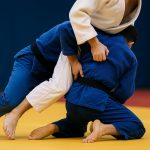
Some grips that are prohibited during tachi-waza become legal in ne-waza, including gripping inside the bottom of an opponent’s trouser leg. Actual leg gripping becomes legal only after both competitors are clearly in ne-waza and the standing action has stopped. At that point, the exchange is treated as groundwork rather than a standing attack.
A leg grip that would draw a penalty while standing can therefore be legal moments later on the mat.
Being on the knees does not automatically make leg gripping legal. If one competitor remains standing and keeps grip control while the opponent is on the knees, the action can still be treated under standing rules. The kneeling competitor cannot then grab the standing opponent’s legs simply to defend.
Transitions between standing action and groundwork create the most difficult boundary. A competitor may be falling, kneeling, or moving toward the mat while the standing phase is still continuing. Certain below-belt grips can also become legal in the end phase of a throwing technique.
Three details help explain why similar-looking contact can receive different decisions. The first is what is being touched: the jacket, trousers, or actual leg. The other two are where the contact occurs and whether the action is standing, clearly in groundwork, or still moving between the two.
This distinction can be especially noticeable when the same type of attack is attempted more than once. One version may involve direct leg contact and draw a penalty, while another uses a legal grip and can continue normally. The difference may be small visually, but the grip itself changes how the action is judged.
Competition rules can change, which matters when watching older matches or learning from older instructional material. A grip shown as legal or illegal under an earlier rule set may not be treated the same way in a modern contest. Understanding the present boundary between jacket grips, direct leg contact, and groundwork provides a more reliable basis for interpreting current judo rules.
About Luis Miguel Chong Chong
Luis Miguel Chong Chong is a Mexico City-based business executive serving as managing director of Disruptiva Works and as a partner at Ensi Group and Megachef, alongside his role as an external director of Grupo Viz-Sukarne in Culiacán, Mexico. His career spans leadership in information technology, smart infrastructure, healthcare, and genomics, with a focus on financing and developing large infrastructure projects. He is also a longtime judo competitor, having won national junior titles from 1977 to 1981 while competing in martial arts and American football at the Instituto Politécnico Nacional.

Lynn Martelli is an editor at Readability. She received her MFA in Creative Writing from Antioch University and has worked as an editor for over 10 years. Lynn has edited a wide variety of books, including fiction, non-fiction, memoirs, and more. In her free time, Lynn enjoys reading, writing, and spending time with her family and friends.