Legal documents have a reputation for being dense, confusing and full of words nobody uses in everyday life. Heretofore. Notwithstanding. Per stirpes. It’s no wonder so many people put off writing a Will. The whole thing feels like it was designed to be difficult.
But a Will doesn’t have to be impenetrable to be effective. In fact, clarity is one of the most valuable qualities a Will can have. When your instructions are easy to follow, your executor can act with confidence, your family can understand your decisions and the chances of a dispute fall dramatically.
Here’s how to approach your Will with readability in mind.
Why clarity matters so much
Most problems with Wills don’t come from bad intentions. They come from ambiguity. A phrase that seemed obvious when you wrote it can mean very different things to different people years later.
Consider a few real-world style examples:
- “I leave my car to my nephew.” What if you have two nephews? What if you’ve replaced the car by the time you die?
- “My savings should be shared among my children.” Equally? Including stepchildren? What about a child who has already passed away?
- “My jewelry goes to my sister.” Does that include your wedding ring? Your watch collection?
Each of these leaves room for interpretation, and interpretation can lead to arguments, delays and court costs. A clear Will closes those gaps.
The building blocks of a readable Will
A well-organized Will follows a logical structure. Think of it as a document with clearly labeled sections, each with a specific job.
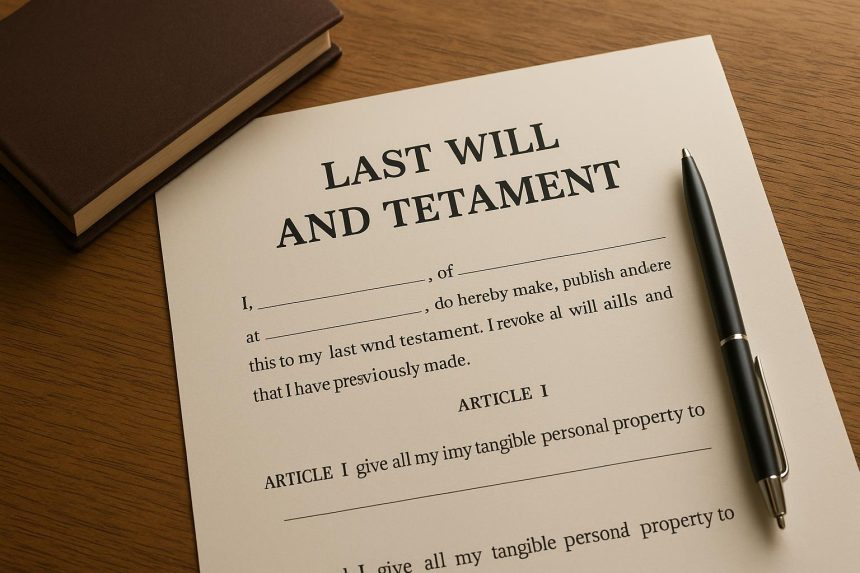
1. Identification. Your full legal name, where you live and a statement that this is your Will. It should also state that it revokes any earlier Wills.
2. Executor. The person responsible for carrying out your instructions, along with an alternate.
3. Guardian. If you have minor children, the person you’d like to care for them.
4. Specific gifts. Particular items or sums of money left to named people or organizations.
5. Residue. Who receives everything that remains after specific gifts, debts and expenses.
6. Alternates. What happens if a beneficiary dies before you.
7. Signatures. Your signature and those of your witnesses.
Following a consistent structure like this makes the Will easier to read and easier to administer.
Use a template, not a blank page
For many people, the hardest part is getting started. A blank page invites rambling, inconsistency and missing pieces. A structured Will pack gives you a framework that already follows a logical order and uses legally appropriate wording. You supply your decisions; the format does the heavy lifting.
This approach is especially helpful for people with straightforward estates who want a valid Will without paying for hours of legal drafting.
Ten tips for writing clearly
Use full legal names. “My brother, Michael James Thompson” leaves no doubt.
Describe relationships. Stating the relationship as well as the name helps confirm identity.
Describe items precisely. “My 2019 Toyota Camry” may be less useful than “any vehicle I own at my death,” which still works if you change cars.
Say what happens if someone dies first. Name an alternate beneficiary for every significant gift.
Be clear about shares. If you’re dividing property, state the proportions, such as “in equal shares,” and make sure any percentages add up to 100.
Keep sentences short. One instruction per sentence reduces the chance of confusion.
Avoid unnecessary jargon. Use legal terms only where the format requires them.
Don’t contradict yourself. Read the whole document start to finish to check for conflicts.
Leave no blanks. Unused spaces in a form can be crossed out or marked “N/A” so nothing can be added later.
Don’t make handwritten edits after signing. Changes should be made through a new Will or a formal codicil.
Make the signing as clear as the writing
Even a perfectly written Will can fail if it isn’t signed correctly. Requirements vary by state, but most require:
- The person making the Will to be at least 18 and of sound mind
- The Will to be signed by that person in the presence of witnesses, usually two adults
- The witnesses to sign as well
Use witnesses who don’t inherit anything under the Will. Many states also allow a self-proving affidavit, a sworn statement signed by the witnesses in front of a notary, which can make probate quicker and simpler.
Readable for the people who matter
Remember who will eventually read your Will: your executor, your family and possibly a probate court. Your executor may be grieving, under pressure and unfamiliar with legal processes. Writing clearly is a kindness to them.
Consider adding a separate, non-binding letter that explains your reasoning in your own words. If you’ve left more to one child than another, for example, a short explanation can prevent hurt feelings and misunderstandings.
Don’t forget assets outside the Will
Some assets don’t pass through your Will at all. Life insurance, retirement accounts and payable-on-death bank accounts typically go directly to the beneficiaries named on the account. Jointly owned property with survivorship rights usually passes automatically to the surviving owner.
For a truly clear plan, make sure these designations align with your Will. A readable Will can still create confusion if it conflicts with outdated beneficiary forms.
Review it like an editor
Good writing benefits from revision, and so does a Will. Revisit yours every few years and after major life events such as marriage, divorce, a new child, a move to another state or a major financial change. Ask yourself whether it still says what you mean.
Simple can be strong
There’s a common belief that the more complicated a legal document is, the more powerful it must be. In reality, a straightforward, well-organized Will is often the most effective. It tells your loved ones exactly what you want, leaves little room for argument and lets your executor get on with the job.
Clear writing is good writing. And when it comes to your Will, it might be the most valuable writing you ever do.

Lynn Martelli is an editor at Readability. She received her MFA in Creative Writing from Antioch University and has worked as an editor for over 10 years. Lynn has edited a wide variety of books, including fiction, non-fiction, memoirs, and more. In her free time, Lynn enjoys reading, writing, and spending time with her family and friends.