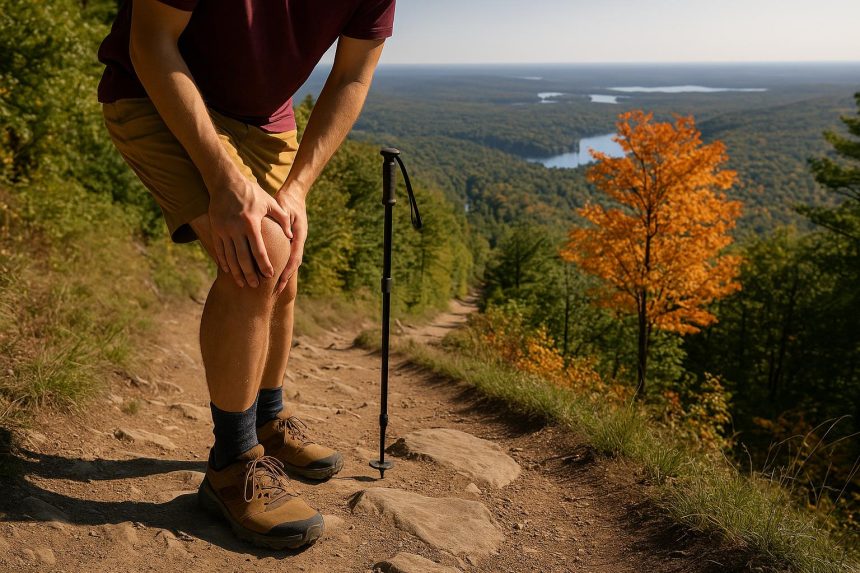
As the weather warms up across the National Capital Region, the parking lots at Gatineau Park fill up fast. Whether you are tackling the steep, rocky ascent of Luskville Falls, navigating the endless stairs at Pink Lake, or pacing yourself on the 8 km loop of Wolf Trail, the park offers incredible terrain. However, for many local hikers, the views are ruined by a sharp, nagging pain in the front or outside of the knee, especially on the way back down to the car!
If you’re looking forward to spring to go for hikes around Gatineau Park or surrounding trails, knee pain isn’t just a minor annoyance; it can be a barrier to getting back into physical activity after a winter of hibernation. Here is an objective look at why your knees hurt on the trails and exactly what you can do about it.
The Biomechanics of the Descent: Why Downhill Hiking Hurts
Most hikers assume the uphill climb is the hardest part of the day. From a cardiovascular standpoint, it is. But from a biomechanical perspective, the descent is far more punishing on your knees.
When you walk downhill, your quadriceps (the muscles on the front of your thigh) have to work as brakes to stop gravity from pulling you forward too quickly. This requires an “eccentric contraction,” meaning the muscle is lengthening while under tension. Eccentric loading places a massive amount of stress on the patellar tendon and the knee joint itself. If your leg muscles are fatigued from the climb, or if your glutes aren’t firing properly to stabilize your pelvis, your knees end up absorbing the shock of every step down those rocky, uneven paths.
Common Trail-Related Knee Injuries
When patients come into our Kanata physio clinic complaining of hiking-related knee pain, it usually falls into one of two categories:
1. Patellofemoral Pain Syndrome (Runner’s Knee) This is a generalized, aching pain behind or around the kneecap. It flares up during activities that heavily load a bent knee, such as squatting, taking the stairs, or descending a steep trail. It is often caused by a combination of weak hip muscles, poor foot mechanics, and overuse.
2. Iliotibial (IT) Band Friction Syndrome If you feel a sharp, stabbing pain on the outside of your knee, the IT band is likely the culprit. The IT band is a thick band of fascia that runs down the outside of your thigh. When the muscles around your hip and glutes are weak, your thigh bone can rotate slightly inward with each step, causing the IT band to snap back and forth across the bony bump on the outside of your knee.
How to Protect Your Knees Before Hitting the Trailhead
A lot of our clients are worried this knee pain could mean an end to their hiking hobby, and are even concerned it could be a sign of early osteoarthritis or another degenerative condition. The good news is, this type of knee pain is 100% treatable! You do not have to give up hiking Champlain Lookout or King Mountain. Preventing trail-related knee pain comes down to preparation, load management, and the right gear.
1. Build Eccentric Strength in Your Legs Standard squats and lunges are great, but they don’t mimic the specific braking motion of hiking downhill. To prepare your knees, you need to train eccentric strength.
- The Exercise: Try eccentric step-downs. Stand sideways on a bottom stair or a sturdy box. Keep your weight on the elevated leg and slowly lower your other heel to the floor, taking 3 to 4 seconds to lower yourself down. Push back up and repeat. Start with 3 sets of 10 reps per leg.
2. Wake Up Your Glutes Your gluteus medius (the muscle on the side of your hip) keeps your pelvis level and stops your knee from caving inward when you balance on one leg. If this muscle is weak, your knee joint takes the hit.
- The Exercise: Incorporate banded lateral walks and clamshells into your weekly routine to build endurance in your hip stabilizers.
3. Use Walking/Nordic Poles (And Use Them Correctly) Walking poles (also called Nordic poles) are not just for older adults or multi-day backpackers; they are a mechanical advantage. Studies show that using poles can reduce the compressive force on your knees by up to 20% on a downhill decline. Plant the poles slightly in front of you on the descent to absorb the impact before your lead foot hits the ground.
4. Respect the Terrain and Elevation Gain A 5 km walk on the flat paved paths of the Ottawa River pathway does not prepare your joints for a 5 km hike with 300 meters of elevation gain on uneven rocks and roots. Progress your hikes gradually. Start with flatter trails like the Sugarbush trail before moving on to the steep inclines of the Eardley Escarpment.
5. Assess Your Footwear Running shoes are built for forward motion on flat surfaces. They lack the lateral stability and aggressive tread needed for the muddy, rocky, and root-covered trails of Gatineau Park. Invest in a dedicated trail running shoe or a lightweight hiking boot that provides traction and stops your foot from sliding forward into the toe box on the way down.
When to See a Physiotherapist
Sore muscles are a normal part of a good hike. Sharp joint pain is not. If your knee pain lingers for days after a hike, causes you to limp, or prevents you from tackling the trails you enjoy, it is time for a professional assessment.
Rest alone rarely cures mechanical knee pain. Once you hit the trail again, the pain will likely return. A physiotherapist can assess your gait, identify specific muscle imbalances, and build a targeted strengthening program to address the root cause of the issue.
At Kinoveo, we help active individuals across Ottawa and Kanata stay on their feet. Don’t let knee pain dictate your weekend plans. Book an assessment today and let’s get you ready for trail season.

Lynn Martelli is an editor at Readability. She received her MFA in Creative Writing from Antioch University and has worked as an editor for over 10 years. Lynn has edited a wide variety of books, including fiction, non-fiction, memoirs, and more. In her free time, Lynn enjoys reading, writing, and spending time with her family and friends.