Most logistics inefficiencies don’t come from bad carriers or poor planning. They come from disconnected information. If information about shipments, invoices, and contracts is scattered across different systems, you are not effectively managing your freight operations.
The real cost of data silos
Many different carriers must be worked with for various reasons. There are certain lanes that regional carriers just cover better than anyone else, national carriers provide scale advantages when an influx of capacity is needed, and especially carriers deal with freight of specific kinds. The issue isn’t working with these carriers. It’s when all of these relationships result in data that is never able to speak to one another.
According to an 2023 estimate on supply chain technology by Gartner, roughly 80% of companies are dealing with substantial value erosion because they lack integrated data across all of their transportation ecosystems. This isn’t a tech gap – it’s a decision-making gap. When contracts and volumes are determined by operations managers and they aren’t able to see carrier performance, cost trends, or delay patterns all in one place, they’re utilizing partial information.
Customer service workers are also hit hard by data silos. If a question about a shipment requires three logins and a phone call to the carrier rep, time and credibility are being dropped on each and every conversation.
From spreadsheets to a single source of truth
For a long time, the workaround was manual consolidation – pulling export files from carrier portals, stitching them together in spreadsheets, and hoping nothing was missed. It worked, at some scale, for a while. But this approach doesn’t hold when shipment volumes grow, when you’re running LTL and full truckload on the same day, or when you need answers fast.
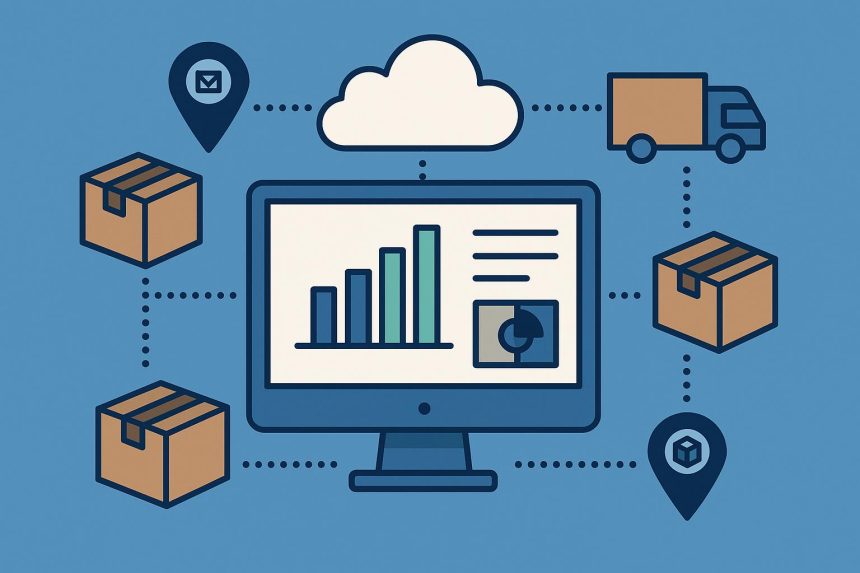
Modern freight management software solves this by acting as the central hub for every carrier interaction. API and EDI integrations pull data from disparate carriers into one environment automatically, standardizing formats so that a transit time from one provider is directly comparable to a transit time from another. Rate shopping happens in real time. Proof of delivery records are captured and stored against the right shipment. Contract terms are applied automatically, not manually checked each time.
The shift isn’t just operational. It changes what questions you can ask. Instead of “did that shipment arrive?” you can ask “which carrier on this lane has the best on-time rate over the last 90 days, and what does that look like against cost per kilogram?”
Carrier performance data as a negotiation tool
Centralized analytics provide companies with information that most carriers assume is beyond reach. When you can present a carrier with their damage rate for the previous six months, or even show how their transit times on a specific lane compare with their competitor’s, you’re not negotiating based on gut feel. You’re negotiating based on information. This puts pressure on carriers, especially during the contract renewal phase. It also highlights when a carrier has quietly slipped in performance. For example, without centralized data, a slight increase in delays may go unnoticed for some time as no one is taking the time to look at all shipments. However, with centralized data, this will become apparent early enough for you to react on it.
The pivot advantage – why this matters more now than before
Here’s the argument you don’t see in many centralized vs fragmented data discussions. Sure, day-to-day operating costs go up when you run multiple disconnected systems. But the much bigger risk is that you lose the first 24 to 48 hours to a carrier strike, weather event, or capacity crunch just trying to figure out what’s impacted.
Which shipments are in transit with that carrier? What’s the volume by lane? What would it cost to shift that volume elsewhere? A centralized system will answer those questions in minutes. A stack of overlapping bolt-ons? Maybe Wednesday.
That’s a strategic, not an executional difference. It’s also far more common today. Carrier strikes, weather events, capacity crunches, and sudden rate increases used to be occasional. Now they’re all regular. You’re going to face a disruption somewhere in your network every year, very likely more than one.
Last-mile delivery is where this becomes most visible to customers. Real-time data synchronization means tracking updates can be pushed automatically without a customer service rep manually checking status. That reduces inbound query volume and keeps customers informed without the overhead.
Freight auditing as a financial control
Freight auditing is an immediate, tangible return on centralization. Carrier invoices are full of errors: fuel adjustment discrepancies, accessorial charges applied incorrectly, billing for the wrong weight breaks. When invoices get matched with purchase orders and paid manually, many of those errors go right through.
But it’s only possible to automate auditing if all the data comes in on a regular, standardized, digital format. Then, the program can compare what was quoted in the RFP response to the actual invoice, flag the discrepancy, and either facilitate payment or route the item to an auditor.
In a high-volume, centralized environment, the recoveries generated by this process can pay for the system. Centralized shipping data doesn’t just make operations tidier. It converts logistics from a cost center that absorbs problems into a function that surfaces them early, responds to them quickly, and negotiates from a position of documented performance rather than assumption.

Lynn Martelli is an editor at Readability. She received her MFA in Creative Writing from Antioch University and has worked as an editor for over 10 years. Lynn has edited a wide variety of books, including fiction, non-fiction, memoirs, and more. In her free time, Lynn enjoys reading, writing, and spending time with her family and friends.