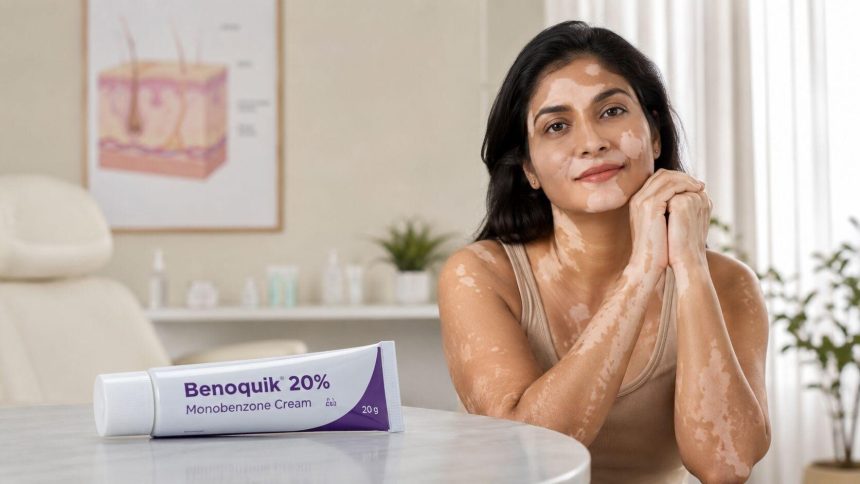
Most conversations about vitiligo treatment focus on one goal: bringing pigment back. Creams, phototherapy and newer dermatological treatments are generally discussed in terms of helping white patches regain color.
But for people living with extensive vitiligo, there is another, very different approach.
When a large proportion of the skin has already lost pigment, attempting to repigment every affected area may no longer be the preferred strategy. Instead, some patients and their dermatologists consider reducing the pigment that remains, creating a more uniform overall skin tone. This is where monobenzone occupies a distinctive place in dermatology.
Benoquik 20% Cream is one product formulated around this unusual active ingredient. Understanding what monobenzone actually does—and what it does not do—is essential before anyone considers this type of treatment.
What Is Monobenzone?
Monobenzone is a topical depigmenting agent also known chemically as the monobenzyl ether of hydroquinone. Despite the chemical relationship between the two compounds, monobenzone should not be confused with conventional hydroquinone creams used for certain forms of hyperpigmentation.
The difference is fundamental.
Hydroquinone is generally used to reduce excess pigmentation in conditions such as melasma or dark spots. Monobenzone is intended to produce permanent depigmentation of normally pigmented skin in selected patients with extensive vitiligo.
Historically, 20% monobenzone cream has been used for final depigmentation in people with disseminated vitiligo affecting more than half of the body surface.
That makes it a highly specialized dermatological treatment rather than a conventional brightening or skin-tone product.
Why Would Someone With Vitiligo Want to Remove More Pigment?
At first, the idea can sound counterintuitive.
Vitiligo occurs when melanocytes—the cells responsible for producing melanin—are lost or destroyed in areas of the skin. This creates the characteristic white patches associated with the condition.
When relatively limited areas are affected, treatment commonly focuses on stabilizing the disease and encouraging repigmentation where possible.
The situation can look quite different when vitiligo becomes extensive.
Imagine that most of the skin has already become depigmented, while islands of normally pigmented skin remain on the face, hands, torso or other visible areas. The contrast between these areas may become more noticeable than the vitiligo itself.
For carefully selected patients, the treatment objective may therefore change from restoring pigment to creating a more uniform appearance through depigmentation of the remaining pigmented skin.
This is the therapeutic role for which monobenzone became known.
How Does Monobenzone Affect Skin Pigment?
Melanin gives much of the skin its visible color and is produced by melanocytes.
Monobenzone acts on this pigment-producing system. Its precise mechanism is not completely understood, but medical labeling describes an effect that can result in the loss or destruction of melanocytes and consequently a substantial reduction in pigmentation.
The important word is permanent.
This is not a cream designed to temporarily brighten the skin. Depigmentation can be irreversible, and pigment loss may sometimes develop beyond the exact locations where the medication was originally applied.
The response can also be unpredictable. Different areas of skin may depigment at different speeds, and achieving a uniform appearance can require prolonged treatment and medical follow-up.
For these reasons, monobenzone requires a very different mindset from ordinary cosmetic skincare.
What Is Benoquik 20% Cream?
Benoquik is supplied as a topical cream containing 20% monobenzone USP. The product listing identifies Quik Pharma as the manufacturer and the tube contains 20 grams of cream.
Consumers researching the formulation can view Benoquik on OKDERMO for its listed composition, product specifications and availability information.
The 20% concentration is particularly notable because 20% monobenzone is the strength historically associated with medical depigmentation therapy for extensive vitiligo.
However, sharing an active ingredient and concentration with established monobenzone therapy does not mean every monobenzone product has identical regulatory approval in every country. Prescription status, availability and personal-import rules can differ substantially between jurisdictions.
Monobenzone Is Not a Cosmetic Whitening Cream
This distinction is perhaps the most important point for consumers.
Monobenzone should not be viewed as a stronger version of a general skin-lightening cream.
It is not intended as a treatment for:
- freckles;
- ordinary sun spots;
- age spots;
- melasma;
- post-inflammatory dark marks;
- uneven tanning;
- general cosmetic skin lightening.
Historical prescribing information for 20% monobenzone specifically warns that the medication is a potent depigmenting agent rather than a mild cosmetic bleach.
That warning matters because someone searching online for a powerful solution to pigmentation may encounter the name monobenzone without understanding that the resulting pigment loss can be permanent.
A product capable of permanently changing melanocyte activity should not be approached in the same way as an exfoliating acid, vitamin C serum or conventional pigmentation cream.
Why Sun Protection Becomes Even More Important
Melanin does more than determine skin color. It also provides part of the skin’s natural protection against ultraviolet radiation.
Removing pigment therefore changes the way skin responds to sunlight.
After significant monobenzone-induced depigmentation, treated skin can become much more susceptible to UV exposure and sunburn. Historical prescribing information for 20% monobenzone states that the skin remains sensitive to sunlight following treatment and requires ongoing sunscreen protection.
For someone considering permanent depigmentation, this is not a temporary inconvenience during treatment. Long-term photoprotection becomes part of everyday skin care.
Depending on individual circumstances, a dermatologist may recommend a combination of broad-spectrum sunscreen, protective clothing, hats, shade and limiting intense midday UV exposure.
This long-term commitment is one of the factors that should be considered before beginning depigmentation therapy.
What Side Effects Should Consumers Know About?
Topical monobenzone can produce skin reactions.
Reported reactions associated with 20% monobenzone include irritation, redness, burning, sensitization and eczematous dermatitis. One particularly distinctive effect is depigmentation occurring at areas distant from the application site.
The degree and pattern of pigment loss can also be irregular.
These characteristics explain why medical supervision matters so much. The goal is not simply to make the cream “work faster.” A dermatologist needs to evaluate whether permanent depigmentation is appropriate in the first place and then monitor how the skin responds.
Pregnancy, breastfeeding, allergies, other skin disorders and the patient’s overall treatment history also require individual medical consideration.
Depigmentation Is a Major Treatment Decision
Perhaps the most useful way to understand monobenzone is not simply as an ingredient, but as part of a treatment strategy.
Choosing permanent depigmentation can affect far more than appearance. It influences future sun protection, skincare routines, treatment expectations and the possibility of later changing one’s mind.
Repigmentation can occur unpredictably in some areas, but anyone considering monobenzone should approach the treatment on the assumption that successful pigment loss may be permanent.
For that reason, the decision is normally most appropriate after a detailed discussion with a dermatologist experienced in vitiligo management.
The conversation may include:
- how extensive and stable the vitiligo is;
- previous attempts at repigmentation;
- remaining areas of normal pigmentation;
- realistic expectations for treatment;
- potential adverse reactions;
- the permanence of depigmentation;
- future sun-protection requirements;
- and the patient’s personal preference regarding skin appearance.
There is no universally correct cosmetic outcome for someone living with vitiligo. The appropriate objective depends on the individual.
A Specialized Option for a Specialized Situation
Monobenzone remains unusual among dermatological ingredients because its purpose is essentially the opposite of most vitiligo therapies.
Instead of attempting to restore melanocytes to depigmented patches, it can reduce the remaining pigmentation around them.
For people with extensive vitiligo who have made an informed decision to pursue final depigmentation, a 20% monobenzone formulation such as Benoquik represents one of the products available within this highly specialized category.
But its strength is also the reason for caution.
Permanent depigmentation should never be confused with everyday cosmetic skin lightening. Understanding the treatment objective, obtaining appropriate medical guidance and accepting the long-term implications are far more important than simply choosing a cream.
For the right patient, monobenzone can represent a completely different way of approaching extensive vitiligo: not trying endlessly to restore every patch of lost color, but working toward a more uniform appearance by changing the pigment that remains.

Lynn Martelli is an editor at Readability. She received her MFA in Creative Writing from Antioch University and has worked as an editor for over 10 years. Lynn has edited a wide variety of books, including fiction, non-fiction, memoirs, and more. In her free time, Lynn enjoys reading, writing, and spending time with her family and friends.