

Home security can feel like it belongs to people with big budgets and permanent addresses. Monitored alarm systems, hardwired cameras and reinforced doors are great if you own the place and plan to stay for decades. But what if you’re renting, or you’ve just bought your first home and every spare dollar is already spoken for?
The good news is that some of the most effective security upgrades are cheap, quick and don’t require drilling holes or calling an electrician. Many modern devices are battery-powered or plug-in, and they can move with you when you leave. A wireless alarm system, for instance, can be set up in an afternoon with sensors that stick to doors and windows, giving renters and homeowners alike genuine peace of mind without a renovation.
Start with the basics
Before buying any gadgets, check the fundamentals. Make sure every external door has a solid lock and that you actually use it. A surprising number of break-ins happen through doors and windows that were simply left open, often during the day.
Check window locks, sliding door locks and the condition of flyscreens and security screens. If you’re renting, ask your landlord about upgrading faulty or missing locks. In many states, landlords have obligations to provide reasonably secure premises, and they’re often happy to fix obvious issues.
Simple habits help too. Don’t leave keys in obvious hiding places like under the doormat. Keep valuables out of sight from windows. Ask a neighbour to collect mail when you’re away, and avoid announcing holidays on social media until you’re back.
Wireless alarms and sensors
Wireless alarm systems have become far more affordable and flexible. Most use a central hub with battery-powered sensors that attach to doors and windows with adhesive strips. Motion sensors can be placed on shelves or mounted with removable fixings. When a sensor is triggered, the system sounds a siren and can send an alert to your phone.
For renters, the beauty of these systems is that they don’t require permanent installation. When you move, you simply peel off the sensors and take everything with you. Homeowners appreciate the flexibility too, as they can start small and add more sensors over time.
Look for systems that offer smartphone control, so you can arm and disarm the alarm remotely and receive notifications. Some include features like panic buttons, entry delays and door chimes that tell you when someone opens the front door.
Cameras and video doorbells
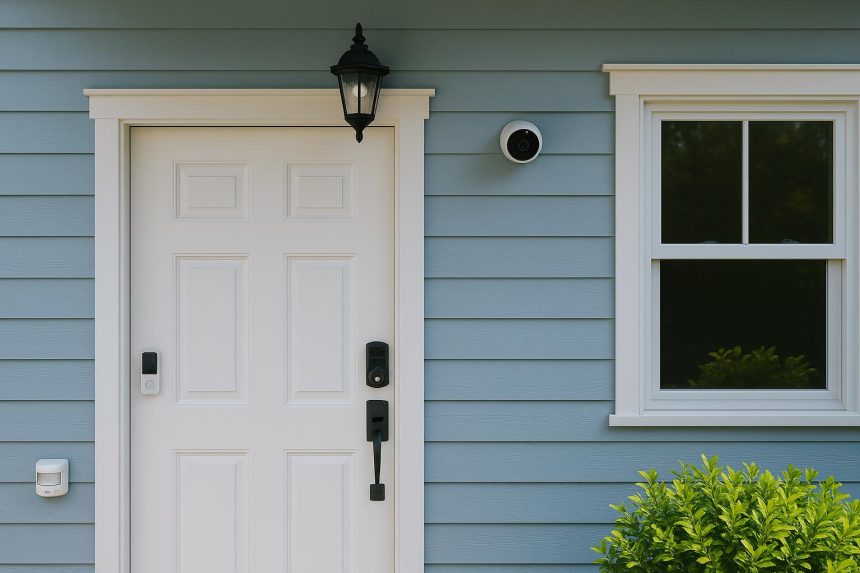
Smart cameras and video doorbells add another layer of protection. Battery-powered video doorbells can be mounted with minimal fixings and let you see and speak to visitors through your phone, even when you’re not home. They’re useful for checking deliveries and deterring opportunistic thieves who knock to see if anyone’s home.
Indoor cameras can be placed on shelves and moved easily. Outdoor cameras with batteries or solar panels avoid the need for wiring. Features such as night vision, motion detection and person recognition help reduce false alerts.
If you’re renting, check your lease before mounting anything outside, and always consider privacy. Point cameras at your own property rather than neighbours’ yards or shared spaces.
Lighting and smart plugs
Lighting is one of the simplest deterrents. Motion-activated solar lights can be placed along paths, near entrances and around side gates without any wiring. They make it harder for someone to approach unseen and help you get safely to the door at night.
Smart bulbs and smart plugs let you schedule lights to turn on and off, making it look like someone’s home even when you’re away. You can also control them from your phone if you’re running late.
Make it a system, not a scattering
Individual devices are useful, but they work best together. Many smart home platforms allow sensors, cameras, lights and alarms to talk to each other. A door sensor could trigger an outdoor light, or a motion sensor could start a camera recording.
Keep security in mind for the devices themselves. Change default passwords, use strong unique passwords, keep firmware updated and buy from reputable suppliers. Smart devices that are poorly secured can create new risks.
Home security doesn’t have to be expensive or permanent. With a few sensible habits and some well-chosen wireless devices, both renters and homeowners can make their homes safer, smarter and far less appealing to anyone looking for an easy target.

Lynn Martelli is an editor at Readability. She received her MFA in Creative Writing from Antioch University and has worked as an editor for over 10 years. Lynn has edited a wide variety of books, including fiction, non-fiction, memoirs, and more. In her free time, Lynn enjoys reading, writing, and spending time with her family and friends.